
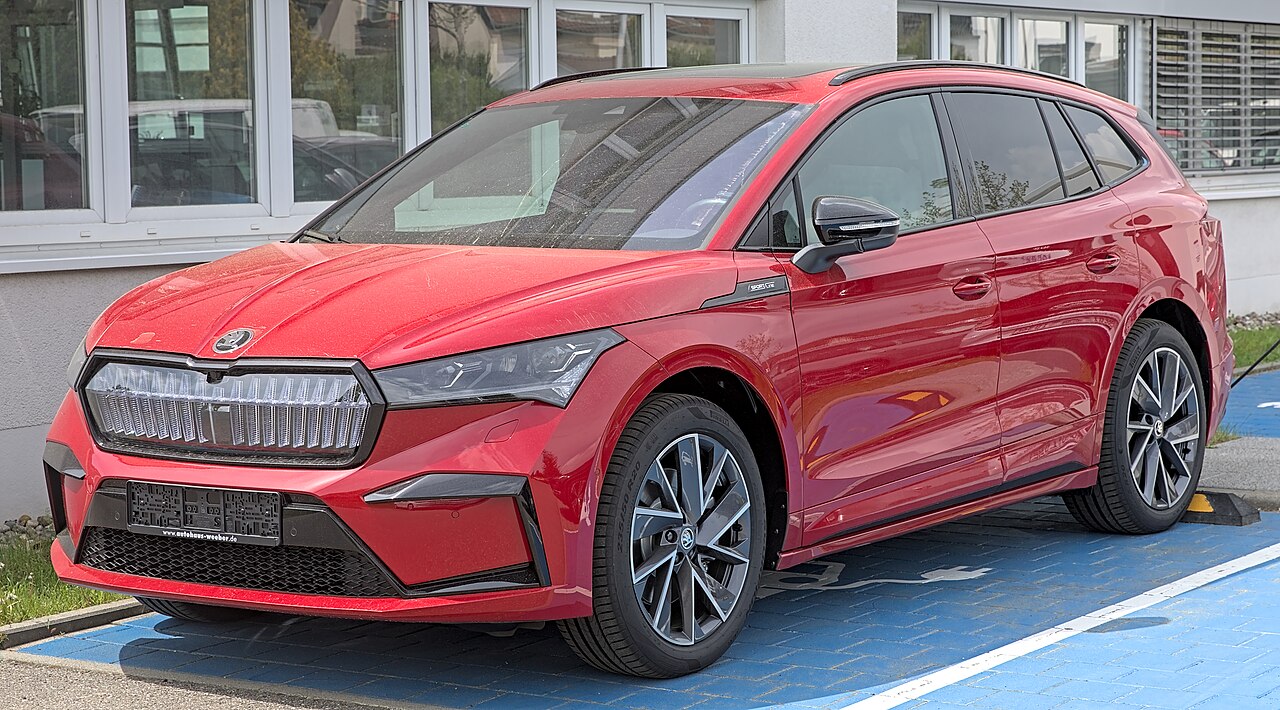
Skoda Auto has put a set of ten official interior accessories on Printables as free downloads, a collection titled "Individual 3D-Printable Accessories." The clearest look at the terms comes from the Top tether hook model page (via mirror), an upload from Skoda Auto a.s. itself. The files cover the electric Epiq, the Peaq and the Fabia IV, plus a handful of parts that fit any car. Trade coverage arrived on September 26 and 28, but the model page shows an update date of September 16, so the drop is a few days older than the headlines suggest.
The reading here comes with a caveat. The live Printables site returned a 403 to our fetch, so the model page was read through a Wayback Machine snapshot. What follows on the licence reflects that snapshot.
What is actually in the collection
VoxelMatters lists the files as a jumbo box, cupholder inserts, a lower console organizer, folding-table accessories, a USB cable holder, a phone bracket, a top tether hook and a coin box, spread across Epiq, Peaq and Fabia IV. 3D ADEPT gives the more useful breakdown, splitting the set into universal and vehicle-specific parts.
The universal group is the USB cable holder, the phone bracket, the coin box and the top tether hook. Those are the ones 3D ADEPT does not tie to a specific model. The vehicle-specific group is where fit matters: cupholder inserts and a jumbo box for the Epiq, lower console organizers for the Epiq and Peaq, folding-table accessories for the Peaq, and a cup holder for the Fabia IV. 3D ADEPT describes the ten as available "for now," which reads as an invitation to expect more.
The tether hook, the one file we could read in full, is a fold-out hook for the luggage compartment, meant for hanging lightweight items. It carries the "Simply Clever" tag, the brand's label for small practical touches, and 3D ADEPT frames the whole collection under that banner.
The licence is the story
Free to download is not free to use however you like. The licence text on the snapshot says the files are for personal and non-commercial use only. Commercial sale or distribution of printed items is prohibited without Skoda Auto's written consent. Two further clauses matter to anyone who prints a part that ends up inside a vehicle: the files are provided "as is," and the user is responsible for print parameters, material, assembly and safety. Skoda also reserves the right to modify or withdraw the files.
Taken together, that is a familiar corporate posture. Skoda gets the goodwill of an open giveaway and keeps the commercial channel closed. It also hands the safety question to the person holding the slicer. For a cupholder insert or a coin box that is unremarkable. For a phone bracket or a tether hook, where a failed part can drop something into the footwell or the load area, the choice of material and orientation is a real decision, and Skoda has explicitly declined to make it for you.
The withdrawal clause deserves a note for anyone who plans to build on these files. If you print a fleet of parts, or link them in a guide, keep your own local copies of the files you rely on. The model page can change, and Skoda has reserved the right to change it.
Where this sits in Skoda's hobby push
According to VoxelMatters, the release follows Skoda's hobby scale-model program, which is organized into collections named Electric Pulse, Combustion Classics, Racing Spirit and Heritage Icons. Filament vendors have been part of that story too. In January 2026, Prusa released Electric Green and Emerald Green filaments matched to the Skoda palette, in both PLA and PETG. So the brand has now moved from models to colour-matched material to functional interior parts, each step aimed at the same community.
The maker credibility is not invented for the occasion. VoxelMatters reports that Skoda has used 3D printing since 1997. Its in-house competence center runs 16 printers across four technologies: FDM, MJF, PolyJet and SLA. It produces roughly 15,000 parts a year, and the maximum part size has grown from 30 cm to 1 m. 3D ADEPT describes the fleet as 14 industrial machines plus two hobbyist-type printers, which squares with the 16 total. VoxelMatters quotes Florian Weymar and Martin Sova on the company's in-house printing: Sova points to the time saved and to the fact that all data stays within the company, and Weymar to the growth in part size.
How it compares with other approaches
3D ADEPT places the release alongside two other models of automotive openness. The first is Ford's 2022 Maverick FITS program, the Ford Integrated Tether System, which accepts both official accessories and ones owners print themselves. As 3D ADEPT puts it, Ford opened an interface and let the community design, while Skoda publishes its own files. The second is WIESEMANN 1893 ENABLE 3D, a platform offering 100 digital designs for tool accessories. Skoda's approach is closer to a curated catalogue than to an open interface. The company designs the parts, fits some of them to specific models, and publishes them under its own terms. The trade-off is a small selection that only Skoda can extend.
The distinction affects how useful this is over time. An open interface invites a long tail of community designs, including ones the manufacturer would never think to make. A manufacturer-authored catalogue gives you parts designed for particular models, but only for what the company chooses to release.
What It Means for Makers
For owners of an Epiq, Peaq or Fabia IV, this is a straightforward win: official, model-specific organizers at the cost of filament. The Epiq and Peaq are the electric models in the set, so their owners get accessories from the manufacturer itself.
For everyone else, the universal four are the ones to look at. The USB cable holder, phone bracket, coin box and tether hook are described as universal rather than model-specific, though the licence still applies to whatever you print from them.
The limits are worth keeping in view. The non-commercial clause rules out printing these to sell, including small-batch sales at a market or through a shop, unless you obtain written consent from Skoda. The safety clause puts material selection on you. In a car cabin that means thinking about heat: a part that sits behind glass in summer is a different problem from one on a desk. The snapshot does not specify recommended materials, so we cannot say what Skoda would suggest, and we would not guess.
The bigger signal is direction. A manufacturer with its own printing operation has decided that giving away geometry is worth doing; 3D ADEPT calls it a low-cost way to offer personalization and keep owners engaged with the brand. Whether other carmakers follow, and on what terms, will decide whether this becomes a trend or stays a Skoda promotional line.
