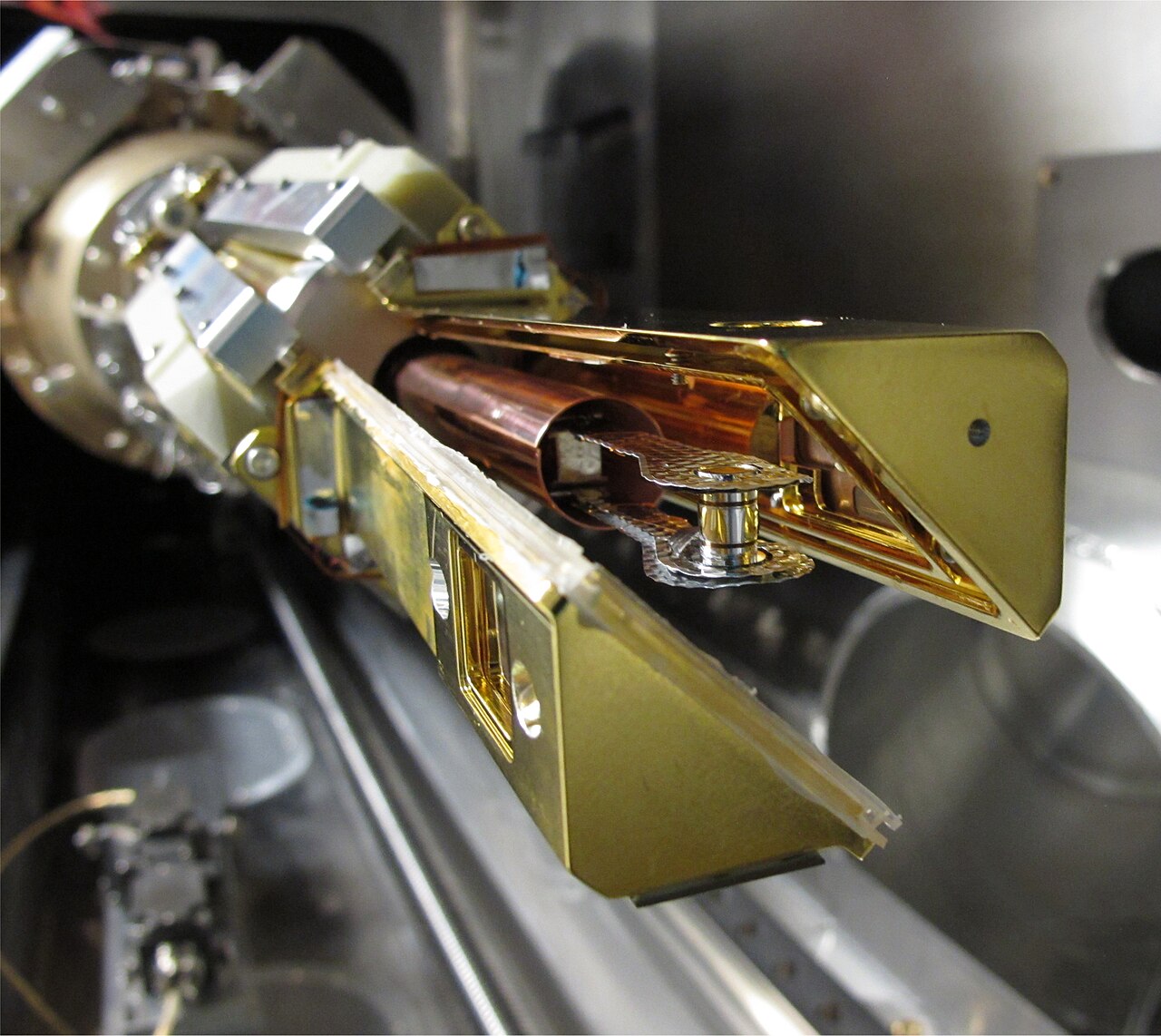
Additive manufacturing usually gets sold on speed and freedom of form. Lawrence Livermore National Laboratory has a case that shows both at the scale of a grain of sand. As the lab reports in its own write-up on target fabrication, its team now makes compound parabolic concentrators (CPCs) for National Ignition Facility (NIF) targets by two-photon polymerization (2PP). A part that took about ten days to make by conventional methods now takes about one. The concentrator is about 1.5 mm across, has no flat surfaces, and narrows to a 20-micron opening at its small end.
Plenty of print-farm operators can claim a tenfold speedup on a single part. This one matters because of what it replaces, and because of what the new process lets the lab's designers ask for.
The Ten-Day Way
According to 3D Printing Industry's coverage, the conventional CPC was built around a sacrificial core. A copper mandrel was shaped by diamond turning and coated with gold and plastic. The piece was then machined into its final form, the mandrel was dissolved out, and the cone was attached to a support structure. LLNL's own account describes the process as lengthy and says the part is smaller than the vacuum tips the team used to manipulate parts.
Each of those steps is precise work, and they run one after another. Diamond turning sets the geometry. Coating adds the layers that become the actual part. Machining trims it. Dissolving the mandrel comes last, on a part whose narrow end is less than half the width of a human hair. A process like that is slow for an obvious reason: you can't machine a coating that hasn't been deposited, and you can't dissolve a mandrel that hasn't been machined.
Any maker who has done lost-PLA casting or built a part over a dissolvable support will know the logic. You make the negative so you can get the positive. It works, but every intermediate is another place to accumulate error and another day on the calendar.
Printing the Positive Directly
Two-photon polymerization skips the negative. It is a resin process at the far end of the resolution scale. Instead of curing a whole layer with a projector or a scanning laser, it uses a high-intensity laser focused to a spot smaller than one micron, so that two photons are absorbed at once and curing happens only in that tiny volume. That makes it slow for anything big. For a 1.5 mm part with smoothly curving walls and a 20-micron throat, it fits the job well.
Per 3D Printing Industry, the lab's 2PP process prints the CPC as a single assembly with no gold coating. The mandrel, the deposition steps and the dissolution step are all gone. The part has no flat surfaces, which is exactly the kind of geometry that is awkward to handle and machine but is a natural fit for a voxel-by-voxel printer.
The lab's account quotes mechanical designer Scott Vonhof and Maxim Shusteff, who leads additive manufacturing deployment for target fabrication. Shusteff explains that earlier additive methods could not reach the required feature sizes, and that their print area was too small, so parts had to be stitched together and then missed the surface roughness requirements. Shusteff appears in the lab's photos alongside assembly technician Nancy Lau. The takeaway is less about a single heroic part than about a production change: target fabrication now has a printed route for a component that used to depend on a multi-day machining and coating chain.
Proving It on the Shot
A national lab doesn't swap a target component on faith. LLNL says any new component introduced into a NIF experiment must be carefully characterized and tested to make sure it will not harm the results, and that NIF runs only about 300 experiments a year.
That test came in April 2026. Both sources report that a 2PP-printed CPC was fielded as part of a gold disc target used to calibrate diagnostics, and that it performed as well as conventionally manufactured components. Calibration targets are a sensible place to start because they exist to produce known, comparable results. If the printed concentrator had changed the outcome, that is where it would have shown up.
The next step went further. The lab then designed a new 2PP CPC for an ion fast ignition campaign under NIF's discovery science program, which accounts for about 8% of the facility's experimental time. The printed CPC kept the same inner shape as the one used on a comparison shot a few months earlier, but its outer profile was changed so it could slide into a gold cone along added guide rails and be tacked with glue. The campaign's first experiment was conducted in September 2026, and the team is now analyzing the data to inform the next shot in the campaign.
Why the Gold Matters
Dropping the gold coating is more than a time saving. In the old process, the gold and plastic layers were built up on a mandrel. A printed CPC has no such constraint. 3D Printing Industry reports that the method has opened up new target configurations for NIF experiments, and that follows directly from the change in process. Once the shape no longer has to be something you can diamond-turn and coat, the people designing targets can draw geometries that the mandrel route could not easily produce. Vonhof put it this way: "Now we have this geometric freedom that has really blown open the design possibilities."
That is the real return on most production 3D printing, at any scale. Speed gets the headline. Design freedom is what changes how engineers work.
What It Means for Makers
Few readers will ever run a two-photon system, and nobody is printing fusion targets on a desk. Still, the Livermore story follows a pattern makers already know well.
- Count the intermediates. The old CPC took ten days because of its chain of sequential steps. If your workflow runs through molds, masters or sacrificial cores, ask whether printing the final part directly removes more time than the print itself adds.
- Validate against the incumbent. LLNL first fielded the printed part on a diagnostic calibration target and compared its performance with conventionally made components. Whether you're printing a jig or an end-use bracket, a test against the part it replaces is the cheapest insurance you can buy.
- Geometry with no flat faces favors printing. Parts that are hard to handle or machine, like compound curves, narrow throats and organic shapes, are where additive pulls furthest ahead. That holds at 1.5 mm and at 150 mm.
- Process changes unlock design changes. Switching to printing pays off most when designers stop drawing parts for the old process.
The bottom line: one of the most demanding experimental facilities in the world has moved a precision component from a ten-day mandrel process to a one-day print, checked it against conventional parts on a real experiment, and is now designing targets around what the new process allows. For anyone still treating 3D printing as a prototyping-only tool, that is a useful data point.