
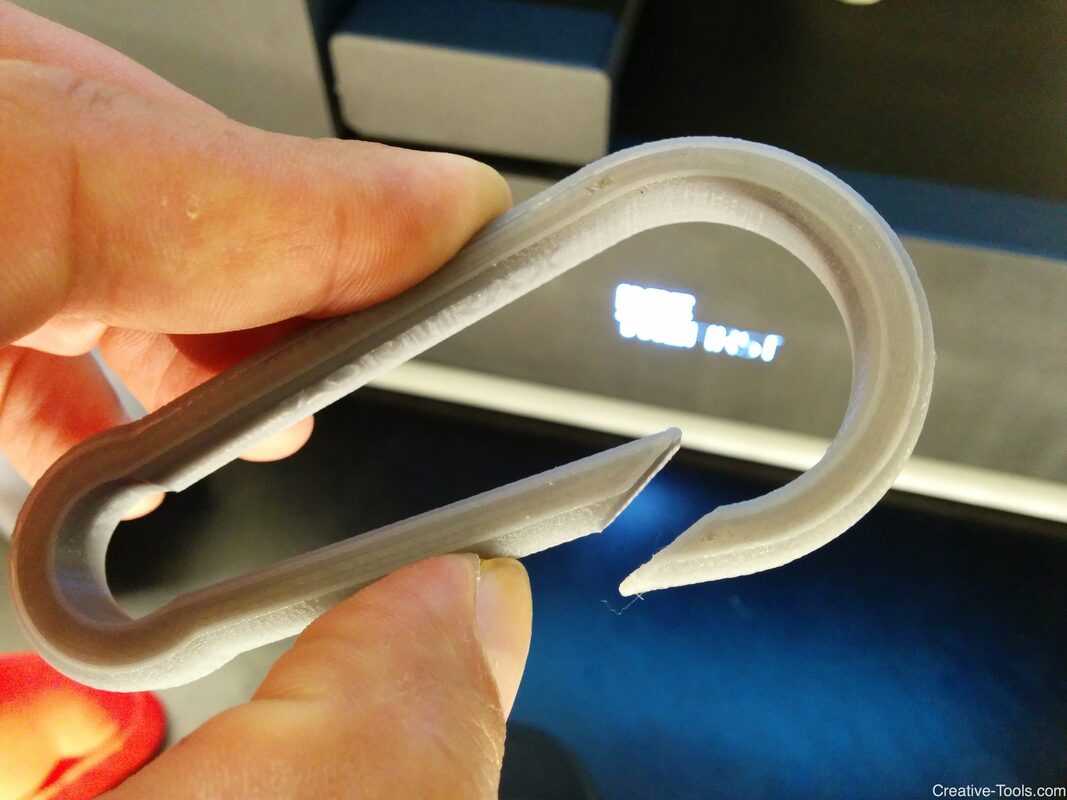
A snap fit either works or it does not. Unlike a bolted joint, which can be torqued down to compensate for dimensional error, a snap arm that is 0.3 mm too stiff will split on first insertion, and one that is 0.3 mm too flexible will never hold. The mechanism looks trivial on a CAD screen, but it concentrates every FDM failure mode into a single small feature: layer anisotropy, dimensional inaccuracy, material creep, and notch sensitivity all show up simultaneously at the root of a 1.5 mm arm. Getting snaps right demands working through beam mechanics, dialing extrusion behavior, and matching material to the stress profile of the joint.
Cantilever Geometry and the Deflection Equation
The cantilever snap arm is the dominant snap type in consumer FDM work. It is a fixed-free beam with a catch feature at the tip. When a mating part is pushed in, the arm deflects by some distance Y (the engagement depth), then springs back to lock. The governing quantity is the strain at the root: if it exceeds the material's allowable strain, the arm fails on first engagement or deforms permanently.
The standard beam formula gives root strain as: e = (1.5 × h × Y) / L², where h is the arm thickness, Y is the deflection required for engagement, and L is the beam length. All three are in millimeters; e is dimensionless. Rearranging for arm length given a target strain and geometry: L = sqrt(1.5 × h × Y / e_allow). For PLA, e_allow sits around 0.02 to 0.03 (2 to 3 percent); for PETG, roughly 0.03 to 0.05; for nylon PA12 or PA6, you can push to 0.05 to 0.08 depending on humidity.
As a worked example: a PLA arm with h = 1.6 mm, targeting Y = 0.8 mm engagement. Using e_allow = 0.025: L = sqrt(1.5 × 1.6 × 0.8 / 0.025) = sqrt(76.8) = 8.76 mm. Round up to 9 mm and you are working at about 87 percent of the allowable strain with nominal dimensions, which leaves a reasonable margin for the 5 to 10 percent stiffness variance typical on a Prusa MK4 or Bambu Lab X1C in standard PLA.
The insertion force follows from the same geometry. F = (E × h³ × b × Y) / (4 × L³), where E is the material's tensile modulus and b is the arm width. This is the classic cantilever load formula derived from Euler-Bernoulli beam theory. Critically, the arm width b appears only to the first power while arm thickness h appears cubed, so thinning the arm in the bending plane is far more effective at reducing insertion force than narrowing it. A 20 percent reduction in h cuts force by nearly half; the same reduction in b cuts it by 20 percent.
Lead-in angle on the catch feature directly trades off against insertion and retention force. A 30 degree lead-in lets the arm deflect gradually during insertion, keeping peak stress low. A 45 degree lead-in increases insertion force substantially but provides a crisper tactile click. The retention side is typically cut at 90 degrees (a vertical wall) for a permanent or tool-assisted release snap, or at 30 to 45 degrees if the joint needs to be opened by hand. Specifying both angles independently in your CAD model is essential; do not just chamfer the tip arbitrarily.
Annular Snaps, Print Orientation, and FDM-Specific Failures
Annular snap fits, the type used to seat a bottle cap or a battery cover, apply a uniform circumferential engagement. The mating part stretches diametrically as it passes over a raised bead and then contracts into a groove. In injection molding, the material stretches uniformly in all directions. In FDM, the circumferential stress falls across layer boundaries on any part printed upright, and FDM's notorious Z-axis weakness becomes the dominant failure mode rather than the material's bulk elongation limit.
The practical fix for small annular snaps (diameters below 30 mm) is to print the ring flat, oriented so the bead runs parallel to the build plate. The ring then stretches in-plane during assembly, which stresses the material along the extrusion direction rather than across layers. Above 30 mm diameter, the ring typically has enough circumferential length to distribute strain across many perimeter lines even when printed upright, and vertical orientation (which gives a better cylindrical form and avoids support on the interior) is usually preferable.
Layer adhesion strength for FDM snap arms printed perpendicular to load (i.e., arms that bend across layer lines) runs at roughly 40 to 60 percent of the along-extrusion tensile strength, depending on material, temperature, and part cooling. On a Bambu Lab A1 mini running Bambu PLA Basic at 220 C with stock cooling, measurements on a 0.2 mm layer single-wall dog-bone put Z-direction tensile strength around 28 MPa versus 48 MPa in XY. The implication for snap arm design is straightforward: orient arms so they bend in the XY plane. A snap arm that must flex out of the plane of its layers should be avoided if at all possible, or designed with substantially more cross-section than the deflection formula implies, applying a knockdown factor of 0.5 to 0.6 on allowable strain.
Clearance between a snap arm and the surrounding wall is an often under-constrained detail. You need enough gap that the arm can deflect fully without contacting the housing, plus printer slop. A reasonable starting point: clearance = Y + 0.3 mm on a printer with 0.4 mm nozzle and well-tuned extrusion, or Y + 0.5 mm on a printer with less dimensional consistency. The 0.3 to 0.5 mm offset accounts for extrusion width variation, elephant's foot on the first layer (mitigated by a 0.2 mm first-layer offset in your slicer or by chamfering the arm base), and the contraction vs. expansion error on inward features vs. outward features.
Material Selection: PLA, PETG, and Nylon
PLA is the obvious first choice for prototyping snap geometry because it is dimensionally precise and stiff, but its low elongation at break (typically 3 to 6 percent for standard PLA, lower with high-speed or high-fill grades) and poor fatigue behavior make it a poor choice for snaps that will be opened and closed repeatedly. Protopasta PLA HDC and PolyMaker PolyLite PLA perform at the standard end; even so, plan for PLA snaps to fail after 5 to 20 cycles under moderate load.
PETG gives 10 to 15 percent elongation at break and meaningfully better inter-layer adhesion than PLA at the cost of some dimensional fidelity. Overhangs tend to droop more with PETG, and it is more prone to stringing, which can fill in snap clearances. Slice PETG snaps at lower speeds (40 to 60 mm/s on perimeters) with slightly more cooling than the material datasheet suggests for structural parts, and run a 0.4 to 0.5 mm horizontal expansion negative offset to compensate for PETG's tendency to print slightly larger than nominal. On a Prusa MK4, a -0.1 to -0.15 mm XY size compensation in PrusaSlicer is often appropriate for snap arm clearances.
Nylon, specifically PA12 or Taulman 910 Alloy, is the right material for snaps that see hundreds of cycles or that need to survive impact. With 30 to 50 percent elongation at break, the allowable strain limit is nearly never the binding constraint: arm geometry and retention force take over as the design drivers. The practical cost is moisture management: PA12 must be dried below 0.2 percent moisture content (PrintDry Pro at 80 C for 6 to 8 hours) before printing, and an enclosure is effectively mandatory. On a Bambu Lab P1S, glue stick on the PEI plate and a first-layer temperature 5 to 10 C above the nominal run temp are standard practice to avoid warp delamination on the first few layers where snap arm roots begin.
On any material, print perimeters at 3 or more walls for snap arms and set infill to 100 percent solid for arms narrower than 4 mm. These features are too small for infill to contribute meaningfully, and a hollow core creates a stress riser exactly where you least want it. In PrusaSlicer or Bambu Studio, a perimeter overlap of 15 percent closes the micro-gap between perimeter and infill that initiates delamination under cyclic loading.
