
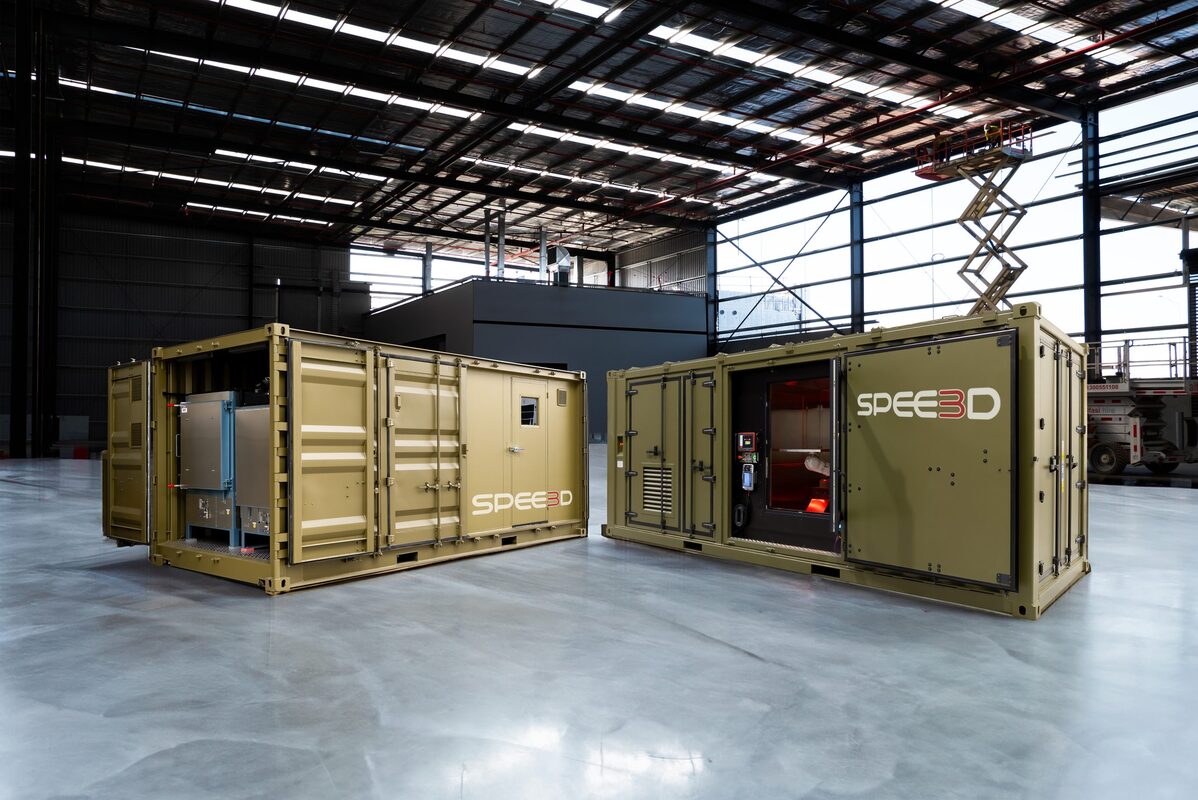
Australian metal-printing company SPEE3D wants to sell factories, not printers, and to run every one of them itself. On 9 November 2026 it launched Phase One of NodeZERO in Darwin. According to the company's official CriticalSPEE3D page, NodeZERO is the first of 50 "rapidly deployable" factories planned across Asia Pacific. Each one is about the size of a basketball court and makes critical metal parts at the point of consumption: close to the gas plants, mines, ports and defence bases that would otherwise wait on a spare part shipped from somewhere else.
The network is called CriticalSPEE3D, and SPEE3D says it will run it as a service. Customers won't have to buy a machine, hire operators and qualify a process themselves. They will buy parts from a factory that SPEE3D runs nearby. Co-founder and CTO Steven Camilleri put it bluntly in comments reported by VoxelMatters: "Our plan is simple: factories everywhere."
The Pitch: Downtime Is the Real Cost
SPEE3D makes its business case with one number. It cites ABB's 2023 Value of Reliability survey, which found that unplanned downtime costs the typical Australian industrial business an average of A$350,000 an hour. Asia Pacific Defence Reporter also put that figure at the centre of its November 10 coverage of the launch, noting that when a critical part comes from overseas, the wait can run to months.
The logic is simple. A failed pump housing or bracket on a remote gas plant can cost far more in lost output than the part itself, and most of that cost comes from waiting. If a nearby factory can make the replacement in hours, the part's price matters much less. SPEE3D says its parts are "ready in hours." That is a vendor claim, but the economics depend on it. At A$350,000 an hour, a few hours saved covers a lot of premium pricing.
That also explains the choice of customers. Gas plants, mines, ports and defence bases all run expensive equipment, often far from where spares are made, and stopping is costly.
How Cold Spray Differs From the Metal Printing You Know
Most makers who have followed metal additive manufacturing know laser powder bed fusion, where a laser melts thin layers of powder inside a sealed chamber. SPEE3D's approach works differently. Each CriticalSPEE3D factory is built around what the company calls Cold Spray Manufacturing, which fires metal powder at up to three times the speed of sound. There's no melting, no moulds and no lasers. The particles bond on impact, not because they are heated to liquid.
SPEE3D describes the resulting parts as dense and "equivalent to a cast part." That comparison is useful. Cast parts are the baseline for many industrial spares, so a process that matches casting without needing moulds or long lead times has an obvious place in maintenance work. The company says heat treatment and machining finish each part on site, and the staffing plan fits that. Among the planned roles, according to VoxelMatters, are CNC machining and quality assurance, along with advanced manufacturing operators and application engineers.
That list shows what the product really is. The cold-spray machine is one part of a production operation that also includes machining and quality assurance. The goal is a finished, checked part, not just a printed blank. SPEE3D's page says the process suits large, heavy-duty parts such as flanges, pump components and parts that suffer from corrosion.
Field Record and Launch-Day Demo
The company has a track record to point to. SPEE3D says its cold spray has been fielded 70 times worldwide, including in combat, maritime, desert and arctic conditions. That is the figure given in the VoxelMatters and Asia Pacific Defence Reporter coverage, though SPEE3D's own CriticalSPEE3D page says 66 deployments, so the count is not consistent across sources. FilamentFeed has not independently verified either number, but SPEE3D has clearly been pitching the technology as something that works far from a clean lab.
Guests from industry, defence and government watched a metal part being made at the launch event, VoxelMatters reported. Global CEO Bryan O'Connor summed up the offer to local industry: "Your critical parts, now made here."
NodeZERO as a Training Pipeline
NodeZERO is a production site and also planned as the hub of CriticalSPEE3D, where people for every factory will come for training and induction. If the company wants 50 sites, it needs crews who can run cold spray, machine the results and sign off on quality, and NodeZERO is where SPEE3D plans to build that skill base.
SPEE3D is building that pipeline with local institutions. VoxelMatters reports that roles are planned to be filled by Northern Territory residents trained on site through Charles Darwin University and TAFE NT, including Indigenous recruitment and training. Charles Darwin University's Professor Steve Rogers described a long-term research and training partnership with SPEE3D through the Advanced Manufacturing Alliance. A network spread across remote industrial sites needs people who already live near those sites, and training them locally is likely to work better than flying crews in. It also lets SPEE3D present the project as regional economic development as well as a supply-chain fix.
Phase One is open to a small group of founding members, according to SPEE3D: operators who bring their problem parts and help shape how the service works.
What It Means for Makers
Few FilamentFeed readers will be ordering a pump impeller from a CriticalSPEE3D site. Still, the launch says something about where industrial additive manufacturing may be going.
Printers sold as a service. Much of the metal AM industry has made its money selling machines, powder and service contracts. SPEE3D is betting that heavy-industry customers want parts, not the burden of owning equipment. If the model works, other companies may copy it: own the hardware, run the site and sell output by the part.
The process matters less than the system around it. Hobbyists often judge printers on speed, resolution and materials. SPEE3D's pitch focuses instead on lead time, location and the people who run the machines. The required skills read like a well-run makerspace: machining, QA and application engineering. If you can take a part from model to finished, inspected component, that is the kind of pipeline SPEE3D is hiring around.
Distributed manufacturing is getting real. The idea of "print it where you need it" has been around consumer 3D printing for years. Here a company is planning 50 physical sites built around that idea, aimed at customers who can put a dollar value on every hour of waiting.
Bottom Line
NodeZERO is a beginning, not proof. Phase One of one site in Darwin is a long way from 50 factories across Asia Pacific, and SPEE3D has not published a timeline for the rest in the sources reviewed here. The pieces are clear, though: a no-melt deposition process that SPEE3D says produces cast-equivalent parts, a strong downtime argument backed by a third-party survey, a local training pipeline, and an operating model where SPEE3D runs the service. Whether customers will pay for parts as a service is the open question, and Darwin is where it will first be tested.
