
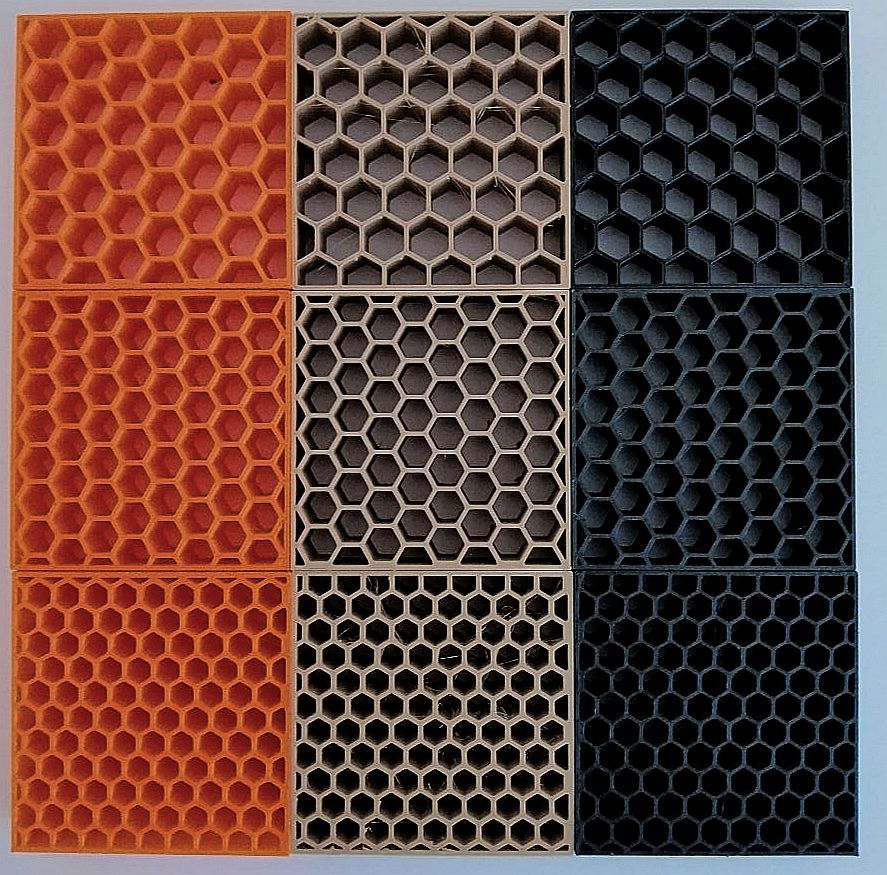
Honeycomb cores are the quiet workhorses of lightweight engineering — sandwiched between skins in everything from aircraft panels to EV battery enclosures, they deliver a lot of stiffness for very little mass. Researchers at Southern University of Science and Technology (SUSTech) in Shenzhen have now published a new 3D printing method that attacks a long-standing limitation of printed continuous-fiber-reinforced composite (CFRC) honeycombs: the fibers have always had to run in essentially one direction, whether the load did or not.
The paper, titled "A novel 3D-printed composite honeycomb with continuous fiber aided by an expansion-forming process," describes a fabrication technique that lets engineers tailor fiber orientation within the honeycomb cell walls rather than being locked into the out-of-plane stacking that fused filament fabrication (FFF) printers typically produce. That distinction matters more than it might sound. A honeycomb's mechanical performance is dictated almost entirely by how the load path inside each cell wall lines up with the reinforcing fiber — get the angle wrong and you're carrying dead weight that isn't doing structural work.
Why Conventional Fiber Placement Falls Short
Continuous-fiber composites are usually built one of two ways: co-curing pre-impregnated fiber sheets in a mold, or automated fiber placement (AFP), where a robotic head lays down tow in precise paths. Both work well at large scale, but neither is a good fit for something as small and geometrically repetitive as a honeycomb cell. Co-curing needs a separate mold for every cell geometry, which is expensive and slow to iterate on. AFP, meanwhile, is simply not cost-effective when you're trying to place fiber inside cell walls that might only be a few millimeters across — the tooling and setup overhead dwarfs the material being placed.
3D printing has been the obvious workaround, since it can build complex cellular geometry without a mold and without per-part tooling costs. The catch is that FFF-based continuous-fiber printing has historically only been able to lay fiber along the print path in a fairly constrained way, which in a honeycomb usually means fibers run out-of-plane (through the thickness of the cell wall) rather than aligned with the actual stress directions a hexagonal or similar cell experiences under compression. That mismatch is the gap the SUSTech team set out to close.
How Expansion-Forming Changes the Fiber Path
The expansion-forming process described in the paper is designed specifically to enable non-0-degree fiber orientations inside the printed cell walls — in effect, giving designers a way to steer continuous fiber to match the load case of a given honeycomb structure, rather than accepting whatever direction the print head's travel happens to produce. That's a meaningfully different capability than simply printing a honeycomb shape with continuous fiber filament; it's about controlling the internal fiber geometry within each wall so the reinforcement actually resists the compressive and shear stresses the part will see in service.
The results reported are substantial. According to coverage from 3DPrint.com's July 1, 2026 news briefs, honeycombs made with the expansion-forming process showed a 126.44% increase in specific compressive modulus, a 198.64% increase in specific compressive strength, and a 32.05% increase in energy absorption compared to conventional honeycombs printed with 0-degree fiber orientation. Just as notable for anyone who has fought warping and tolerance drift on printed composite parts: dimensional error dropped by 82.76%. That's the kind of number that speaks to process control as much as material performance — a honeycomb that's both stronger per gram and closer to its nominal geometry is a much easier part to actually put into an assembly.
The "specific" qualifier on the modulus and strength figures is worth pausing on. Specific properties are normalized by density, meaning the gains aren't coming from simply adding more material — they reflect genuine improvement in how efficiently the existing mass is being used structurally. For sandwich-panel designers, where every gram in the core competes directly against payload or range, that's the metric that actually matters.
The research team frames the work squarely as an enabling technology for structural applications, noting that "the proposed technique holds considerable promise for the integrated fabrication of lightweight CFRC structures with complex fiber directions and superior mechanical properties." The stated target sectors are aerospace, automotive, and civil engineering — three industries where sandwich structures with honeycomb cores are already standard practice, and where a manufacturing route that skips molds and AFP tooling while improving mechanical performance would be a genuine process upgrade rather than just an academic curiosity.
What It Means for Makers
This is a research-stage process out of a university lab, not a slicer feature or a commercial filament you can order — 3DPrint.com's brief and the underlying Composites Part B: Engineering paper don't describe a path to a desktop-printable workflow, and there's no indication yet of open hardware, print profiles, or a spin-out product. So don't expect to reproduce these numbers on your own continuous-fiber printer this year.
What it does signal is a direction worth watching if you print continuous-fiber composites for functional parts — drone airframes, load-bearing brackets, or your own sandwich-panel experiments. The core insight, that fiber orientation control (not just fiber presence) is the lever that unlocks the bulk of a composite honeycomb's strength, is directly applicable even with today's more limited tools. If you're currently printing continuous-fiber honeycomb or lattice structures with fiber running in whatever direction your slicer's default toolpath dictates, this research is a data point for why it may be worth manually reorienting cell walls, or choosing print orientations, so fiber runs closer to the load path even within existing hardware constraints. It's also a reminder that dimensional accuracy and mechanical performance in composite printing aren't separate problems — the same process refinement that improved SUSTech's compressive numbers also cut their dimensional error by more than 80%, suggesting tighter process control pays off on both fronts at once.
Sources
- A novel 3D-printed composite honeycomb with continuous fiber aided by an expansion-forming process — ScienceDirect / Composites Part B: Engineering (primary research paper)
- 3D Printing News Briefs, July 1, 2026: Prosthetics, Drug Delivery, & More — 3DPrint.com
