
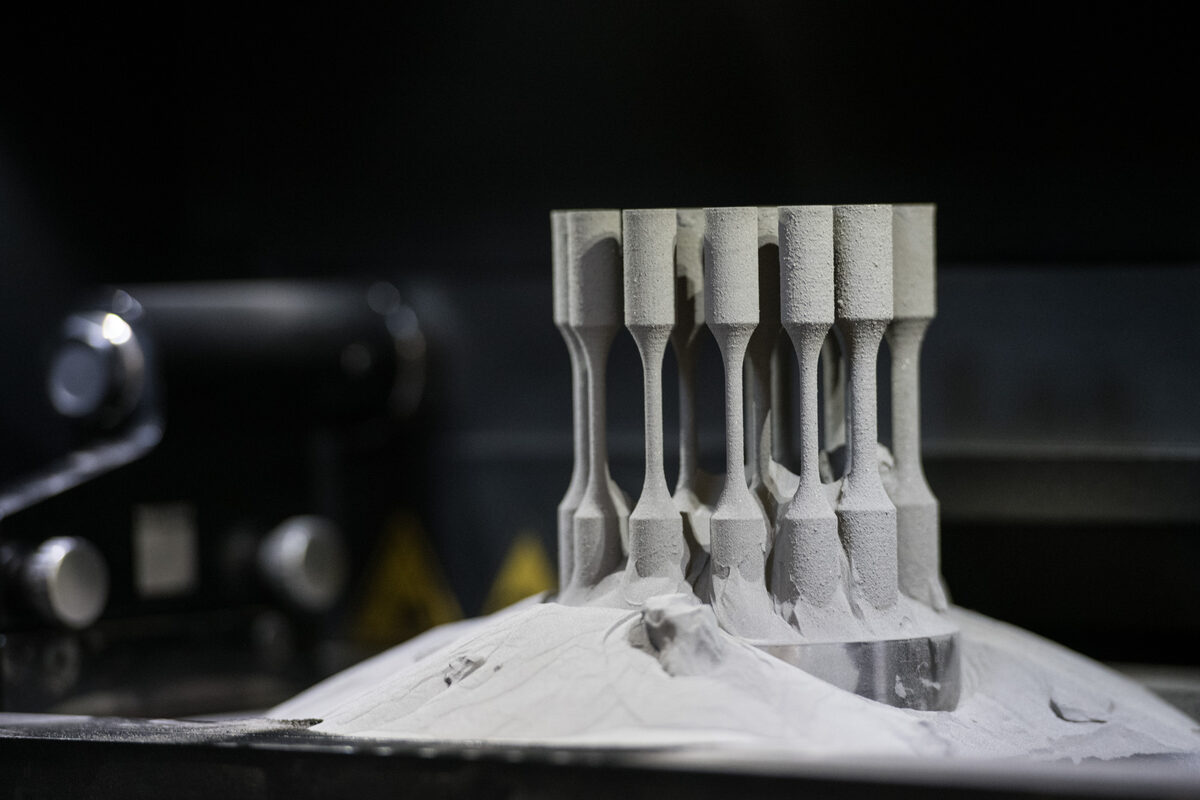
A small Italian valve manufacturer best known for oil-and-gas ball, gate, and check valves has just demonstrated something the metal additive manufacturing industry has been chasing for years: a viable path from automotive scrap metal to laser powder bed fusion (LPBF) feedstock. According to a report from VoxelMatters, Piantedo-based Valland has completed the ToZero project — "Towards Zero Waste in Aluminum BiW Manufacturing" — showing that AA5083 aluminum scrap recovered from body-in-white (BiW) car body production can be atomized, printed, and turned into a structural part without the hot cracking that has historically plagued this alloy family in additive processes.
The project, funded under Italy's Accordi per l'Innovazione program, paired Valland with two technical universities — Politecnico di Torino and Politecnico di Bari — and automotive supplier Fontana Group. Together they built a closed loop that starts on the automaker's stamping floor and ends at a build plate: aluminum offcuts and trim scrap generated during body-in-white manufacturing, the stage where sheet metal is stamped and welded into a car's structural shell before painting, were collected, processed into metal powder suitable for LPBF, and then printed into a real demonstrator component.
Why AA5083 Is a Hard Alloy to Print
AA5083 is a magnesium-heavy, non-heat-treatable aluminum alloy prized in automotive and marine applications for its strength, weldability, and corrosion resistance. It is not, however, a natural fit for powder bed fusion. The alloy's wide freezing range and elevated magnesium content make it prone to hot cracking — solidification cracks that form as the last liquid film between grains is pulled apart by shrinkage stress during the rapid, localized melting and cooling cycles a laser produces layer by layer. That susceptibility is a big part of why the metal AM industry has standardized almost entirely on AlSi10Mg and similar silicon-rich casting alloys, which solidify over a narrower range and resist cracking far more readily. Successfully printing 5083 — recycled or not — without cracks is therefore a nontrivial materials-science result on its own, independent of where the powder came from.
From Scrap Bin to Structural Part
To prove the recovered powder was more than a lab curiosity, the ToZero team printed it into a component called "Voletto," a structural demonstrator part. The team used topology optimization — software-driven redesign that strips material from a part while preserving load paths — to cut the target part's mass from 1.68 kg toward a target of roughly 0.8 kg, a reduction of more than half. The printed parts met the project's mechanical and ductility targets and, critically, came out of the build without hot cracking, the failure mode that has kept 5083 off most metal printer spec sheets.
Valland and its partners also ran a full lifecycle assessment against ISO 14040/44, the international standards for cradle-to-grave environmental accounting, and found that process optimization cut the component's carbon footprint by roughly 73%. VoxelMatters' report doesn't spell out the exact baseline used for that comparison, but the likely driver is straightforward given the project's premise: remelting and atomizing aluminum that already existed as automotive scrap skips the energy-intensive bauxite mining and primary smelting stages that dominate the carbon footprint of virgin aluminum production.
The project wasn't a story of unqualified success on every front. VoxelMatters' report notes that the recycled alloy printed more slowly than commercial AlSi10Mg powder, a gap the team has flagged as the next challenge to solve before the process could scale toward production volumes. Print speed in LPBF is governed by how a powder's particle size distribution, flowability, and thermal behavior interact with laser scanning strategy, and matching a virgin, purpose-atomized powder's throughput with a recycled one is rarely trivial — expect follow-on work on powder characteristics and process parameters before this becomes a production-line technology rather than a proof of concept.
Not Valland's First Foray Into Metal AM
ToZero didn't emerge from nowhere. Valland has been active in additive manufacturing since 2016, working across binder jetting, powder bed fusion, and wire arc additive manufacturing (WAAM), according to the company's own additive manufacturing page. That page also confirms Valland is "in the process of acquiring a new laboratory-scale hybrid technology atomizer (VIGA + Plasma) to develop new R&D projects and produce raw materials... from traditional manufacturing scraps and by-products" — corroborating that ToZero is one piece of a broader, deliberate scrap-to-powder strategy rather than a one-off grant-funded experiment. VIGA (vacuum induction melting gas atomization) and plasma atomization are two of the standard industrial routes for turning molten metal into the spherical, flowable powder that LPBF machines require; owning both in a lab-scale hybrid rig would let Valland iterate on feedstock chemistry and particle morphology in-house rather than outsourcing powder production to a third-party atomizer.
What It Means for Makers
Nothing here is going to change the powder sitting on a hobbyist's shelf tomorrow — LPBF machines remain industrial equipment, and AA5083 recycled feedstock isn't showing up in a consumer catalog. But the ToZero result matters to anyone tracking where metal 3D printing is headed on cost and sustainability. Metal powder remains one of the largest cost and carbon line items in industrial AM, and most of it today is atomized from virgin ingot. A validated process that takes scrap generated on an automaker's own factory floor and turns it into qualified LPBF feedstock — for a notoriously crack-prone alloy, no less — is a template that other alloy families and other scrap streams (extrusion offcuts, machining swarf, even end-of-life parts) could plausibly follow. For makers running desktop and prosumer polymer or resin printers, the direct relevance is limited, but the broader trend line is worth watching: as industrial metal AM comes under more pressure to justify its environmental footprint, closed-loop scrap-to-powder pipelines like Valland's are likely to become a bigger part of how that case gets made, and the process knowledge (topology optimization for mass reduction, hot-crack mitigation in high-magnesium alloys) tends to filter down into tooling and best practices that eventually touch the wider AM ecosystem.
The immediate next step for Valland's team is closing the print-speed gap between recycled and virgin powder — the difference between an interesting lab result and something an automotive supplier would actually specify on a production part.
