
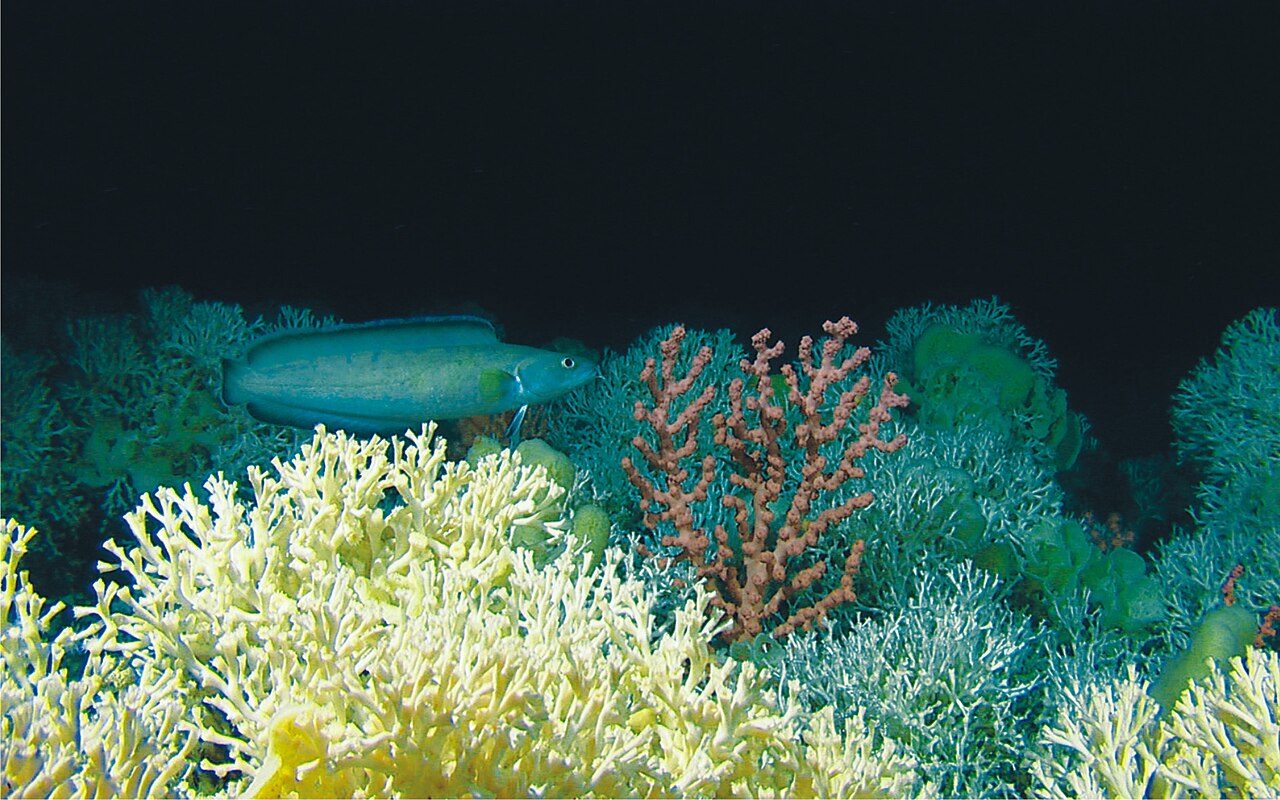
Deep-sea corals grow slower than almost anything else on Earth, which makes them nearly impossible to restore once trawl nets have scraped a reef flat. This August, a Franco-Irish research team lowered 23 3D printed concrete structures onto the seabed of the north-east Atlantic, betting that additive manufacturing can compress a process that would otherwise take decades or centuries into something closer to human timescales.
The deployment, announced by the University of Galway on September 20, is the field phase of a three-year effort called REDECOR, a collaboration between the University of Galway, French ocean-research institute Ifremer, and Sorbonne University. Working from the research vessel L'Atalante, the team placed printed reefs at two separate sites: the south-west Porcupine Bank off Ireland's continental shelf, at depths between 900 and 1,100 meters, and the Guilvinec Canyon in France's Bay of Biscay. Both locations once supported extensive cold-water coral reefs before bottom trawling ground them down over decades of bottom trawling. REDECOR itself feeds into a larger EU-funded effort, the Horizon Europe REDRESS project, which is testing restoration techniques across multiple damaged marine habitats.
"With this project, we are testing whether we can actively accelerate that recovery by creating new starter structures for corals to grow on which also mimic reef structure to help re-establish functioning reef habitats," said Dr. Anthony Grehan, a deep-sea ecologist at the University of Galway and co-leader of the Porcupine Bank mission, in comments accompanying the announcement. The idea, in Grehan's framing, is that coral colonization normally has to wait for suitable hard substrate to accumulate naturally on the seafloor — a slow, opportunistic process — and a printed reef skips that step by arriving as a ready-made settlement surface, potentially shaving decades or centuries off the time it takes a reef to re-establish itself.
Concrete That's Built to Be Climbed On
The engineering behind the reefs is where this story gets interesting for anyone who thinks about additive manufacturing for a living. According to reporting from 3D Printing Industry, each unit is a cylinder roughly 80 centimeters tall and a meter across, weighing about 600 kilograms, printed from a low-carbon concrete mix that incorporates volcanic material — a nod to reducing the embodied carbon of a structure whose entire purpose is ecological restoration. That's a familiar move from the terrestrial construction-printing world, where volcanic ash, slag, and other supplementary cementitious materials have become standard ways to cut a print's carbon footprint without sacrificing strength. What sets these apart from a simple printed cylinder is the internal geometry. The print head builds in tunnels, ledges, and overhangs specifically intended as microhabitat features — the kind of nooks that give coral larvae, sponges, and the small fish and invertebrates that follow them, places to settle and hide. That's a feature that gravity-fed concrete pours or cast molds struggle to produce economically at this scale; layer-by-layer deposition can generate complex void geometry in a single pass with far less tooling than a mold would require, which is presumably why the team reached for a printer rather than a traditional precast method.
The team also tested two different ways of seeding coral onto the structures rather than simply hoping larvae would find them on their own. One approach uses oyster-shell and ceramic settlement surfaces attached to the reefs, aimed at capturing free-swimming coral larvae drifting through the water column. The other is more direct: coral "nubbins," small fragments broken or cut from existing colonies, are attached to oyster shells and physically anchored to the printed structures before deployment. The target species for both approaches are Lophelia pertusa and Madrepora oculata, the two reef-building cold-water corals that historically dominated these Atlantic sites and are among the most widely studied corals in deep-sea restoration science. Running both seeding methods in parallel lets the researchers compare passive recruitment against active transplantation once they return to survey the sites; both the University of Galway announcement and the 3D Printing Industry report say that follow-up monitoring of the Irish and French sites is planned for next year, aboard an Irish research vessel.
What It Means for Makers
None of this involves a desktop FDM printer, but the underlying story is one that anyone who follows large-format additive manufacturing will recognize: printing in concrete is graduating from architectural novelty to infrastructure tool, and marine restoration is turning out to be a genuinely demanding proving ground for it. A structure destined for 1,100 meters of water pressure and decades of biofouling has different requirements than a printed pavilion or a construction-industry demo wall — it needs a mix chemistry that survives saltwater immersion indefinitely, a geometry that print heads can actually deposit without slumping under their own weight before curing, and internal void structures deliberate enough to double as habitat rather than just structural fill. That combination — carbon-reduced concrete mixes, complex non-load-bearing internal geometry, and single-pass fabrication of shapes that would be prohibitively expensive to mold — is exactly the pitch large-format concrete printing has been making to the construction industry for years. Seeing it applied to something as unglamorous and slow-moving as coral restoration is a useful data point: it suggests the technology's value proposition (fast, low-tooling production of geometrically complex, materially efficient concrete forms) travels well beyond buildings. For makers working in concrete printing, bio-receptive materials, or environmental engineering more broadly, REDECOR is worth tracking as one of the more rigorous field tests of whether a printed object can function as functioning ecological infrastructure rather than just a stand-in for a naturally occurring substrate. The real verdict won't arrive until researchers return next year to survey the reefs in place — via photography, video, and 3D mapping — but the fact that funding agencies are willing to bankroll a multi-year monitoring program around printed hardware says something about how far the technique has come from proof-of-concept.
Sources
- University of Galway part of international mission to restore deep-sea coral reefs — University of Galway
- University of Galway and Ifremer Test 3D Printed Reefs for Cold-Water Coral Recovery — 3D Printing Industry
