
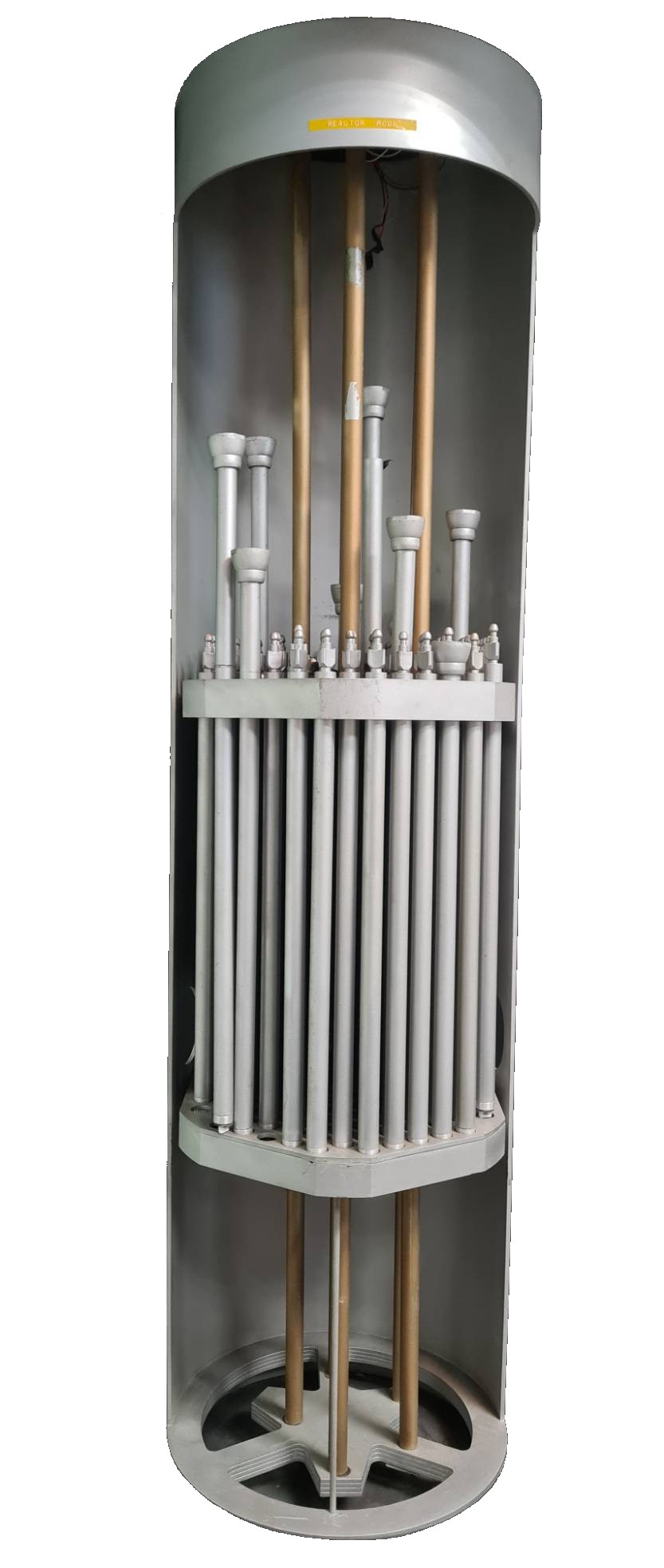
A Florida energy startup says it has 3D printed the core of a nuclear reactor — not a scale model, not a prototype bracket, but the actual pressure-bearing structure meant to hold nuclear fuel. On July 1, 2026, AMPERA unveiled what it calls the world's first full-scale, 3D-printed nuclear reactor module at its innovation center in Palm Beach Gardens, betting that additive manufacturing can shrink the enormous cost, timeline, and complexity that have throttled advanced nuclear projects for decades.
The unveiling drew more than 100 local officials, business leaders, and employees to a ceremony that looked more like a product launch than a reactor dedication — appropriate, given AMPERA's pitch: build reactors the way you'd build any other factory product, using the same digital-manufacturing playbook that has reshaped aerospace and medical devices.
What Was Actually Printed
The centerpiece is a spherical, monolithic reactor core and pressure vessel roughly the size of a basketball, printed entirely in silicon carbide (SiC) — a ceramic prized in nuclear and aerospace applications for its ability to withstand extreme heat (AMPERA says the material tolerates temperatures approaching 3,000°C) without degrading. Rather than machining or casting the vessel from solid stock, AMPERA's process builds the sphere as a single printed structure with an internal gyroid lattice, the same triply-periodic minimal-surface geometry that FDM users will recognize from lightweight infill settings, just executed here at ceramic-grade precision and load-bearing intent rather than as a shortcut to save filament.
A gyroid lattice distributes structural load and thermal stress evenly in every direction, which is exactly the property you want in a pressure vessel that has to survive sustained heat cycling without developing stress-concentration cracks. Printing the geometry directly, rather than machining channels and cavities into a solid ceramic blank, is also the only practical way to produce some of these internal structures at all — traditional subtractive methods can't reach the interior of a fully enclosed lattice sphere.
Inside, the design is fueled with TRISO thorium kernels — thorium-232 encapsulated in ceramic and carbon layers that absorbs neutrons and transmutes into fissile uranium-233 inside the core. TRISO (tri-structural isotropic) particles are a containment approach already used in other next-generation reactor concepts, since each particle acts as its own tiny containment vessel in addition to whatever vessel surrounds the whole core. AMPERA says the fueled version of this design is engineered to run up to 30 years without refueling, and that a single core is rated around 15 MWe, with larger, multi-core configurations intended to scale to as much as 30 MWe of output — enough for a substantial industrial load, though far short of a utility-scale plant.
Subcritical by Design — and Unfueled Today
The hardware shown at the ceremony was unfueled demonstration equipment, not a live reactor, and posed no radiological risk as displayed. Independent tech-press coverage of the unveiling framed the announcement within the broader industry scramble to find next-generation nuclear power for the compute boom.
The safety case rests on the reactor's subcritical, solid-state architecture. In simple terms, a subcritical reactor cannot sustain a chain reaction on its own — it depends on an external neutron driver to keep fission going, and reporting corroborates that the design automatically halts the reaction if that driver shuts off. There's no control rod to fail to insert and no positive feedback loop to run away with itself; remove the external trigger and the physics stops on its own. That's a meaningfully different risk profile than a traditional critical reactor, and it's central to AMPERA's argument that this technology can be sited closer to industrial customers than conventional nuclear plants typically are.
AMPERA founder and CEO Brian Matthews framed the milestone in similar terms, saying the printed core and pressure vessel "sets the foundation for factory-built, mass-produced nuclear energy" — proof, in his telling, that a reactor core is now a manufacturable object rather than a decades-long megaproject.
Why Data Centers, Why Now
The target customer list is telling. "Our reactors are built for the markets that need power the most: AI data centers, defense, industrial and maritime," Matthews said in the company's release. All four share the same underlying problem — a need for dense, reliable, on-site power that doesn't depend on adding new transmission capacity to an already strained grid. AI training and inference clusters in particular have turned into some of the most power-hungry industrial loads ever built, and utilities in several regions have already signaled they can't add gigawatt-scale data center demand fast enough through conventional grid expansion. A factory-built, subcritical reactor that can theoretically be trucked to a site and run for decades without refueling is a direct response to that bottleneck, at least on paper.
AMPERA is also moving to lock down its fuel supply chain: the company established an Australian thorium-supply subsidiary in June 2026, according to the press release, positioning itself ahead of what would presumably be a scramble for thorium feedstock if this reactor class reaches commercial scale.
What It Means for Makers
Nobody is printing a reactor core on a desktop FDM machine, and this isn't a story about consumer hardware. But it's a striking data point for anyone tracking additive manufacturing at the high end: ceramic 3D printing at structural, mission-critical scale, with internal lattice geometry that would be impossible to produce any other way. The gyroid infill pattern that shows up in your slicer settings to save time and filament is the same geometric family being used here to survive fission-level thermal and mechanical stress. That's a useful reminder that infill strategies aren't just about weight and speed — they're genuine structural engineering tools, and the industries validating them at the extreme end (aerospace, now apparently nuclear) tend to eventually push refined versions of that knowledge back down into more accessible printing workflows and materials.
It's also a case study in how far "3D printed" can now stretch as a manufacturing claim. This isn't a plastic housing or a jig — it's a pressure vessel intended to contain nuclear fuel for decades, which says something about how much materials science for engineering-grade ceramics has matured alongside the printers themselves.
The Long Road Ahead
AMPERA's timeline is ambitious and conditional: first commercial nuclear deliveries are expected sometime between 2028 and 2030, and that entire window depends on approval from the U.S. Nuclear Regulatory Commission, which has not yet certified this design for fueled operation. Regulatory review of any novel reactor concept typically takes years and isn't guaranteed to conclude on a startup's preferred schedule. For now, what exists is unfueled demonstration hardware, a manufacturing claim, and a bet that printing a reactor core is a solvable engineering problem rather than an inherent one.
Sources
- AMPERA Marks Major Nuclear Milestone (PR Newswire, July 2, 2026)
- Startup targets datacenters with 3D-printed nuclear reactor module (The Register, July 3, 2026)
- AMPERA Unveils First 3D-Printed Thorium Reactor Core: Subcritical Design Targets AI Power (Tech Times, July 3, 2026)
