
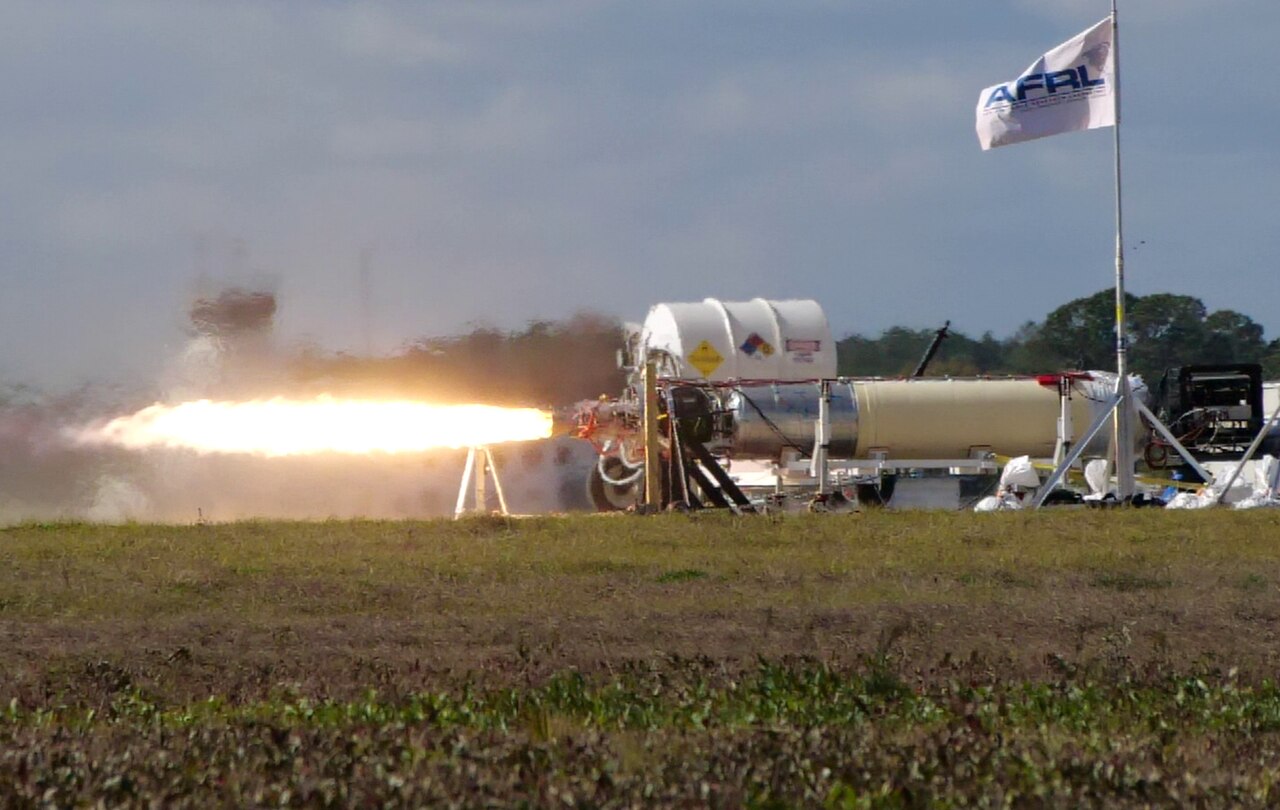
The Air Force Research Laboratory has exercised a $10.9 million option on its contract with Ursa Major to continue development of Draper, a storable liquid rocket engine built for hypersonic applications. The Colorado propulsion company announced the award in a November 12 release distributed via PR Newswire. The option follows successful flights of the Affordable Rapid Missile Demonstrator, which flew under the same contract. That ordering matters. Exercising an option means the government is paying for the next phase of a program it already holds, and it did so after the demonstrator flights rather than on ground tests and slide decks alone.
3D Printing Industry covered the award this week, and its framing is the more useful one for this audience. It treats the option as one of three propulsion programs that rely on additive manufacturing and have flown, or are funded to fly, under U.S. military contracts.
What Draper Is, and Why "Storable" Matters
Ursa Major describes Draper as a storable liquid rocket engine. In propulsion terms, "storable" separates engines whose propellants can stay loaded for long periods from those that need cryogenic handling just before launch. For a weapon or a test vehicle that has to sit ready and then fire on short notice, that is an operational requirement as much as an engineering one. The release says Draper has already flown with AFRL. This option keeps development going rather than starting a program from nothing.
The release does not give a detailed breakdown of the engine's specifications or of what the $10.9 million pays for beyond continued development. Readers should take it as what it is: a funding milestone backed by flight history, not a technical disclosure. Nor does it say that Draper itself is a printed part. It says only that Ursa Major uses additive manufacturing across its business.
The Company Behind It
Ursa Major was founded in 2015 and is headquartered in Berthoud, Colorado. It runs manufacturing operations in Youngstown, Ohio. The company says it uses additive manufacturing, adaptable design and flexible production methods, which is close to the standard pitch for venture-era propulsion startups. Its portfolio claims show that the pitch has turned into hardware:
- Hadley, a liquid rocket engine that, according to the company, powers the Department of War's hypersonic test bed.
- Draper, the storable engine at the center of this award, which has flown with AFRL.
- HAVOC Missile System, the company's all-up-round for hypersonic and long-range precision strike: a complete system, not just an engine.
Ursa Major says it has flown its hypersonic systems more than a dozen times. The release also includes a statement from the company's president, Jason Meredith. In separate announcements listed alongside it, the company said it promoted Meredith to president and appointed Kevin Fox chief financial officer, effective November 9, 2026. A new CFO and president alongside a fresh government option is consistent with a company organizing itself around recurring defense work instead of one-off demonstrations, though that reading is ours, not the company's.
A Pattern, Not a One-Off
3D Printing Industry puts the Draper option next to two other propulsion programs that rely on additive manufacturing, and together they show a clear trend.
The first is Beehive Industries. In May 2026, Beehive received a $29.7 million U.S. Air Force contract covering flight testing, vehicle integration and qualification of Frenzy 8, an additively manufactured jet engine rated at 200 lbf of thrust, intended for uncrewed aerial defense systems. Like Ursa Major's AFRL contract, the award includes options, in this case for further testing and flight demonstration of the smaller 100 lbf Frenzy 6. Funding goes through the SOSSEC consortium to the Air Force Life Cycle Management Center's Small Expendable Turbine prototyping effort. The words "expendable" and "qualification" are the important ones. An expendable turbine is meant to be used once, and qualification is the step that moves a prototype toward something a program office can buy repeatedly.
The second is Firehawk Aerospace, a defense energetics manufacturer. In 2025, according to the 3DPI report, Firehawk flew its additively manufactured GMLRS-class hybrid rocket engine system, the Firehawk Analog, above 18,000 feet and past the speed of sound. The flight was the first in a planned series under the company's Phase III SBIR contract with the Army Applications Laboratory, with Javelin-class and Stinger-class analogs planned next. That puts a printed hybrid motor in the size class of a fielded guided artillery rocket family, flying at a meaningful altitude and speed.
Taken together, the three programs cover a wide range of propulsion: a storable liquid rocket engine for hypersonics, small expendable jet engines, and a hybrid rocket motor. What they share is that each involves additive manufacturing and a U.S. military customer, though they sit at different points. As 3DPI notes, Draper's demonstrator had already flown before the option was exercised, Beehive's options cover flights still ahead, and Firehawk has completed the first flight in its planned series.
What It Means for Makers
No one is printing a hypersonic engine on a desktop FDM machine, and nothing here is a weekend project. Parts like these come from industrial processes, controlled supply chains and qualification regimes far beyond hobby work. Still, there are a few reasons the trend is worth following if you design and print parts for a living or for fun.
Design for AM is the real product. When Ursa Major talks about "adaptable design and flexible production," the lesson for the rest of us is that geometry, part consolidation and iteration speed can be worth more than the printer itself. That way of thinking applies at any scale. Combining an assembly into one printed part, designing internal channels that machining can't produce, and revising a design in days instead of months are the same habits makers use when they redesign a bracket for a printer instead of copying a machined original.
Flight data drives funding. The Draper option came after demonstrator flights. Beehive's contract is explicitly about flight testing and qualification. Firehawk's milestone is a flight. In each case the hardware is being proven in use, and further money follows or depends on that. Anyone selling printed parts commercially, from drone components to tooling, faces a smaller version of the same rule: test data persuades customers more than claims about the process.
Skills and jobs follow the money. Ursa Major runs manufacturing operations in Youngstown, Ohio, and defense propulsion contracts like these plausibly sustain demand for people who understand build preparation, post-processing, inspection and design for additive manufacturing. For makers thinking about turning a hobby into a career, these are industrial roles worth watching, even though none of the sources discusses hiring.
Bottom Line
A $10.9 million option is small by defense budget standards. What stands out is that it came after flights, and that it sits beside other military-funded propulsion work built around additive manufacturing, from the Air Force's Beehive award to Firehawk's Army-backed flight series. Taken together, these programs suggest additive manufacturing is increasingly part of how the military develops and flies demanding propulsion hardware. Expect more announcements like this one, and expect them to look routine.
