
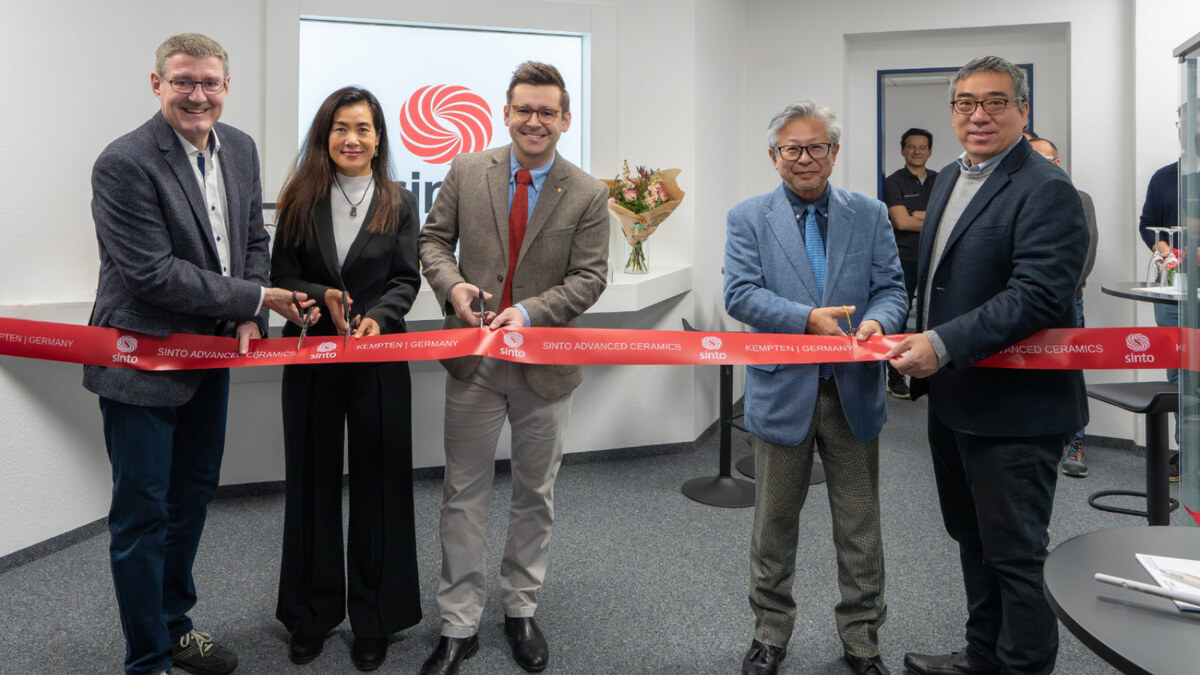
About a year after the Sinto Group made public its acquisition of Bosch Advanced Ceramics, the renamed business has a new home. Sinto Advanced Ceramics Europe says on its official news page that it opened a new facility in Kempten, Germany, on 23 November 2026. The site is meant to hold the company's whole additive manufacturing operation for technical ceramics in one place: development, production, quality assurance, logistics, sales and management. It replaces the former Bosch premises in Immenstadt, and the additional production and logistics space is meant to support future growth.
Taken alone, a business moving into a bigger building is a small story. In this case the timing and the list of departments make it worth a closer look. Sinto has done more than keep a former Bosch unit running. It has moved that unit out of the former Bosch premises and into a facility of its own, which fits a buyer that plans to grow what it bought.
From Immenstadt to Kempten, without stopping the line
According to VoxelMatters, the relocation from Immenstadt came almost exactly one year after the Japan-based Sinto Group's acquisition of the business was made public. The report says the acquisition laid the foundation for further investment in expanding additive manufacturing of technical ceramics, and it presents the extra production and logistics space as capacity for future growth and an expansion of manufacturing operations, not just a change of address.
The move is not completely finished. VoxelMatters reports that final work on the Kempten building was still under way at the time of the opening. Anyone who has moved a production cell knows the hard part is less the walls than the machines, the calibration and the paperwork, and the report says the move took place while production ran at a very high level of utilization. During the same period the company was also represented at two trade shows: COMPAMED in Düsseldorf and SEMICON Europa in Munich. Managing Director Nikolai Sauer called completing the relocation under these circumstances "an extraordinary team effort," and credited close cooperation with Bosch during the transition period.
Those two shows point to the customers Sinto is after. COMPAMED is the supplier fair for medical technology, and SEMICON Europa serves the semiconductor equipment and materials industry. Showing up at both while moving the factory suggests which buyers the company wants to keep happy.
A busy autumn on the news page
The opening caps a run of announcements on the company's news page that, read in order, show a supplier filling in the basics an industrial customer checks for:
- 4 August 2026: ISO 9001:2015 certification.
- 24 September 2026: an expanded portfolio that adds non-oxide ceramics.
- 15 October 2026: an Outstanding Product Award at CIIF 2026.
- 19 October 2026: the relocation announcement.
- 23 November 2026: the opening of the Kempten facility.
Each item covers a different part of the business. The ISO 9001:2015 certificate is a quality-management credential that procurement teams commonly look for in suppliers. The move into non-oxide ceramics widens the range of materials the company can offer. The CIIF award gives it some recognition at a trade fair. The new building then puts development, production, quality assurance and logistics under one roof. Having quality assurance and logistics on the same site as production is the kind of operational detail that tends to matter to customers in demanding fields.
Two upcoming events are also listed. On 3 December 2026 the company is part of an online webinar hosted by VoxelMatters called "Beyond the Prototype: Why Some Ceramic AM Projects Scale and Others Don't." It will also exhibit at Hannover Messe on 5–8 April 2027. The webinar title is a fair summary of where the company says it wants to be: in production, not just making samples.
Why consolidation matters in ceramic AM
Ceramic additive manufacturing is a process chain more than a single printing step. A printed part is the start of a sequence that ends with a dense, finished technical component, and every handoff along the way is a chance for variation. Keeping development, production and QA in one building shortens the loop between the engineers who adjust a process and the staff who measure the results. That is a reasonable case for bringing the whole value chain to one site, even though the company has not released numbers on capacity or output for the new building.
Readers should note what has not been said. The sources give no square footage, no count of printers or furnaces, no headcount and no investment figure for Kempten. The acquisition is described as laying the foundation for further investment in ceramic AM, but neither the official news page nor the VoxelMatters report puts a number or a schedule on it. Until Sinto publishes those details, the move is best read as a statement of intent backed by a real building, not as a measured jump in capacity.
What It Means for Makers
If you print in PLA and PETG at home, a ceramics factory in Germany will not change your weekend. It is still worth paying attention to, for three reasons.
First, it shows how industrial AM businesses change owners and keep going. When a large company like Bosch sells off a specialist unit, the unit could shrink, stall or be absorbed into something else. In this case the business has moved into its own site within about a year of the acquisition becoming public, while production ran at a very high level of utilization. That is a good sign for the technology and for the engineers and customers who rely on it.
Second, the company's trade-show choices suggest ceramic AM is aimed at medical and semiconductor work. Those fields tend to buy on qualification and repeatability, not on the excitement of a new print process. The ISO certificate, the in-house QA and the "Beyond the Prototype" messaging all fit that picture. Makers who work in engineering jobs, or who send out functional prototypes, may meet suppliers like this more often as ceramic parts move from test pieces into products.
Third, it is a useful case study for anyone running a print farm or a small shop. Moving equipment while keeping orders flowing is hard at any scale. Sinto's approach of moving under heavy load, finishing building work afterward and saying openly that the job is not done is a sensible model, even if the company has not described how it handled the logistics.
Bottom Line
Sinto Advanced Ceramics Europe now has a dedicated Kempten site for its full ceramic AM value chain, opened about a year after the Bosch unit's sale became public, with the last building work still to come. Coming after ISO certification, a broader non-oxide material range and an industry award, the move looks aimed at medical and semiconductor customers. The real test is whether the promised investment shows up as measurable capacity, and Hannover Messe in April 2027 is the next public chance to find out.
