
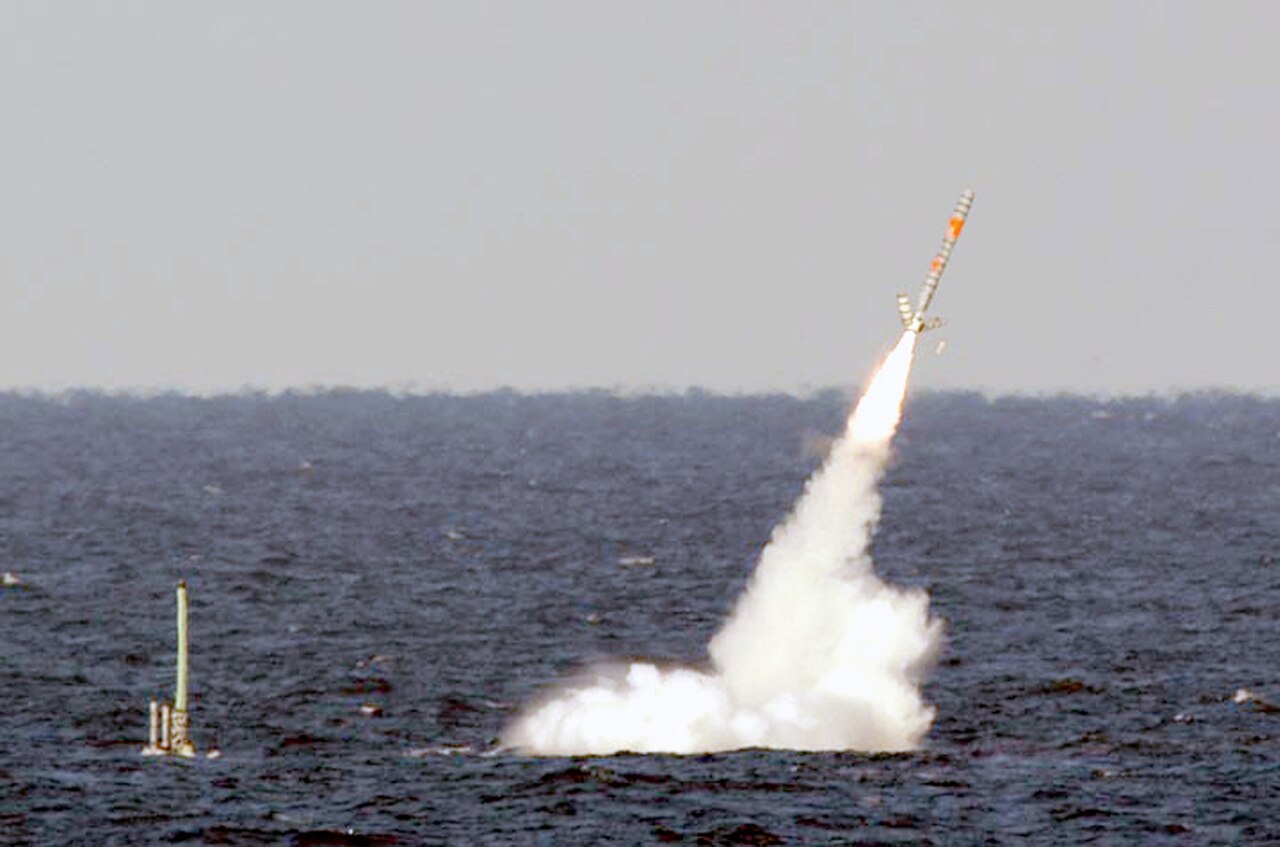
A metal additive manufacturer is now part of the team building a US Navy nuclear-armed cruise missile. On November 24, RTX's Raytheon announced it had received an Other Transactional Authority (OTA) agreement from the US Navy to advance development of the Nuclear-Armed Sea-Launched Cruise Missile, known as SLCM-N. Three outside companies are named as contributors: Anduril Rocket Motor Systems, Williams International and Divergent, the aerospace manufacturer whose production is built around additive manufacturing.
The release, datelined Tucson, gives no contract value and doesn't say what each partner will supply. Even so, Divergent's place on the list says something about where industrial 3D printing has ended up. For years it was the tool for brackets, prototypes and tooling. Now it shows up in the supplier roster of a strategic weapons program alongside a rocket motor house and a jet engine maker.
What Raytheon Actually Announced
The announcement is about a phase change, not a production order. According to Raytheon, its Advanced Technology team is moving SLCM-N out of early concept work and into a focused development phase. That phase has three stated goals: mature the design, integrate key subsystems, and prepare for future prototype demonstrations. In other words, there's no flying hardware yet, and the program is still working toward the point where prototypes get built and shown.
Raytheon frames the work around what it calls a "composable weapons" approach. Per the release, that approach uses mature, modular building blocks that can be integrated into new systems to reduce cycle time and accelerate missile development. The release doesn't go into more technical detail, but the idea is easy enough to follow: assemble a new weapon from proven, interchangeable pieces instead of designing every element from scratch. Colin Whelan, president of Advanced Technology at Raytheon, is quoted in the announcement, saying the company is applying its "proven design, integration and test expertise to rapidly field a highly reliable capability." The company also says it is significantly expanding its engineering workforce to support critical military programs.
The contracting vehicle is worth a note. An OTA isn't a conventional procurement contract. The Defense Department generally uses these agreements for prototyping and fast-moving development work, and they tend to make it easier to bring in companies outside the traditional prime-contractor pool. The release doesn't say the OTA format is the reason Divergent is involved. It does say Raytheon is expanding its industrial base to deliver capabilities quickly, and a mixed supplier list under an OTA fits that framing.
A Program With a Long Runway
TCT Magazine's report on the deal notes that SLCM-N has been in development since 2018. That makes the program roughly eight years old and still short of prototype demonstrations, which says a lot about how slowly weapons programs at this level of sensitivity move. This latest step, from concept to focused development, is where design decisions start to firm up. It's also where the supply chain starts to get locked in.
That timing matters to a company like Divergent. Getting onto a program while the design is still being matured gives a manufacturer a chance to shape parts around its own process instead of reverse-engineering legacy drawings built for machining or casting. For an additive house, that difference counts. The geometric freedom of printed parts pays off most when engineers design for it from the start.
Divergent's Defense Streak
The Raytheon agreement isn't Divergent's first move into defense. TCT places it as the latest deal in the defense sector, with partnerships already established with General Atomics Aeronautical Systems, AEVEX and Lockheed Martin. Taken together, those names span an aircraft maker, a defense contractor and one of the largest primes in the industry, and the SLCM-N work adds a nuclear-armed naval strike weapon to the list.
On the manufacturing side, TCT notes that Divergent announced its Monolith One additive manufacturing system earlier in 2026. The company's production operations are set to transition entirely onto its proprietary AM technology in the coming months and years. TCT also links to an interview with CEO Lukas Czinger, describing the company's plans to scale with a proprietary 12-laser AM system.
Twelve lasers is a production-scale number. Multi-laser powder bed fusion machines split a build plate among several beams, which raises throughput and makes larger parts practical within a reasonable build time. A manufacturer that commits its entire production to a single in-house platform is betting that the platform can handle volume, qualification and repeatability all at once. Defense customers will test that bet hard, because the documentation and process-control demands on flight hardware are severe.
What We Don't Know
The sources leave several obvious questions unanswered:
- Which parts? Neither Raytheon nor TCT says what Divergent will make for SLCM-N. Structural airframe parts, internal brackets and housings, and subsystem hardware are all plausible, but nothing has been confirmed.
- How much money? The release gives no value for the OTA, and nothing has been disclosed about Divergent's share.
- Which machine? TCT ties the news to Divergent's broader production plans and the Monolith One system, but the sources don't say whether SLCM-N hardware will be built on that platform.
- When? Raytheon says only that it is preparing for "future" prototype demonstrations, with no date.
Those gaps are normal for a defense announcement at this stage, and especially for a nuclear-related program. Readers should treat Divergent's role as confirmed participation in a development phase, not as a production supply contract.
What It Means for Makers
Most FilamentFeed readers won't be printing anything for a cruise missile. The story still shows where part of the additive industry is heading. Defense and aerospace production work is an increasingly visible customer for metal AM, and companies like Divergent are building their whole operations around printing as the primary manufacturing method rather than as a supplement to machining.
That could have downstream effects. Defense demand for production-grade, multi-laser systems can pay for development of process monitoring, qualification methods and design-for-AM practice. Historically, techniques proven in high-stakes industrial settings tend to inform software, materials and design approaches further down the market over time. The modular "composable" philosophy Raytheon describes also lines up reasonably well with how additive designers already think: discrete, optimized subassemblies whose geometry follows function.
There's an uncomfortable side too. The same technology the maker community uses to build tools, art and replacement parts is now explicitly part of nuclear weapons development. Whether that's reassuring evidence of the technology's maturity or a reason for unease is a call each reader will make. Either way, it's no longer hypothetical.
Bottom Line
Raytheon's SLCM-N agreement moves an eight-year-old program into focused development and names Divergent as one of three outside contributors. The commercial details (parts, dollars, dates) are still undisclosed. The direction is clear, though: additive manufacturing is being written into defense programs from the design phase onward, and Divergent's 12-laser production bet is aimed squarely at that market.
