
Amaero, which makes titanium and refractory metal powders for additive manufacturing, has finished its US listing. According to the company's final Form 424B4 prospectus filed with the SEC and dated October 14, 2026, Amaero is selling 4,705,883 shares of common stock at $4.25 each, for about $20 million in gross proceeds. The shares are approved for the Nasdaq Capital Market under the ticker AMRO. The company's CHESS Depositary Interests stay on the Australian Securities Exchange under 3DA. 3D Printing Industry reports that net proceeds come to about $15.7 million and that closing is expected on October 16. The same report says the company expects to need more capital in 2027.
So the IPO is done, but the money it brings in looks less like a growth fund and more like a bridge to the next raise.
The Deal Terms
The pricing was set close to where the stock already trades in Australia. The prospectus gives the last ASX price for the CDIs as A$0.155 on October 12, 2026. Each CDI represents one-fortieth of a common share, and the prospectus converts that price to about $4.33 per share. The US offering came in slightly below that, at $4.25. Baird and Lake Street are the joint bookrunners, with Baird taking 2,941,177 of the shares and Lake Street 1,764,706. Amaero files as an emerging growth company and a smaller reporting company, which lets it use the lighter disclosure and compliance rules US securities law allows for smaller and newer issuers.
The underwriters also have a 30-day option on another 705,882 shares, a "greenshoe" that covers over-allotments. 3D Printing Industry says that if the option is fully exercised, net proceeds would rise to about $18.5 million. At the IPO price, the outlet puts Amaero's implied equity value at about $121.3 million, based on 28,539,063 shares outstanding after the offering and assuming the option is not exercised. Insiders, including the CEO, CTO and CFO, held about 35.5% of the company before the deal.
What Amaero Actually Makes
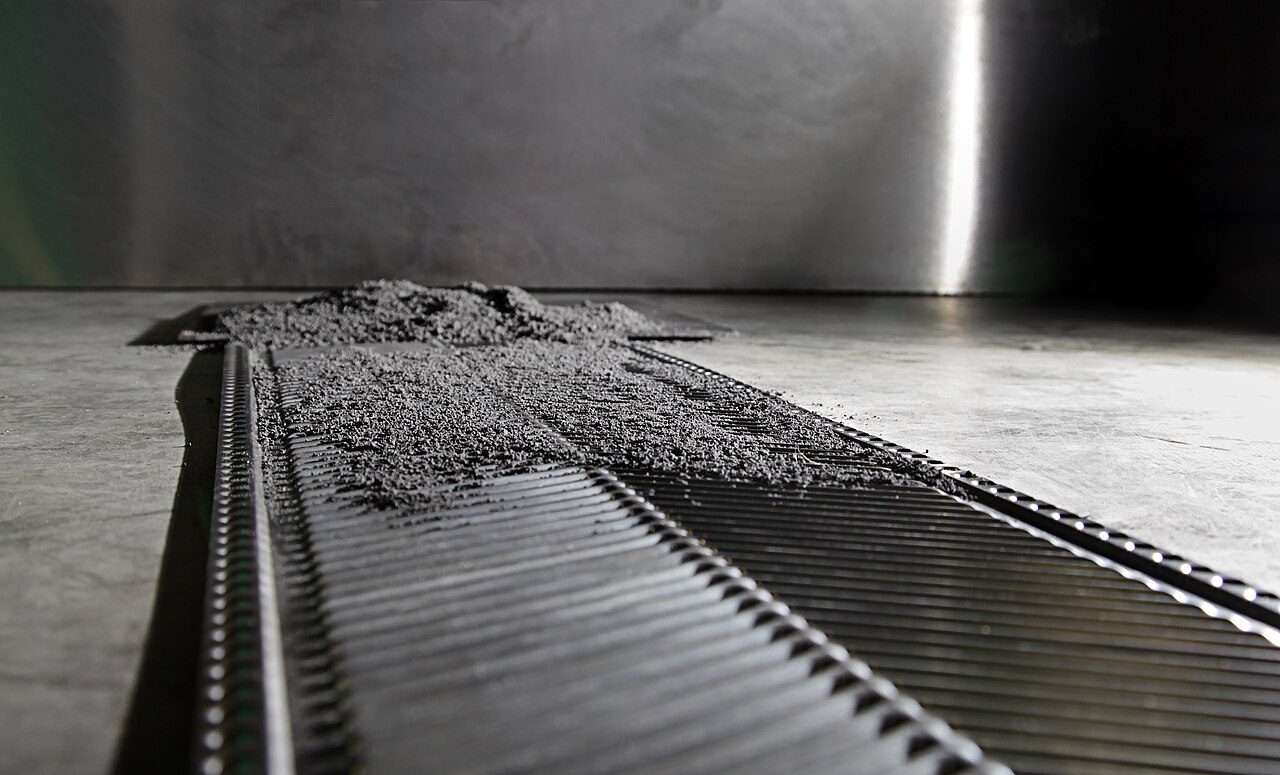
Amaero is a supplier to the people who run metal powder-bed and directed-energy machines. It does not make printers. Its plant in McDonald, Tennessee, runs three gas atomizers, and the prospectus says it has contracted for a fourth EIGA Premium atomizer and expects to commission it in June 2027. The company describes EIGA as a crucible-free gas atomization technology: because the molten metal does not touch other materials while melting, it helps minimize contamination and yields high-purity powder. Gas atomization breaks a molten metal stream into fine droplets that solidify into spherical powder, and the resulting powder is the feedstock that laser and electron-beam systems melt layer by layer.
The added atomizer is a significant step in capacity. 3D Printing Industry gives current annual nameplate capacity as 680 metric tons, with a maximum of 720 depending on product mix. With the fourth unit online, that rises to about 920 tonnes, with a maximum of 960. The same report notes that Amaero also makes large near-net-shape parts through powder metallurgy hot isostatic pressing, and lists niobium, tungsten, tantalum and molybdenum among its refractory powders.
Growing Revenue, Growing Losses
Revenue is rising quickly from a small base. The prospectus reports revenue of $1.3 million in fiscal 2024 and $6.3 million in 2025. In the first half of 2026 alone, revenue reached $7.4 million, already more than the whole of the prior year. Preliminary, unaudited third-quarter 2026 revenue, according to 3D Printing Industry, falls between $3.96 million and $4.12 million.
Losses are growing too. The company lost $18.4 million in 2025 and $13.4 million in the first half of 2026. Its accumulated deficit stood at $75.5 million on June 30, 2026, and its total debt on that date was $19.6 million, all of it loans under an EXIM Bank credit agreement.
The cash figures explain why the IPO happened when it did. Amaero ended 2025 with $31.9 million in cash. By June 30 that had fallen to $13.6 million, and by the end of September it was about $4.95 million, according to 3D Printing Industry. Set against those numbers, the roughly $15.7 million in net proceeds buys time rather than a long runway. The trade publication reports that management expects the proceeds plus existing cash to fund operating expenses and capital spending into the second quarter of 2027, and that the company warns it could need capital sooner than that. It also reports that going-concern doubt will persist even after the IPO closes. That fits with the company's own expectation that it will need to raise more money in 2027.
The Fire
The prospectus also discloses a flash fire at the facility in May 2026, which injured two employees; it also mentions two other fires that caused no injuries or material damage. 3D Printing Industry reports that the May fire paused titanium production for six weeks and is expected to cost roughly $0.8 million in related expenses, only part of which insurance is expected to cover. A plant with three atomizers has limited spare capacity, so a six-week stop on its main product shows up directly in output. Investors buying AMRO are being asked to accept that operating risk along with the financial one.
Bottom Line for Makers
The link to a desktop FDM bench is indirect. Most FilamentFeed readers will never buy Amaero powder, and nobody is loading titanium into a hobbyist machine. Still, metal AM's supply chain affects things makers do use. Service bureaus that print titanium brackets, drone parts and custom tooling buy powder from companies like this one, and powder price and availability plausibly feed into the quotes those bureaus give for one-off metal parts.
Read that way, the Amaero filing is a frank look at what it costs to build domestic metal powder capacity. Revenue is real and growing quickly. Each new atomizer is a large investment. Even after a public listing, the balance sheet will need refilling within about a year. Anyone interested in low-volume metal printing should treat this as a test of whether specialty powder suppliers can grow fast enough to bring prices down before they run out of money.
Watch three things: whether the underwriters exercise the greenshoe, which would add about $2.8 million in net proceeds; whether the fourth atomizer arrives on its June 2027 schedule; and when the 2027 raise comes and on what terms. A deal priced at a discount would suggest investors are losing patience with the growth story. A smooth raise would suggest the capacity build is working.
