
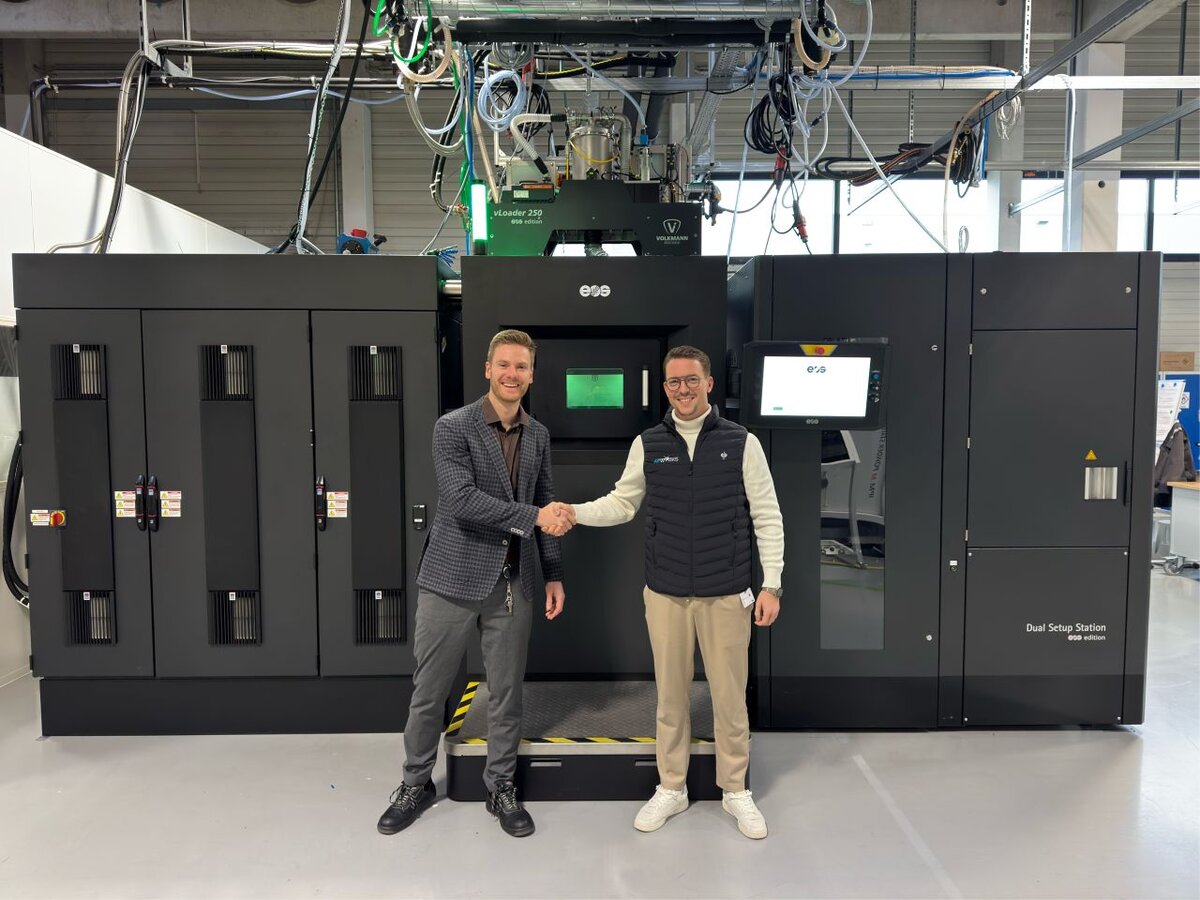
APWORKS, the Airbus spin-off based in Taufkirchen near Munich, is adding a six-laser EOS M4 ONYX to its metal additive manufacturing floor, with installation planned for the second quarter of 2027, VoxelMatters reports. The company says the purchase is about titanium capacity. Its stated reasons are long-term contracts, growth in serial production, and rising demand from defense customers. Those are not the reasons a shop gives when it wants another machine for prototypes. They are what a contract manufacturer says when its order book has outgrown its build plates.
The addition is small, a single system, but it shows clearly where industrial powder bed fusion is heading in 2026: more lasers, bigger platforms, and a sales pitch built on cost per part rather than on what geometry the machine can produce.
Who APWORKS Is
APWORKS was founded in 2013 as a spin-off from Airbus and has been part of the aerostructures supplier Premium Aerotec since 2018. It runs EN9100-certified series production in two main materials: titanium and Scalmalloy, the high-strength aluminum alloy it developed with Airbus specifically for 3D printing. Its customers span aerospace, defense, motorsport and other high-performance industries. EN9100 is the aerospace quality-management standard, and holding it signals documented, audited process control. This is not a bureau printing one-off brackets for trade show booths.
That context matters when reading the purchase. In a certified serial environment, a new machine is not just switched on and loaded with parts. Processes have to be qualified, and parameter sets have to be locked down and validated against the customer's requirements. A machine whose launch processes already include Ti64, the titanium alloy at the center of the stated capacity goal, is far easier to justify than one that needs a new materials program built from scratch.
The Machine, by the Numbers
EOS introduced the M4 ONYX at Formnext 2025. According to the EOS product page, the headline specifications are:
- Build volume: 450 x 450 x 400 mm, including the build platform. EOS advertises this as 25% more build volume and calls it the largest in its portfolio.
- Lasers: six 400 W ytterbium fiber lasers, each with its own F-theta lens and high-speed scanner.
- Scan speed: up to 7.0 m/s, with a focus diameter of roughly 90 microns.
- Power draw: 45.0 kW maximum, 29.0 kW typical.
- Launch processes: Ti64 with a new 60-micron parameter set, and IN718, are the validated processes at launch.
EOS's productivity claims are the figures APWORKS is effectively buying: up to 50% higher throughput, up to 30% lower part costs (EOS's footnote says this excludes powder), and over 90% powder recovery. VoxelMatters adds that job changeovers take under 30 minutes and that the RFS Pro filtration system cuts hazardous waste by up to 90%. There is also an FLX variant that replaces the six standard lasers with four 1 kW beam-shaping lasers.
Why six lasers and a 60-micron layer go together
Throughput in laser powder bed fusion comes down to a simple equation: how much melt area you can scan per unit time, multiplied by layer thickness, less the time lost to recoating. Six independent scanners divide each layer into regions processed in parallel, which addresses the first term. A 60-micron Ti64 parameter set addresses the second. Thicker layers mean fewer recoats per millimeter of build height. EOS says the Ti64 60-micron process delivers faster build rates, improved microstructure, reduced porosity and better surface finish, so the speed gain is not presented as a quality sacrifice.
For aerospace and defense brackets, housings and structural nodes, faster builds matter because those parts' economics are dominated by machine hours. A part that spends less time on the platform costs less, which is likely where much of EOS's 30% part-cost figure comes from. That figure is a manufacturer's claim, not an independent benchmark, and real results will depend on part geometry, nesting density and how much of the platform a given job fills.
The parts nobody puts in the brochure photo
Two of the less glamorous specs deserve as much attention as the laser count. Changeovers under 30 minutes matter because a multi-laser machine sitting idle between jobs wastes the capital that justified buying it. Powder recovery above 90% matters because titanium powder is expensive, and every kilogram that goes to waste instead of back into the system shows up in the part price.
The filtration claim is the third piece. Metal PBF filters capture condensate and fine particulate that must be handled and disposed of as hazardous waste. A system that reduces that volume by up to 90% lowers both a cost line and an operational headache.
Reading the Defense Signal
APWORKS explicitly names defense demand among its reasons for the purchase, alongside long-term contracts and serial production growth. The company has not said, at least in the reporting available, which programs or parts the new capacity will serve, so any speculation about specific platforms would be just that. VoxelMatters notes that titanium AM capacity in Europe has been expanding as defense suppliers seek shorter lead times for qualified metal components, and describes APWORKS as among the service providers betting on serial titanium volumes rather than one-off parts.
The Q2 2027 timeline looks realistic. A machine installed in the spring of 2027 still has to pass through qualification before it produces certified serial parts. The delay between a press release and a flying part in this industry is measured in quarters, not weeks.
What It Means for Makers
Nobody reading this is putting a 45 kW, six-laser titanium system in the garage. But industrial machines like this one tend to shape what happens further down the market, in three ways worth watching.
First, the competition in metal AM is increasingly about economics rather than capability. The headline numbers EOS chose to promote are throughput, part cost and powder recovery, not resolution or exotic geometry. Expect service bureaus to talk about price per part more and about design freedom less, and expect quotes for printed titanium to be compared directly against machined billet.
Second, more industrial capacity in certified titanium could, over time, ease availability for less demanding work. If you are a maker who outsources metal parts, such as a custom bike component, a drone frame node or a replacement part for an old machine, the long-term trend in available capacity may run in your favor, though no single machine addition changes the market on its own.
Third, the 60-micron Ti64 process is a reminder that layer height is a business decision, not just a quality setting. It resembles the trade-off FDM users make when they choose a 0.28 mm draft profile over a 0.12 mm fine one: fewer layers and faster prints. On an FDM printer that usually costs surface quality, whereas EOS claims its thicker-layer titanium set does not. The scale is very different, but the economic reasoning is the same.
Bottom Line
APWORKS is buying one machine, but it is buying it for clear reasons: contracted serial work, defense demand, and a platform whose validated launch materials include Ti64. EOS's specifications for the M4 ONYX are strong on paper. The real test will come once the system is qualified and running production jobs in Taufkirchen, sometime after its Q2 2027 arrival.
