
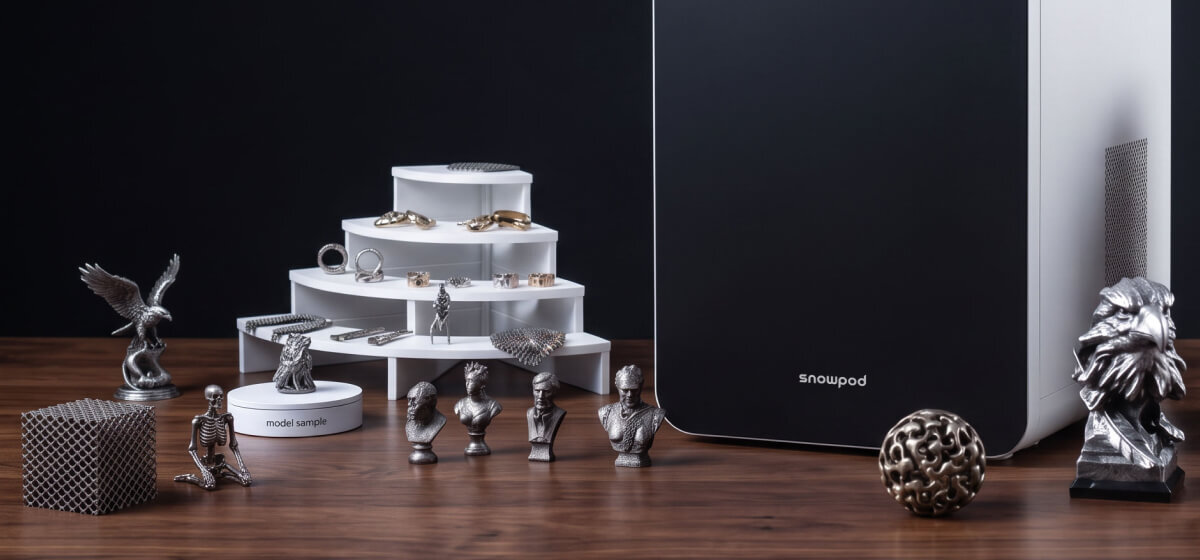
SnowX has been working toward a desktop metal printer for some time, and at Formnext 2026 in Frankfurt the company showed the SnowPod running, named two software partners and set a date. In an interview with 3Dnatives, conducted at the SnowX booth with founder and CEO Fangda Xu, the outlet reported that SnowPod, a desktop selective laser melting (SLM) printer for 316L stainless steel, is set to launch on Kickstarter on December 8. The SnowPod Printer Kit is listed at $4,999 for early reservations, against a manufacturer's suggested retail price of $9,299. SnowX also announced a partnership with Autodesk around Fusion, aimed at a more connected workflow with the printer, and a separate collaboration with Meshy AI for AI-assisted 3D creation.
The schedule is now specific. According to SnowX's official site, the campaign opens at 10 a.m. ET on December 8, and a $50 deposit holds a VIP price "starting at" $4,999. That wording matters. "Starting at" usually means the cheapest configuration or the earliest backer tier, and the finer details of what the kit includes have not been published yet.
The Problem SnowX Is Trying to Solve
Powder-bed metal printing has stayed in factories for practical reasons. As the 3Dnatives piece explains, conventional SLM has traditionally demanded loose powder that trained operators pour, sieve and recover by hand, an inert gas atmosphere, and a controlled environment to keep it all in check. Machine prices often start around $100,000. Together, those requirements explain why most individual creators and small studios have outsourced their metal parts rather than printing them.
SnowPod is SnowX's attempt to address those barriers rather than just shrinking an industrial machine. 3Dnatives describes the company's answer as rethinking the whole workflow around precision, safety and usability, which makes containment and automation as important to the pitch as the optics.
What's Inside the Box
Containment starts with the material. SnowPod uses 316L stainless steel powder supplied in sealed cartridges, so the user doesn't scoop or pour loose powder. Sieving and recovery are built into the machine, and SnowX's site says a built-in recovery cartridge captures unprinted powder after every cycle, claiming a recovery rate of 90 percent or more under laboratory conditions. The site also describes a transfer box that keeps the part enclosed during retrieval, so the user never reaches in bare-handed.
Filtration is the second layer. According to 3Dnatives, SnowPod uses multi-stage filtration with real-time PM2.5 monitoring. SnowX's site specifies dual HEPA 13/14 filtration rated at 99.995 percent efficiency for particles of 0.3 microns and larger, plus a "PM2.5 InterLock." Per the site, continuous sensors track PM2.5, air quality, temperature and humidity, and if a reading drifts outside safe limits a hardware interlock pauses the printer automatically. That ties the particulate monitoring to machine operation rather than just a display, which is the right design instinct for a machine meant to sit in rooms people work in. A built-in camera adds what the site calls AI detection, covering first-layer, real-time print and unexpected-object detection.
On the optical side, SnowPod uses a 40-micron laser spot. 3Dnatives notes that this is roughly half the size common in industrial machines. SnowX lists a layer thickness of 30 to 60 microns and a dimensional accuracy of 0.05 mm. That accuracy figure comes from SnowX's own internal test of a 12 x 12 x 12 mm lattice, so it is a vendor benchmark on a small, favorable geometry, not an independent measurement across a range of part sizes.
The build volume is 80 x 80 x 100 mm, inside a machine with a 360 x 360 mm footprint. That is a small envelope, and it should set expectations. SnowX points to jewelry, tooling, hardware and intricate components. This is not a machine for anything you'd measure in hand-spans.
Supports You Can Snap Off
One of the less obvious problems with metal powder-bed printing is what happens after the build. Parts come off the plate with support structures that have to be removed, and for a maker without a machine shop, that post-processing can be a bigger hurdle than the print itself.
SnowX's answer is its SnowPath slicer, which generates thin, Origami-style supports that 3Dnatives describes as designed to be torn away by hand. SnowX's site is a little more cautious, saying the supports break away by basic hand tools such as pliers, and that the specific tools required may vary with part geometry and support structure. If that works across a reasonable range of geometries, it is one of the more important parts of the pitch, because it would remove a step that otherwise sends metal parts back to a shop with heavy tools.
The Software Partnerships
The Autodesk partnership is the more significant of the two announcements for engineering users. Per 3Dnatives, users can design a part in Autodesk Fusion, set its manufacturing parameters and send them directly to SnowPod, with the aim of reducing the steps between design and a finished metal part. SnowX hasn't published the specifics of the integration, such as which Fusion tiers support it or how much of the build setup happens inside Fusion and how much in SnowPath.
The Meshy AI collaboration is aimed at a different user: someone who wants to generate a shape rather than engineer one. 3Dnatives describes it only as extending the software ecosystem toward AI-assisted 3D creation, and how generated models will be checked for the constraints of metal printing, such as wall thickness, overhangs and support access, remains an open question.
What It Means for Makers
The headline number is the price. Even at the $9,299 MSRP, SnowPod would sit far below the roughly $100,000 where 3Dnatives says machine prices often start for conventional SLM. At the $4,999 early reservation price it lands in a range where a small shop, a serious hobbyist or a school makerspace could plausibly consider owning metal powder-bed capability instead of sending parts to a service bureau.
The caveats are the usual ones for crowdfunded hardware, plus a few specific to metal. SnowX's own site warns that renderings may differ from the final production design, so the machine backers receive may not look exactly like the marketing images. The accuracy figure is an internal test. The site lists 316L and 17-4PH stainless steel as supported, with other alloys still in testing, and says reactive powders such as titanium and aluminum are not supported, so material choice is narrow. The site shows per-part cost estimates, but how those compare with the real price of powder cartridges is something backers will have to check. The build volume is small. The site also says SnowX is contacting third-party bodies to pursue powder safety certification for the full printing workflow, so that certification is not yet in hand.
Still, the shape of the product is more convincing than a bare spec sheet would be. SnowX has focused on the parts of metal printing that keep it out of non-industrial spaces: powder exposure, air quality and support removal. The December 8 campaign should reveal how much of that holds up once tier details, consumable pricing and delivery timelines are public. Anyone considering the $50 deposit should wait for those details before committing the full amount.
