
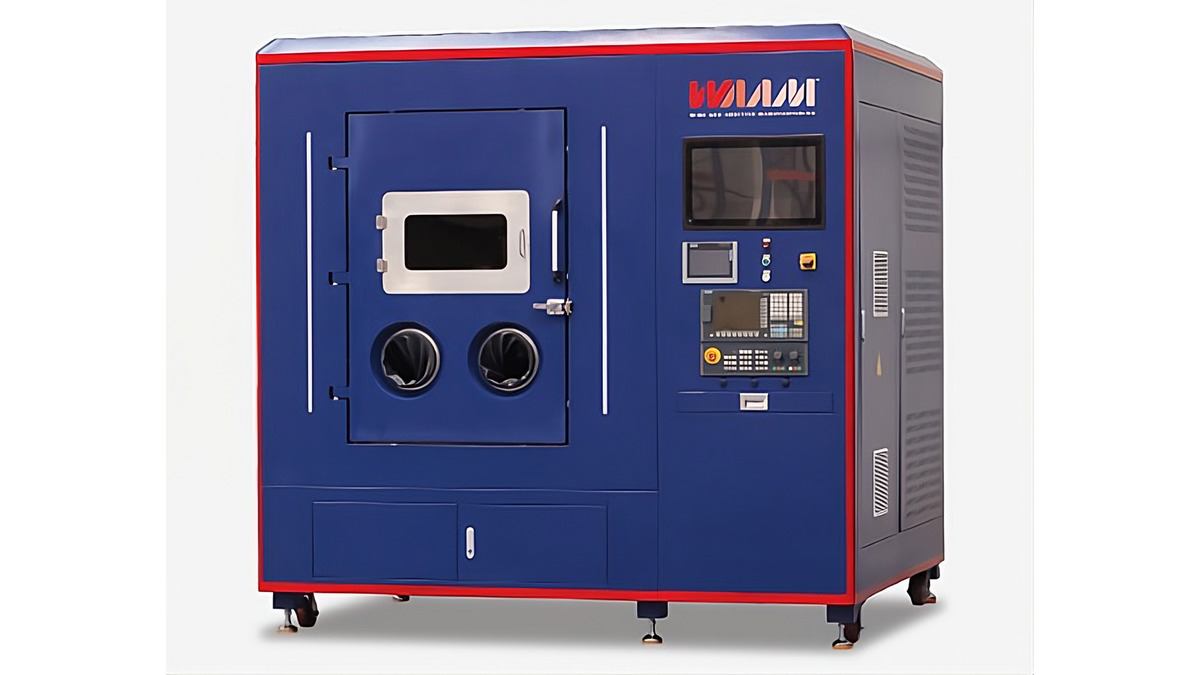
WAAM3D, the wire-arc additive manufacturing company based in Milton Keynes, has renamed its smallest machine the MiniWAAM/DW and made dual-wire feeding standard equipment. 3D Printing Industry reported the upgrade ahead of Formnext 2026. The pitch is simple: two metals in one build, either combined in a single component or alloyed as the part is deposited. The manufacturer's MiniWAAM product page already lists the dual-wire Plasma Transferred Arc (PTA) process and says the machine "ships natively with multi-material capabilities to produce functionally graded components or new alloys in-situ." One caveat on sourcing: we confirmed the hardware and specifications against WAAM3D's own page, but we read the details of the DW announcement only through 3D Printing Industry's coverage.
From Option to Default
The two wire feeders are not new. According to 3D Printing Industry, the MiniWAAM launched at TCT 3Sixty in 2024 with two independently controlled wire feeders, a design CEO Filomeno Martina highlighted at the time. What changes with the /DW name is that dual-wire feeding is now fitted as standard hardware, and WAAM3D says the upgrade gives the small machine capabilities normally found on its bigger systems.
That matters because of how the two feeds can be used. With a single wire, every bead in a part is the same material. With two independently controlled feeds, the machine can combine two different metals in one component or alloy them as the part is deposited. At the 2024 launch, Martina also explained that mixing materials at a controlled rate in the melt pool can create new alloys not available as a single wire. The result is what WAAM3D calls functionally graded components: parts whose composition changes from one region to the next instead of meeting at a sharp bonded seam.
The Examples WAAM3D Is Leading With
The company's two showcase pairings, as described by 3D Printing Industry, point to where it expects buyers to come from.
Marine: steel plus nickel-aluminum bronze. According to WAAM3D, the pairing can give marine components high strength and high resistance to cavitation damage, the damage caused when vapor bubbles collapse against a surface in moving water. Nickel-aluminum bronze also appeared in a multi-material structure displayed at the 2024 launch, where it was combined with 316L.
Aerospace, energy and nuclear: low-carbon steel clad with Invar. Invar provides dimensional stability, which WAAM3D ties to applications where parts go through significant temperature fluctuations. Cladding it onto low-carbon steel is aimed at parts that need both properties. WAAM3D also shared images of a functionally graded steel-Invar component, with a cross-section and a dilution diagram showing the transition between the two materials. For a graded joint, how that transition behaves is the thing to scrutinize.
The Machine Itself
The MiniWAAM is the small end of WAAM3D's range, but "mini" is relative. The specifications on the manufacturer's page:
- Print envelope: 600 x 600 x 500 mm
- Machine footprint: 2400 x 2100 x 2300 mm, with an inner chamber of 1600 x 1500 x 1600 mm
- Accuracy: ±0.1 mm
- Motion: 4-axis CNC, made up of a 3-axis overhead system and a rotational table rated for a 60 kg payload
- Atmosphere: automatic inert-gas chamber purging and atmosphere maintenance, at less than 50 ppm oxygen
- Sensing: pyrometers, cameras and laser interferometry on the PTA end-effector
- Control and software: Siemens PLC, with WAAM3D's WAAMPlanner and WAAMCtrl software
- Facilities: on-board fume extraction and filtration, in a turnkey standalone system that can be transported and redeployed
For comparison, 3D Printing Industry notes that WAAM3D's RoboWAAM Plus offers a 2 x 2 x 2 m build area and handles parts up to 3 tonnes. The RoboWAAM and RoboWAAM Plus run the patented GMAX process, which deposits up to 15 kg/hr and works with steel, nickel, aluminum and copper alloys. A plasma-based alternative, PMAX, is available for more challenging materials including titanium, copper, high-strength steels and refractory metals. The MiniWAAM uses the dual-wire PTA process.
The sensor package deserves attention. Wire-arc deposition puts a lot of heat into the part, and WAAM3D says the MiniWAAM packs the same monitoring and control features available on its RoboWAAM Advanced, to give users confidence in part quality. Combined with an oxygen-controlled chamber, that is the kind of toolkit a two-alloy build needs to be repeatable instead of a one-off, though independent data would be needed to say how well it does.
Speed to First Part
WAAM3D is also selling turnaround. Marketing manager Ilhan Yigit Basar told 3D Printing Industry that "it can be just a matter of hours from completing the CAD design to producing the first part." WAAMPlanner and WAAMCtrl account for multi-material requirements and can predict build rate, and the company runs an evaluation service in which users submit a CAD file and receive an estimate of production time per part. WAAM3D also makes parts on contract at its UK production facility. That gives prospective buyers a way to test a material pairing before committing to a machine.
What It Means for Makers
No hobbyist is putting a 2.4-meter, Siemens-controlled, inert-chamber plasma system in a garage. The MiniWAAM is industrial equipment. Its likely buyers are fabrication shops, research labs, universities and companies in the marine, energy and aerospace supply chains. Even so, the announcement is worth following for anyone who works in metal or follows where additive manufacturing is heading.
First, multi-material deposition is moving down-market. Graded and clad metal parts have mostly been a large-machine capability. Making dual-wire feeding standard on a machine with a 0.6 m envelope lowers the scale at which engineers can experiment with alloy placement, and a dilution diagram turns a marketing claim into something measurable.
Second, the business model points to access without ownership. A CAD-based time estimate plus a contract manufacturing service means a small engineering team or a well-funded maker space could, in principle, try a steel-bronze or steel-Invar part without buying hardware. Whether that is affordable depends on pricing, which WAAM3D has not published in the material we reviewed.
Third, the design thinking carries over. Filament users already work with multi-material printing: rigid cores with flexible skins, or soluble supports. The MiniWAAM/DW applies the same logic to metal. The questions become where each property is needed and how sharp or gradual the transition should be, rather than which single material is good enough everywhere.
Bottom Line
The MiniWAAM/DW does not introduce new hardware so much as recommit to an existing design. Two independently controlled wire feeders have been part of the machine since its 2024 launch. Now they are standard. With a 600 x 600 x 500 mm envelope, ±0.1 mm accuracy, an oxygen-controlled chamber and in-process sensing, WAAM3D is betting that the compact end of the metal market wants parts that are more than one alloy. Independent data on build quality will matter more than launch-week examples. For now, the steel-bronze and steel-Invar parts give a concrete picture of what the company thinks a two-wire machine is for.
