
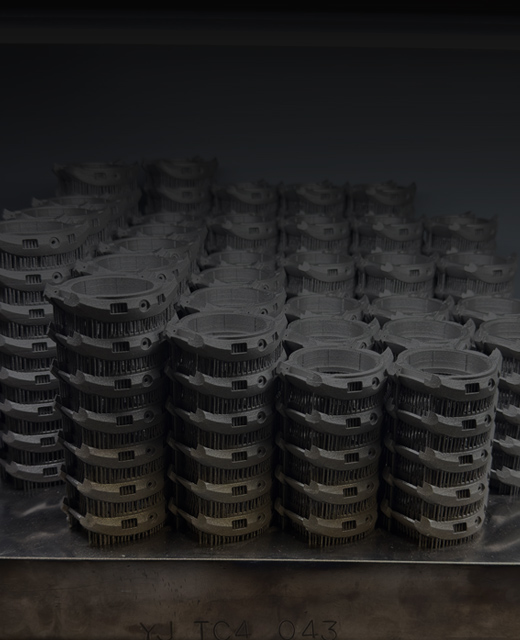
Hangzhou-based Eplus3D has introduced the EP-M550L, a large-format metal powder bed fusion system that the company presents less as a standalone printer than as a "Production-Ready Automation Line." According to the Eplus3D product page, the machine offers a 550 x 550 x 600 mm build volume, can be configured with 8, 9, 12 or 16 fiber lasers, and has a theoretical build rate of up to 560 cm3/h. The headline laser count will get the attention, but the more consequential engineering sits outside the build chamber: automated powder suction, sieving and recycling under inert gas, and a build cylinder that travels as its own module so the chamber can be reloaded without being opened.
The system was introduced ahead of Formnext 2026 in Frankfurt, where Eplus3D planned to exhibit it at booth 12.0-E101, as 3D Printing Industry reported. Eplus3D, which has facilities in Beijing, Hangzhou and Stuttgart, says it built China's first powder bed fusion machine in 1993, so this is not a newcomer trying to buy its way into the large-format segment with a spec sheet.
The spec sheet, read carefully
Each laser in the standard configuration is a 500 W fiber source, with 700 W and 1000 W options listed. Spot size runs from 70 to 120 µm, maximum scan speed is 8 m/s, and layer thickness is adjustable from 20 to 120 µm. The chamber is held at an oxygen content of 100 ppm or less, using argon or nitrogen, and the machine runs on 380 V power.
Two of those numbers deserve context. First, the 560 cm3/h figure is explicitly theoretical. Build rates in laser powder bed fusion are usually calculated from laser count, layer thickness and scan parameters under ideal conditions; real throughput on a given part depends on geometry, how evenly the scan work can be divided among lasers, recoating time and the parameter set qualified for the material. Treat it as a ceiling, not a quote.
Second, the range of laser counts matters as much as the maximum. Offering 8, 9, 12 and 16 laser configurations on the same 550 x 550 mm platform suggests Eplus3D expects buyers to size the optics to their workload and budget rather than defaulting to the top configuration. The wide layer-thickness window points the same way: thin layers for fine features, thick layers when speed on bulkier parts matters more than surface finish.
The listed material families are broad: titanium, aluminum, nickel alloys, maraging steel, stainless steel, cobalt-chrome and copper alloys. Eplus3D also describes melt pool and powder bed monitoring, the in-process sensing that production users increasingly expect when they need a record of how each layer was built.
Why the powder station is the real story
Anyone who has worked around a metal PBF machine knows that the printing is only part of the job. Unloading a build, depowdering, sieving and returning powder to the machine is labor-intensive, messy and, with reactive powders such as titanium and aluminum, a genuine safety and quality concern. Every time the chamber is opened, powder is exposed to air and an operator has to handle it.
The EP-M550L's modular design separates the print module from a powder recovery station. The build cylinder is swapped as an independent module, which Eplus3D says enables closed-chamber reloading. Powder suction, sieving and recycling are automated, and the company says the full process is kept under an inert atmosphere. The intent, as the company describes it, is that a build cylinder can be exchanged without the operator breaking the protective environment.
That separation also changes the utilization math. If depowdering and powder conditioning happen at a separate station, the print module can, in principle, start its next job while the previous build is still being processed. Eplus3D itself points to multi-cylinder continuous operation as a way to maximize overall equipment effectiveness. On a large, multi-laser machine whose cost has to be spread across as many productive hours as possible, reducing idle time between builds is arguably worth as much as adding another laser.
Designed for the lights-out factory
Eplus3D says the EP-M550L builds on the automation architecture of its EP-M300L, and it extends that approach outward. The product page describes integration with automated guided vehicles (AGVs), robotics and manufacturing execution systems (MES), with the stated goal of a "Lights-Out Factory." 3D Printing Industry notes that AGVs and the MES connection can be added depending on the configuration.
The target markets reflect that ambition. Eplus3D lists aerospace, mold and tooling, 3C electronics and precision manufacturing. Its own example applications are telling: watch cases and mobile phone hinges. Those are not one-off aerospace brackets; they are consumer-electronics parts made in volume, where a machine has to behave like any other piece of automated production equipment rather than a lab instrument tended by specialists.
What hasn't been disclosed
Despite a trade-press headline promising pricing, Eplus3D has not publicly disclosed what the EP-M550L costs or when it will ship. The sources also give no measured build rates for specific parts or materials, and no figures on how much operator time the automated powder handling actually saves in a production setting. Those are the numbers that will determine whether the line delivers on its pitch, and buyers will need them from Eplus3D directly.
What It Means for Makers
Let's be direct: nobody is putting a 380 V, argon-fed, 16-laser metal printer in a garage shop. The EP-M550L is industrial capital equipment, and the people buying it will be contract manufacturers, tooling shops and electronics suppliers.
But the machine is still worth paying attention to, for a few reasons. If you order metal parts from a service bureau, systems like this are what shape your quotes and lead times. Larger build plates and more lasers mean more parts per build, and automated powder handling cuts the labor that often dominates the cost of small metal parts. Over time, that is the kind of change that makes printed titanium or stainless parts more accessible to small teams and independent designers.
It is also a useful signal about where the industry's effort is going. The competitive frontier in metal PBF is increasingly less about the printer and more about the workflow around it: powder logistics, inert handling, part transfer and factory software. Makers who have watched desktop FDM evolve toward automatic plate changing, filament management and print farms will recognize the pattern. The same pressure to remove human hands from the repetitive parts of the process is now reshaping the top end of the market.
Until Eplus3D publishes pricing, delivery dates and real-world throughput data, the EP-M550L is best read as a statement of direction: a big, configurable metal platform built from the start to be part of an automated line.
