
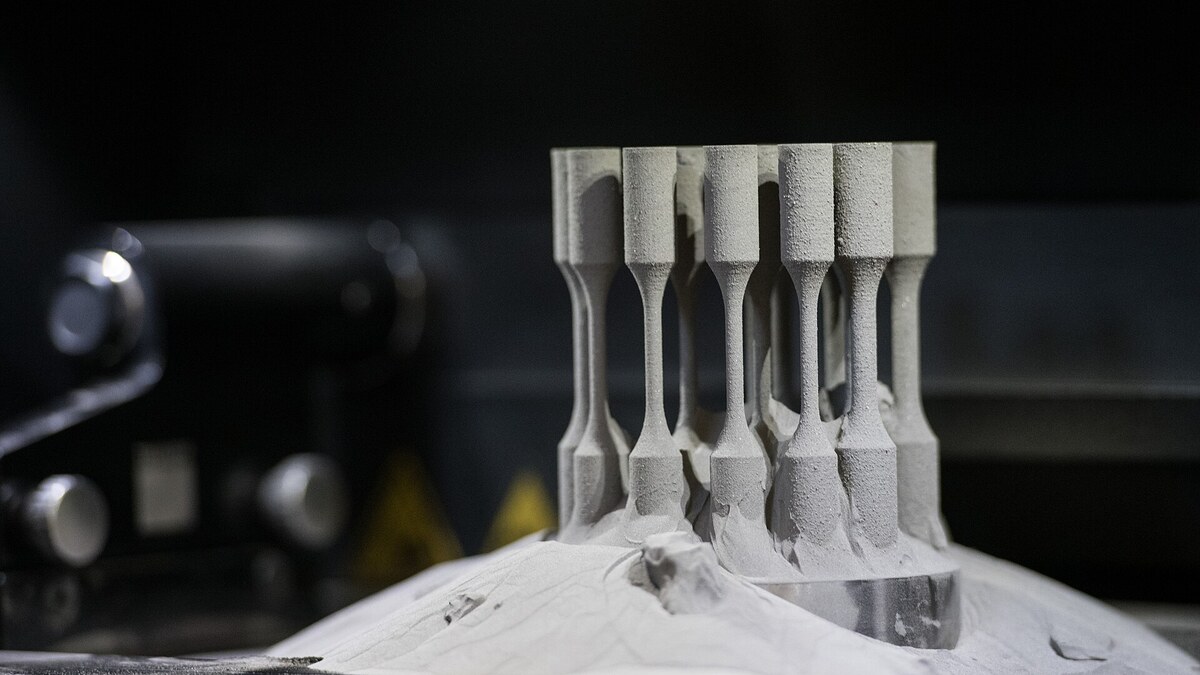
For most of the last decade, the headline number in metal laser powder bed fusion has been laser count. More beams covering more of the build plate means more parts per hour, and machine makers have competed hard on that axis. A demonstration planned for Formnext 2026 points at a different number. According to VoxelMatters, ATLIX and DHR Engineering will show a robotic cell built around the ATLIX xBUILD 3000 that takes over the powder and cylinder handling between builds, with the cell designed for up to 98% machine utilization.
The two companies are clear that this is not a product. VoxelMatters reports that the cell is a concept demonstration and the first result of the ATLIX and DHR collaboration, meant to start discussions with manufacturers rather than to take orders. That matters for how to read the 98% figure: it is a design target for the cell, not a measured result from a production floor.
The Machine at the Center
The robot cell only makes sense once you look at the printer it serves. ATLIX's xBUILD 3000 product page describes it as an industrial additive manufacturing system with full-field multilaser capability, and VoxelMatters calls it an LPBF system built for series production. VoxelMatters puts the build volume at 300 x 300 x 400 mm and says the machine runs up to two 700 W lasers, each able to reach the entire build plate rather than being restricted to its own zone.
Full-field coverage is useful for throughput, since the control software can send either laser to whatever needs exposing, but it creates a calibration problem. When two beams can melt the same region, any offset between them can show up as a seam or a dimensional deviation where their scan areas meet. ATLIX handles this with what it calls Automatic Multilaser Alignment (AMA). The product page says the system checks alignment every two layers with 40 µm accuracy, and VoxelMatters reports the same figure. The page also lists Melt Pool Monitoring, Powder Bed Monitoring and a closed inert powder circuit.
The closed powder circuit matters most for the automation story. According to the product page, the closed cycle with an integrated conveyor and a dedicated sieving station enables inert powder handling through a glovebox, preserving powder properties and preventing oxygen or moisture absorption. A machine already designed to keep powder sealed off from air is a natural starting point for handing that handling to a robot.
What the Robot Actually Does
The parts of LPBF that robots are being asked to take over are worth spelling out, because they are not the glamorous parts. The lasers do their job without supervision. The trouble comes between builds, when the machine needs feeding and emptying.
VoxelMatters lists four tasks for the DHR-built cell. An industrial robot loads and unloads work cylinders, exchanges supply cylinders, transfers recovery containers, and refills powder at the sieving station. The report says it works with a custom lid system inside the printer, so the cell can move from one job to the next with no operator involvement.
Put together, those tasks cover many of the manual touchpoints that keep a powder bed machine running from one job to the next. In a conventional setup, an operator has to be on hand when a build finishes to swap cylinders, handle powder and get the next job started. If a build finishes in the middle of the night, the machine usually sits idle until someone arrives. That idle time is what the 98% target is aimed at. VoxelMatters says the largest gains are expected in high-mix, low-volume production, and adds that taking operators out of powder handling improves safety.
VoxelMatters also describes the cell as modular, so that it can grow from a single automated printer to a production line with several machines and a post-processing station. The report does not detail how the modules are divided or which configurations are planned. Those questions are presumably what the Formnext showing is meant to raise with customers, and visitors will see the automation running at the booth.
Why Utilization Is the New Battleground
Faster machines have a catch. VoxelMatters notes that multilaser systems have made metal AM machines faster, so cylinder changes, powder handling and job preparation now limit how much a machine can produce. As exposure time per build shrinks, that fixed overhead becomes a larger share of the total cycle. A shop that doubles its laser throughput without changing anything else will find a growing fraction of its expensive machine's day spent waiting for a person.
Labor makes it worse. The report says these tasks need skilled AM staff, who are hard to find. A cell that handles the repetitive changeover work leaves those people free for higher-value work, which the report names as the goal, instead of carrying containers.
Pairing a printer maker with an automation specialist reflects that split. ATLIX brings a machine with alignment checking and melt pool monitoring, which should matter when nobody is standing at the window watching a build. DHR Engineering brings the robotic handling. The sources we read do not say how responsibilities between the two will be divided if the concept moves forward.
What It Means for Makers
Nobody reading FilamentFeed is going to put a robot-tended LPBF cell in a garage. The relevance is indirect, but it is real.
First, it shows where industrial additive manufacturing is spending its engineering effort. The hard problems are shifting from "can we print this part" to "can we keep the machine printing." That is the same problem desktop users meet in miniature with print farms, automatic plate ejection and filament runout handling: the printer is rarely the bottleneck, but the human who has to clear it often is.
Second, for makers who send metal parts out to service bureaus, utilization drives price. A machine that sits idle for long stretches has to recover its cost from fewer parts. If cells like this one turn into products and actually get close to their utilization targets, the result over time could be steadier lead times and better per-part economics from the shops that install them.
Third, keep the caveats in view. This is a concept, the 98% figure is a design goal, and the coverage so far rests on one trade-press report plus ATLIX's own product page. Neither source we read gives pricing, availability, or measured throughput gains. ATLIX's and DHR's own announcement was not available to us, so details may change once the companies present the cell at Formnext.
Bottom Line
The ATLIX and DHR cell is a bet that the next big gain in metal powder bed fusion will come from removing the person who has to be there between builds, not from adding another laser. The xBUILD 3000 already has a closed powder circuit and in-process monitoring, which are the kind of features automation of this sort builds on. Whether the robotic cell becomes something customers can buy depends on the conversations Formnext is meant to start.
