
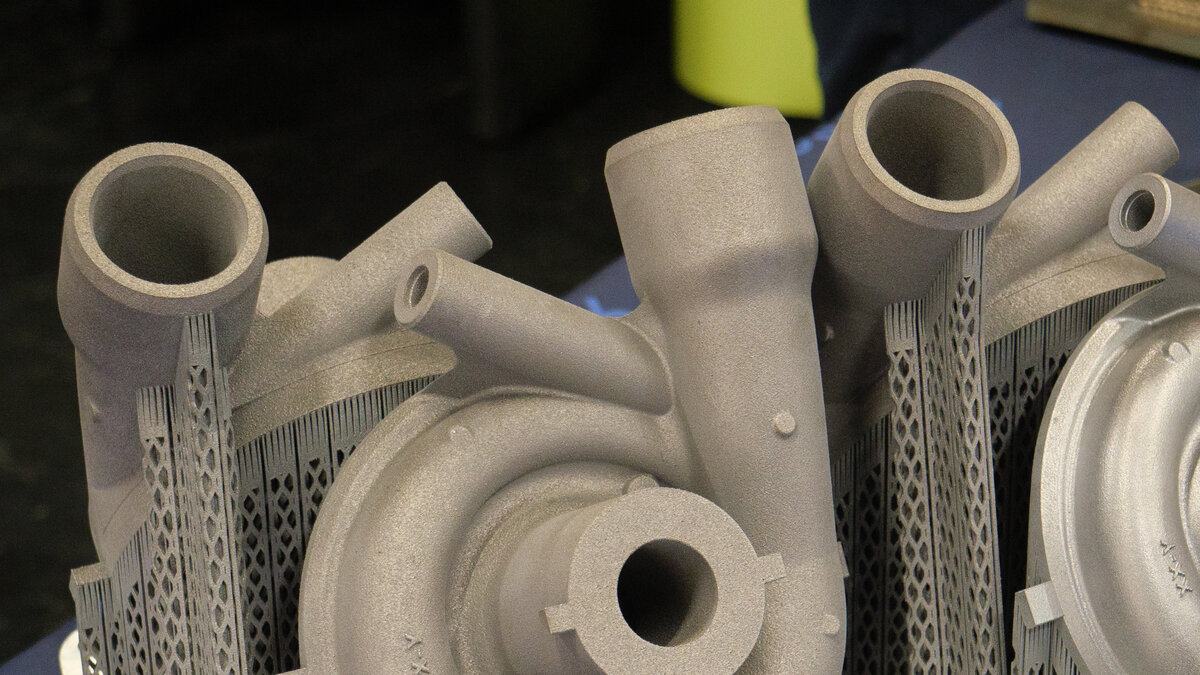
BMW Group is adding several ATLIX xBUILD 5000 laser powder bed fusion (LPBF) systems to its Additive Manufacturing Campus in Oberschleissheim, TCT Magazine reported on 16 November. The machines will produce aluminium components for both prototyping and series use. The headline feature is not build volume or laser count, though the machine has four lasers and a sizeable build area. It is the claim that the printer can run for long stretches with nobody standing next to it.
The announcement lands in the same week as Formnext 2026, where ATLIX is exhibiting in Hall 12.0, Booth D99. Trade-show timing is common for deals like this. What makes this one worth a closer look is how much of the xBUILD 5000's design is about the hours between builds rather than the build itself.
A Printer Designed Around Its Downtime
Anyone who has run a powder bed machine, metal or polymer, knows the hidden cost of the process. The printing itself is only part of the cycle. After a job finishes, the build has to cool, the chamber has to be opened, the part and its surrounding powder have to be removed, the machine has to be cleaned and recoated, and the next job has to be set up. On a large metal system, that changeover can leave an expensive machine sitting idle for a long time while a technician works through it.
ATLIX's answer is to treat the build cylinder as a swappable module. According to TCT, empty build cylinders are loaded into the xBUILD 5000 automatically. The machine calibrates itself and starts the job without an operator. When a build is done, the finished cylinder is sealed gas-tight and unloaded on the opposite side of the machine, where it cools on its own schedule rather than holding up the printer. The next job restarts within 15 minutes.
ATLIX's own product page describes the same idea: the finished build module moves aside while a new, empty module loads in parallel, which the company says cuts downtime to 15 minutes. The page pitches the machine under the line "High-efficiency automation for cost-effective mass production," which is a fair summary of where its engineering effort has gone.
Matthias Himmelsbach, CEO of ATLIX, told TCT the system is designed for "fully automated lights-out production at the lowest possible cost per part." In manufacturing, "lights-out" means a cell that keeps producing overnight or over a weekend without staff on the floor. For LPBF, which can involve long builds, that matters more than shaving a few minutes off scan time.
The Spec Sheet, and a Discrepancy
Both sources agree on four lasers, with TCT noting they operate simultaneously. They disagree on how powerful those lasers are, and on the build height. TCT describes four 1.5 kW lasers. ATLIX's product page lists four 1 kW fiber lasers. FilamentFeed has not been able to reconcile the two figures. The manufacturer's published spec is 1 kW per laser, and that is the number we would treat as the baseline until ATLIX says otherwise. It is possible BMW's machines use a different laser configuration from the standard listing, but neither source says so.
Other details, per TCT and ATLIX:
- Build area: TCT gives 500 x 500 x 600 mm, with closed-loop automation. ATLIX's technical data lists a 500 x 500 x 400 mm build module, so the height is another figure the two sources do not agree on.
- Spot size: 80 to 200 µm, according to ATLIX.
- Build plate heating: preheat up to 200 °C, with optional active cooling.
- Laser alignment: ATLIX's Automatic Multilaser Alignment checks alignment every two layers with 40 µm accuracy. TCT also notes automatic multi-laser alignment.
- Recoating: double-side recoating, which ATLIX says reduces inactive time by up to 50 percent.
- Job handling: multijob processing.
- Powder handling: excess powder is sieved in parallel with the build, and an optional open-loop unit can recycle powder across multiple machines.
- Software: monitoring through ATLIX's xCREATE software.
The alignment feature deserves a note. With four lasers covering one build area, the zones where their fields overlap are a classic source of defects if the lasers drift out of registration. Checking alignment every two layers, rather than during periodic maintenance, is exactly the sort of feature an unattended machine needs. If nobody is watching, the machine has to catch its own drift.
Double-side recoating attacks a similar problem from another angle. A recoater that deposits powder in both directions of travel avoids a return stroke that does no useful work. ATLIX's "up to 50 percent" figure refers to inactive time, not total build time, which is the more honest way to state it.
A Partnership Years in the Making
This is not a cold purchase. Himmelsbach told TCT that ATLIX's collaboration with BMW began in 2019 with a research project called IDAM. In other words, the two companies have been working together on automated metal additive production for several years, and the multi-machine installation at Oberschleissheim reads as the industrial follow-through on that work.
BMW is not betting on a single process, either. TCT reports that the company has also added wire arc additive manufacturing (WAAM) to its toolkit and expects to launch a vehicle next year carrying its first WAAM 3D-printed component. WAAM is a very different process from powder bed fusion, and running both suggests BMW is matching process to part rather than looking for one machine to do everything.
What It Means for Makers
Nobody reading FilamentFeed is going to put a four-laser aluminium LPBF cell in the garage. But the logic behind the xBUILD 5000 is directly relevant to anyone who runs printers for output rather than for fun.
The lesson is that throughput is dominated by everything that is not printing. Print farms built from consumer FDM machines have run into the same wall: the bottleneck is clearing the bed, checking the machine and starting the next job. That is why automatic part ejection, swappable build plates and queue-management software have become such a focus in the hobby space. ATLIX has applied the same thinking at industrial scale by making the entire build volume a cartridge that leaves the machine to cool.
The self-calibration angle is similarly familiar. Automatic bed leveling and calibration routines on desktop machines exist for the same reason ATLIX checks laser alignment every two layers: a printer that can verify itself can be trusted to run unattended.
And the BMW story is a reminder that serious manufacturers increasingly treat additive as a production process, not just a prototyping tool. When an automaker is expected to deploy several large machines for series aluminium parts and plans to ship a WAAM component in a production vehicle, the question is no longer whether 3D printing belongs in manufacturing. It is how cheaply each part can be made.
Bottom Line
BMW's xBUILD 5000 installation is a bet on automation as much as raw speed. The four-laser layout is consistent across sources, though readers should note the gap between TCT's 1.5 kW and ATLIX's published 1 kW per laser, and between the two build heights. The more interesting engineering is in the cylinder swap, the 15-minute restart and the constant self-checking. If those hold up in a production setting, the machine's real selling point will be the hours it spends working when nobody is in the building.
