
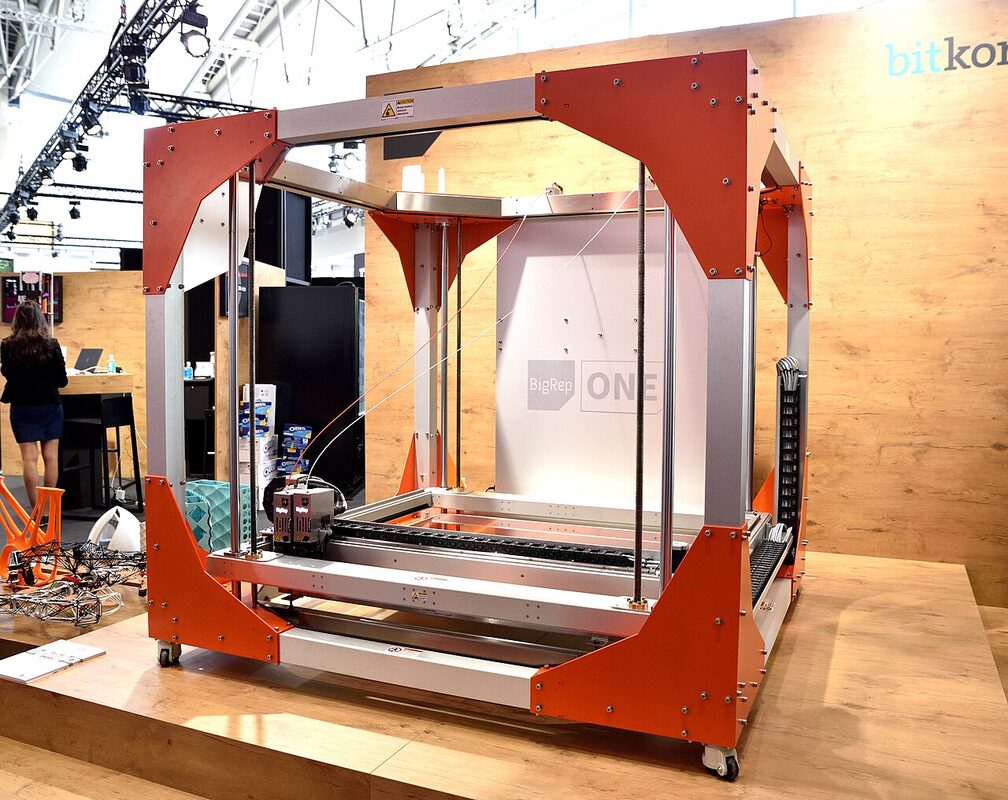
BigRep, the Berlin-based maker of large-format extrusion printers, is a private company again, roughly two years after it went public. 3D Printing Industry reported on October 28 that shareholders approved a simpler ownership structure. BigRep GmbH is now held by three family-owned firms that were already investors: Koehler Invest GmbH, DeKrassny GmbH and Hage Holding GmbH. Alongside the ownership change, the company opened worldwide orders for the ALTRA 670. It is a high-temperature machine with a 1200 x 700 x 800 mm build volume, and BigRep says the first series units are already in production.
Doing both at once sends a clear message. A company that leaves the public markets often looks like it is retreating. Opening orders for a new high-temperature machine in the same announcement suggests BigRep sees the delisting as a reset rather than a step back, though that reading is ours, not the company's.
A Shorter Public Life Than Planned
CEO Thomas Janics-Jakomini, who has led the company since November 2024, was unusually frank about why the listing did not last. "Our initial public offering two years ago was based on the expectation of rapid market acceleration in additive manufacturing, an assumption that proved more optimistic than the market ultimately allowed," he said. He added that returning to private ownership lets the company refocus its resources on product development and growth.
Being listed brings ongoing costs: reporting duties, investor-relations work and pressure to hit quarterly numbers. When voxeljet delisted from NASDAQ in 2024, its CEO cited exactly that kind of expense. BigRep's CEO pointed instead to market expectations that did not materialize. With a small group of long-term owners, BigRep can plan without explaining every quarter to the market.
The company does not describe the move as a rescue. It reports revenue growth of about 45 percent over the past twelve months. The sources do not give absolute revenue figures or say anything about profitability, so the percentage is best read as a sign of momentum rather than a full financial picture. BigRep attributes the growth to changes since Janics-Jakomini took over, including technology initiatives, additions to the product portfolio and a restructuring of operational processes. It also says every printer it sells is now built in its own facility in Austria, which it says gives it full control over its supply chain and more flexibility in production and delivery.
The ALTRA 670: The 280's Motion System, Scaled Up
The ALTRA 670 is built on the ALTRA 280 and carries over that machine's servo motors, ball-screw drive and industrial control system while increasing the build volume. This is closer to machine-tool design than to the belt-and-stepper setups most makers know. Ball screws hold their position under load and do not stretch the way belts do, and servos run in a closed loop, so the controller knows where the axes actually are. BigRep's product page says the welded frame, ball screws and servo motors keep accuracy up even on long print jobs.
The headline figures:
- Build volume: 1200 x 700 x 800 mm, which BigRep's product page describes as a 670-liter chamber for parts up to 1200 mm long.
- Thermal environment: chamber and bed both reach up to 140 C.
- Extrusion: two DSX extruders running at up to 450 C.
- Controls and compliance: BigRep states that its platforms use control systems manufactured in the West and comply with the cybersecurity standards of the EU's new Machinery Directive.
The temperatures tell you what the machine is for. An extruder that reaches 450 C opens up high-performance polymers, and BigRep says its machines accept compatible third-party materials, naming PEEK and ULTEM. The company says the 140 C chamber and bed create a thermally stable environment that supports strong layer bonding and dimensional accuracy. That matters because large high-temperature parts tend to warp or split between layers when the space around them is too cold, which is why a heated chamber of this size is what makes meter-scale parts in these materials realistic.
BigRep lists three target uses: aerospace-grade parts, functional prototypes tested at their real operating temperatures, and durable tooling such as jigs and fixtures. The first two are aimed squarely at engineering buyers. The third is where large-format printing has long made sense on factory floors, because a custom fixture printed in-house can replace one that would otherwise be machined or ordered out.
The point about Western-made controls and Machinery Directive compliance is mainly for procurement teams. BigRep frames its products, software and services around secure, traceable supply chains, particularly for customers in defense, aerospace and other sensitive sectors. It is selling that as a feature, not burying it in a spec sheet.
Where It Sits in the Lineup
The ALTRA 670 joins a lineup that includes the ONE.5X, released in April as an update to the ONE.5 with more automation and broader material support. The VIIO 250 is a highly automated large-scale system with BigRep's Infinity Box for continuous printing, and the IPSO 105 and ALTRA 280 were developed for automotive, defense and other critical industrial sectors. BigRep has also formed technology partnerships beyond its own filament-based systems: Massive Dimension for pellet extrusion and Endless Industries for continuous-fiber reinforcement.
Distribution and Footprint
BigRep has signed three new resellers in recent months: Alfex CNC in Australia, 3DXTECH in the United States and Phillips Corporation in Malaysia. It says it is also strengthening its offices in Singapore and the US.
The installed base is already sizable. BigRep reports more than 1,000 of its large-scale printers in operation, with users including Bridgestone, Kawasaki, Ford, Airbus and Daimler, along with educational and research institutions. These are large industrial and transport manufacturers, the kind of buyer the ALTRA 670 is aimed at.
What It Means for Makers
To be blunt, the ALTRA 670 is not a garage machine. It has servo axes, a 670-liter heated chamber, 450 C extrusion and an industrial control system, and the sources we read list no price. Even so, independent makers and small shops should pay attention for a few reasons.
First, the change in ownership matters to people who already own BigRep hardware. Private ownership by long-term family investors may mean less pressure for quick returns, which could help with long-term support, spare parts and steady product development, though BigRep has made no specific commitments on these points in the sources we read.
Second, BigRep says its machines are open to compatible third-party materials. That matters to anyone who has dealt with locked filament ecosystems. Being able to source PEEK or ULTEM from the supplier you choose would give you more control over material cost and qualification.
Third, the ALTRA 670 shows how far high-temperature extrusion has moved into large formats. A 140 C chamber and 450 C nozzles at a 1200 mm scale, built in Austria and sold through regional resellers, are a capability worth tracking for small fabrication businesses doing tooling or short-run parts for industrial clients, even if buying one is years away.
Finally, the CEO's remarks are a useful check on the industry. Additive manufacturing keeps growing, but by his account more slowly than the expectations behind BigRep's listing. BigRep has now adjusted its corporate structure to fit that reality.
