
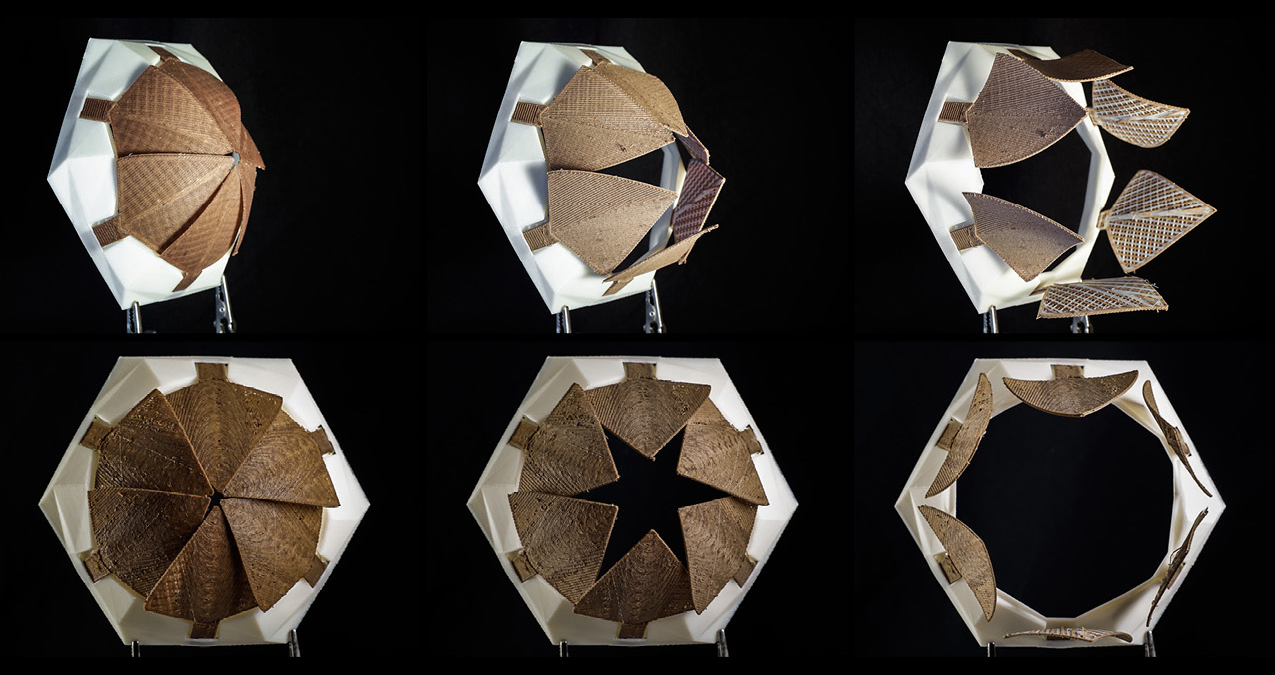
The hardest part of building a curved composite part usually is not the layup — it is the mold. Every compound curve needs its own machined tool, and for the twisting blades of a vertical-axis wind turbine that tooling can dominate the cost and the calendar. A team at Concordia University has now demonstrated a way to skip the curved mold entirely: print the blade dead flat, then let the material bend itself into the finished geometry as it cools. Their approach, which they call "inverse 4D printing of composites," is described by Concordia and published in the journal Polymer Composites.
The work comes out of the Concordia Centre for Composites, with researcher Emad Fakhimi and Professor Suong Van Hoa. The headline numbers are the kind that make a maker sit up: blade segments that came out roughly 80% lighter than aluminum, on turbines that spun faster than their aluminum-bladed counterparts across a range of lab conditions — all produced on flat tooling.
What "inverse" actually means here
Conventional 4D printing starts with a printed object and asks what it will do when you heat it, wet it, or otherwise trigger a stimulus. The shape change is the interesting result you observe after the fact. Concordia's team ran that logic backward. They begin with the geometry they want — the specific curve of a vertical-axis turbine blade — and then solve for the flat laminate and stacking sequence that will deform into exactly that shape once it comes off the heat. Hence "inverse": the target curve is the input, and the flat printing recipe is what the method computes.
The physics doing the folding is differential thermal expansion, and it is the same effect that warps a badly balanced FDM print, only here it is a feature rather than a defect. Carbon fibers barely expand along their length as temperature changes, while the surrounding epoxy matrix expands far more. Orient the plies in different directions within a laminate and each layer wants to shrink by a different amount as the part cools from its cure temperature. Lock those mismatched tendencies together in a bonded stack and the whole laminate has no choice but to curl. Choose the ply angles deliberately and you can aim that curl at a target shape instead of fighting it.
The laminate, by the numbers
According to 3D Printing Industry, the demonstrated blades used carbon/epoxy prepreg with continuous fibers at 50–60% fiber volume — genuine structural composite, not chopped-fiber filament. The layup was a three-ply [0/90/90] stack about 0.45 mm thick. That asymmetry is the whole point: a symmetric stack would have no reason to curl, while the deliberately unbalanced arrangement of 0-degree and 90-degree plies builds in the internal stress that drives the shape change on cooling.
The weight comparison is stark. An aluminum blade segment weighed 256.2 grams; the equivalent carbon/epoxy segment came in at 51.3 grams — the roughly 80% reduction the headline promises. And lighter did not mean slower. In fan-driven bench tests, the composite turbine reached 30, 52, and 76 rpm across three fan settings, against 27, 48, and 71 rpm for the aluminum version. The lighter rotor has less inertia to overcome, so it spins up faster and turns quicker at a given wind speed — exactly the behavior you want from a small turbine that has to catch gusty, low-grade urban wind.
Why vertical-axis turbines are the target
The method is aimed squarely at vertical-axis wind turbines — the rooftop and urban designs whose blades sweep in tight, curved arcs rather than the long straight airfoils of a utility-scale horizontal turbine. Those curves are precisely what makes them expensive to build in composite: each blade normally demands a dedicated curved mold, and molds are slow and costly to produce. By coaxing a flat laminate into the curve on its own, the Concordia approach removes the tooling step that has kept high-performance composite blades out of reach for small, distributed installations. The researchers frame it as cutting both the manufacturing time and the cost of curved composite segments.
What It Means for Makers
Nobody is printing continuous-fiber prepreg at 50–60% fiber volume on a bedroom Ender, and it is worth being clear about that. This is lab research using aerospace-grade material and controlled cure cycles, not a downloadable profile. What makes it relevant to makers is the idea underneath it, which travels well.
First, it reframes warping. Every FDM user has cursed a print that lifted or twisted because different regions cooled at different rates. Concordia's result is a reminder that the same anisotropy and thermal mismatch we normally suppress can be engineered toward a target shape. Print-flat-then-self-fold is an increasingly practical way to reach geometries that are awkward to print directly — and it lets you print with your strongest, fastest, most reliable orientation, flat on the bed, then let the part find its final form.
Second, it lands right in the middle of the growing composites-on-desktop conversation. Continuous-fiber machines and fiber-reinforced workflows are steadily filtering down to prosumer budgets, and hobbyists are already experimenting with ply orientation and layup logic that would have been exotic a few years ago. The inverse-design premise — decide the shape you want, then compute the flat layup that becomes it — is a concept the fiber-printing community can borrow long before the exact materials are accessible. If you are already thinking in plies and fiber angles, you are thinking in the same vocabulary this paper uses.
Finally, it is a clean proof that eliminating tooling is a legitimate goal in its own right. Molds are the hidden tax on curved composite parts. Any technique that trades a machined tool for a computed layup and a controlled cool-down changes the economics of one-off and small-batch curved parts — which is exactly the territory makers live in.
Bottom Line
Concordia's inverse 4D printing does not put self-folding turbine blades on your workbench tomorrow. What it does is validate, with concrete numbers, an idea that maps neatly onto where desktop fabrication is heading: design for the finished curve, print flat, and let engineered material behavior do the shaping. An 80% weight cut and a faster-spinning rotor, achieved without a single curved mold, is a strong argument that the mold — not the material — was the thing worth getting rid of.
