
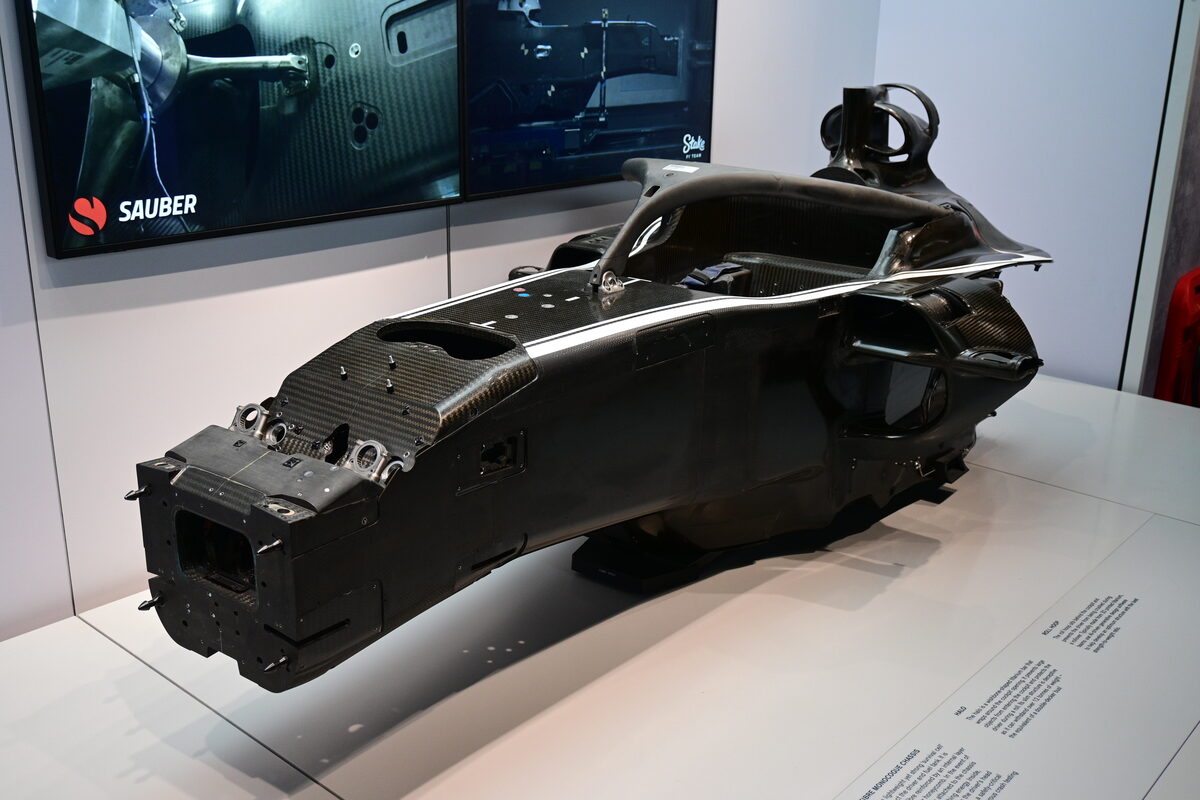
At the Goodwood Festival of Speed, running July 9-12, 2026, UK composites and engineering specialist Dash-CAE unveiled a new single-seat carbon monocoque technology demonstrator built using its Large Format Additive Manufacturing (LFAM) process — a workflow the company says can take a chassis from CAD file to finished carbon structure in a matter of days, largely by replacing conventional autoclave tooling with 3D-printed patterns and molds.
That is a striking claim in a corner of manufacturing where tooling lead time, not layup or cure, is usually the bottleneck. Traditional composite monocoques for motorsport and low-volume automotive applications typically require machined or hand-laid master patterns, followed by production tooling capable of surviving repeated autoclave cycles at elevated temperature and pressure. Depending on part complexity, that tooling phase alone can run from several weeks to a few months before a single carbon layup even begins. Dash-CAE's pitch is that large-format 3D printing collapses that front end of the process down to days, without giving up the structural properties that make autoclave-cured carbon the standard for chassis work in the first place.
Two Materials, Two Jobs
The demonstrator is built around a pair of proprietary LFAM feedstocks developed in-house by Dash-CAE and tuned for different stages of the tooling chain: Dastrude100, used for patterns and jigs, and Dastrude165, described as a Class-A production tooling material capable of standing up to repeated composite cure cycles. Splitting the materials this way lets the company use a cheaper, faster-printing formulation for one-off or low-durability tooling — patterns that only need to hold shape long enough to generate a mold — while reserving the more capable Dastrude165 for tooling that has to survive the actual autoclave environment multiple times over a production run.
That two-material split matters because it's the detail that separates a genuine production process from a one-off proof of concept. Plenty of large-format printers can extrude a big, roughly net-shape pattern quickly; far fewer feedstocks can then go on to serve as Class-A tooling that repeatedly survives autoclave temperature and pressure without warping, off-gassing, or degrading surface finish on the parts it molds. By naming and differentiating the two materials, Dash-CAE is signaling that its LFAM tooling isn't a shortcut used once and discarded, but part of a repeatable pipeline it intends to run at production tempo.
Quasi-Isotropic SMC, Not Prepreg
The monocoque itself is produced from quasi-isotropic sheet molding compound (SMC) rather than the unidirectional or woven prepreg typically associated with autoclave-cured chassis work. Quasi-isotropic SMC is engineered so its mechanical properties are roughly uniform in multiple in-plane directions, rather than concentrated along specific fiber orientations — a property that suits geometrically complex, molded structures better than hand-laid prepreg sheets, which need careful ply orientation to avoid weak axes. Combined with 3D-printed molds instead of machined aluminum or composite production tooling, the SMC route lets Dash-CAE compress both the tooling and the layup side of the process simultaneously, which is presumably how the company arrives at its matter-of-days CAD-to-chassis claim.
Notably, the sourced reporting frames this as recyclable tooling — a detail that speaks to Dash-CAE's broader positioning. Conventional composite tooling, once machined from tool-grade materials, is expensive to produce and often ends up as waste once a program ends or a design changes. Printed patterns and molds that can be reprocessed after use fit a low-volume, rapid-iteration motorsport and prototyping market where chassis designs change between seasons or even between events.
What It Means for Makers
None of this is desktop-printer territory — LFAM systems operate at a scale and material cost far beyond anything running in a home shop or makerspace, and Dash-CAE's Dastrude materials are proprietary formulations, not something you'll find on a filament spool rack. But the underlying logic is directly relevant to anyone doing composite work with printed tooling at smaller scale: the pattern/production-tooling split, the choice of a cure-cycle-durable material for anything that touches an autoclave more than once, and the pairing of a quasi-isotropic layup material with a printed mold rather than hand-laid prepreg are all techniques that scale down. Hobbyists and small shops building carbon parts around 3D-printed molds — drone frames, RC chassis, small enclosures — already lean on similar tradeoffs between disposable printed patterns and more durable printed tooling meant to survive multiple cycles.
The bigger signal for the broader additive manufacturing industry is what it says about LFAM's maturity as a tooling technology rather than a novelty. A CAD-to-chassis claim measured in days, if it holds up under independent scrutiny beyond a trade-show demonstrator, would put 3D-printed tooling in direct competition with the machining and hand-fabrication shops that have historically owned the composite tooling supply chain for motorsport and low-volume automotive work. That's a tooling market, not a parts market — and tooling lead time is exactly the kind of bottleneck that print-based rapid manufacturing has been chipping away at for years in other industries, from injection molding inserts to foundry patterns.
Context: A 20-Year-Old Composites Shop Placing a Bet on Print
Dash-CAE displayed the new demonstrator alongside its existing TR01 chassis, launched in 2024, giving Goodwood attendees a side-by-side look at the company's prior autoclave-tooled work next to its printed-tooling result. The showcase doubles as an anniversary statement: Dash-CAE was founded in 2006, and the Goodwood display arrives alongside news of an expanded 30,000-square-foot headquarters that adds both 5-axis machining and additional LFAM equipment. That combination — more traditional subtractive capacity going in at the same time as more large-format printing capacity — suggests Dash-CAE sees LFAM tooling as a complement to its existing composites shop rather than a wholesale replacement, at least for now.
What's not yet public is independent, third-party validation of the company's days-long CAD-to-chassis claim, pricing for LFAM-tooled chassis work relative to conventional tooling, or how many production cycles a Dastrude165 mold can survive before it needs replacing. Those are the numbers that will determine whether this demonstrator is a genuine shift in how low-volume carbon chassis get built, or a striking trade-show showpiece that doesn't yet scale to a customer program.
