
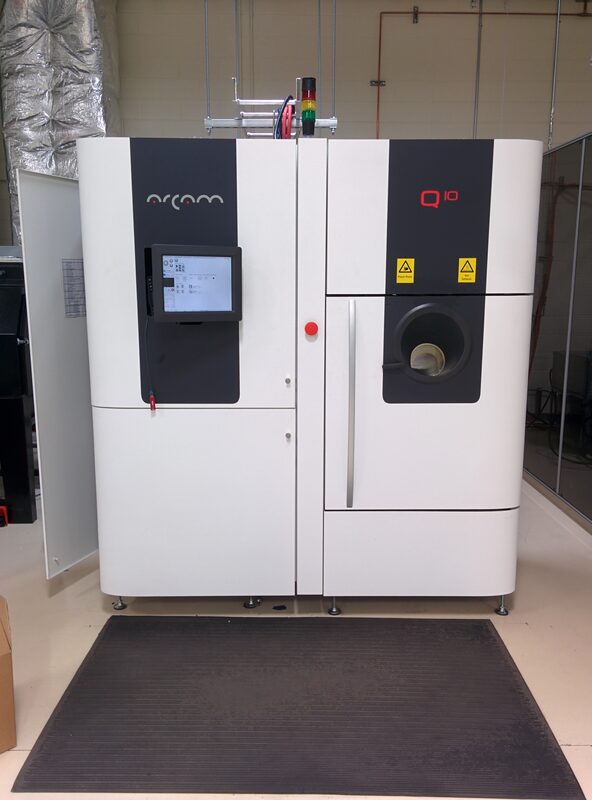
For most of its commercial life, electron beam powder bed fusion (EB-PBF) has been sold on brute-force credentials: a beam that can hit thousands of degrees, scan at speeds no laser can match, and keep a powder bed hot enough to relieve stress as it prints. But according to a July 10, 2026 industry analysis by veteran additive manufacturing executive Ulf Lindhe, the technology's next competitive battleground isn't raw power at all. It's precision — specifically, how finely a machine can control where, when, and how long its electron beam dwells on a given point of powder.
The piece, published on 3DPrint.com, surveys a shift already underway among several EB-PBF equipment makers: away from continuous, laser-like scan paths and toward point-based exposure strategies that treat the beam more like a programmable instrument than a simple heat source. Lindhe names three companies pushing this shift from different angles — Colibrium Additive, Freemelt, and ProBeam — alongside a fourth, JEOL, whose contribution is less about how the beam melts and more about how the machine watches itself do it.
From Scan Paths to Point Melting
Traditional EB-PBF systems, like their laser powder bed fusion cousins, largely work by sweeping a beam continuously along a toolpath, tracing contours and hatch lines across each layer. Point-based exposure, sometimes called point melting, breaks that continuous path into a sequence of discrete beam placements, each with its own dwell time, spacing, and power profile determined by software rather than a fixed mechanical or optical scan pattern.
Colibrium Additive's implementation of this idea, EBM Point Melt, is one of the approaches Lindhe cites by name. Rather than melting powder along a swept line, the strategy exposes many individual points in a layer, giving the system programmable control over the thermal history of each location on the build plate. Colibrium reports that the approach enables more accurate temperature control, reduced temperature gradients, reduced sintering needs, improved surface quality, and simpler support structures compared with continuous scanning. Freemelt and ProBeam are named as pursuing parallel point-based strategies of their own, part of a broader industry pattern rather than a single vendor's proprietary trick.
The appeal of this approach, per the analysis, is thermal control. Electromagnetic beam deflection enables very high scan and jump speeds, which the analysis says is what makes point-based strategies possible: the beam can address many points across a layer in rapid succession, effectively heating a broad region "simultaneously" from the part's perspective while still controlling the energy delivered to each spot. That granularity opens the door to managing heat buildup, residual stress, and solidification behavior at a resolution that a single continuously-scanning beam path struggles to achieve.
JEOL's Eyes on Every Layer
The second thread in Lindhe's analysis concerns not how the beam melts material, but how the machine sees what it just did. JEOL's JAM-5200EBM electron beam metal 3D printer is highlighted for its use of back-scattered electron (BSE) imaging, captured layer by layer during the build itself, to support real-time defect detection.
Back-scattered electrons are a byproduct of the same electron-optical process the machine already uses to melt powder — high-energy electrons striking the material and bouncing back carry information about surface topography and material density. JEOL's system captures a BSE image after each layer is melted, effectively giving the printer an in-process imaging capability without a separate optical camera or added hardware. JEOL describes the goal as automatic detection of internal defects and deformation as the part is built, which the company says can reduce reliance on post-production X-ray CT testing — letting operators catch problems layer by layer rather than only after a part is cut open or scanned.
The JAM-5200EBM's own specifications illustrate why an integrated, camera-free monitoring approach fits the process: the machine builds inside a chamber held at 1×10⁻² Pa or lower, with the powder bed preheated to as high as 1200°C in its high-temperature configuration, using a 6 kW electron beam and layer thicknesses of 50 or 75 microns. That combination of hard vacuum and sustained high heat is a much harsher environment for conventional camera hardware than the open, room-temperature build chambers typical of laser powder bed fusion machines — one reason a monitoring method that piggybacks on the beam itself, rather than bolting on a separate optical sensor, is a notable fit for EB-PBF specifically.
What Beam Control Buys You: Grain Structure
The analysis also points to research on Alloy 718 (a nickel-based superalloy widely used in aerospace and high-temperature applications) showing that EB-PBF melting strategies can tailor grain morphology — including transitions between columnar, equiaxed, and bimodal structures — by changing processing conditions and local solidification behavior. EB-PBF's distinct thermal environment, in which the powder bed is preheated and held at elevated temperature throughout the build, gives it a wider window for this kind of grain-structure control than most laser-based processes typically operate in. By manipulating solidification conditions through controlled beam exposure, EB-PBF can influence how grains form and grow within a part, a lever that matters directly to mechanical properties like fatigue life and creep resistance in demanding alloys.
This is the throughline connecting point-based exposure and in-process imaging: both are, at bottom, about giving operators finer control over the thermal history a part experiences, and finer visibility into whether that control produced the intended microstructure. Melting powder has never been the hard part of EB-PBF. Controlling exactly how it solidifies, and confirming it solidified correctly, is where the analysis says the real competitive differentiation now lives.
What It Means for Makers
None of this is desktop-relevant hardware — EB-PBF machines from JEOL, Colibrium Additive, and Freemelt build inside vacuum chambers and are aimed at aerospace, medical implant, and other metal production applications far removed from FDM or resin printing on a workbench. But the trajectory is worth tracking for anyone following where metal AM is headed, because it mirrors a pattern familiar from other corners of 3D printing: once a process proves it can reliably produce parts at all, the competitive fight moves to control, repeatability, and in-process verification.
For makers and small shops eyeing metal AM services or considering where the technology is going, the signal is that EB-PBF is positioning itself less as "the fast, hot alternative to laser PBF" and more as a process with unique metallurgical capabilities — tailored grain structure chief among them — that laser systems structurally can't match. If that differentiation holds up, it suggests EB-PBF's long-term niche may be less about general-purpose metal printing and more about applications where microstructure control is the whole point, from turbine components to load-bearing implants.
Sources
- The Next Phase of EB-PBF Will Be Defined by Beam Control — 3DPrint.com, July 10, 2026, by Ulf Lindhe
- JEOL JAM-5200EBM electron beam metal 3D printer — JEOL product page
