
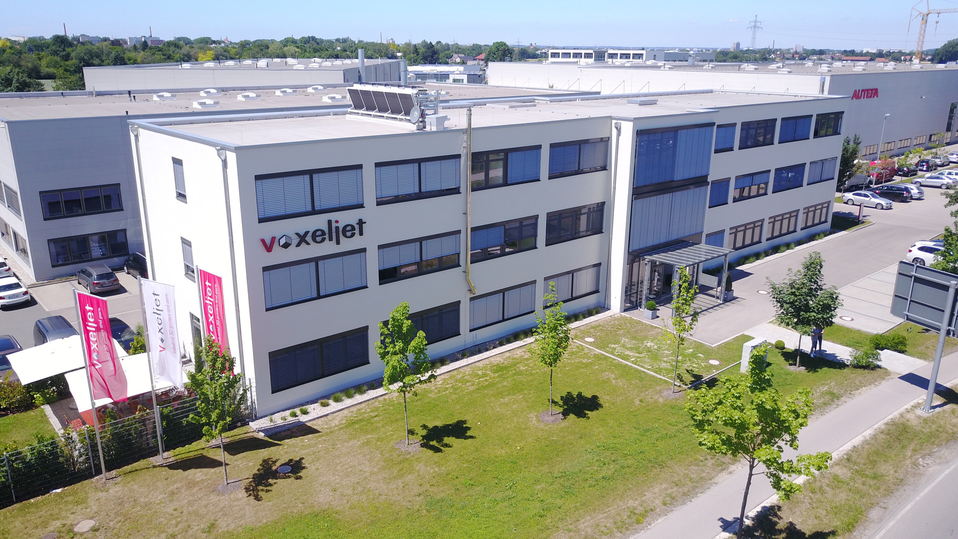
Two of binder jetting's founding names are no longer just under common ownership — they're now, legally, the same company. According to ExOne's official newsroom, ExOne GmbH and voxeljet GmbH have completed a formal unification, capping a process that began when Anzu Partners separately acquired the assets of both firms in 2025.
The merger became legally effective on August 13, 2026, and was reported by TCT Magazine on August 18. The combined entity is now registered in the German commercial register and headquartered in Gersthofen, Germany, near Augsburg — long the home base of ExOne's German operations. Rather than adopting a new brand or a hyphenated name, the surviving legal entity continues to operate as ExOne GmbH. voxeljet doesn't disappear from the market entirely, though: the company says the voxeljet brand name will be retained specifically for its PMMA (polymethyl methacrylate) casting-pattern systems and its High Speed Sintering (HSS) polymer line, distinguishing those product families from the sand and metal binder jetting systems that carry the ExOne name.
Two Rivals, One Owner, Now One Company
For most of the past two decades, ExOne and voxeljet were the industry's two most visible binder jetting pure-plays — competitors that effectively invented commercial sand-casting 3D printing and metal binder jetting as parallel, rival tracks. ExOne, spun out of the Ex One Company/Extrude Hone lineage in Pennsylvania, built its reputation on metal and sand printing for foundries and industrial parts. voxeljet, founded in Germany, carved out its own niche in large-format sand molds and cores, plus PMMA lost-pattern casting and, more recently, HSS polymer parts. Both companies went public at different points, both cycled through ownership changes, and both ultimately landed in the hands of Anzu Partners, a Washington, D.C.-based investment and operating firm that invests in and provides operational support to industrial technology companies. Anzu's 2025 moves to acquire the assets of ExOne and voxeljet separately set up exactly the kind of combination that followed: rather than running two AM brands with overlapping sand and binder jetting capability as separate legal and operational structures indefinitely, Anzu has folded them into a single entity. That's a materially different move than a shared parent company loosely overseeing two subsidiaries. A single legal entity means one balance sheet, one set of corporate governance obligations under German commercial law, and — in principle — one unified engineering, sales, and service organization rather than two that happen to answer to the same investor. According to the companies, the combined organization brings together more than three decades of industrial 3D printing experience concentrated in sand 3D printing and binder jetting, while continuing to operate through subsidiaries across Germany, the United States, Japan, China, and India rather than consolidating into a single physical footprint.
Who's Running It, and What Changes for Customers
Eric Bader, who leads ExOne Global Holdings, is CEO of the unified company. In comments carried by TCT, Bader framed the merger less as a paperwork exercise and more as an organizational one: "A step of this scale does not succeed through contracts and notary appointments. It succeeds through people who learn new things and take on the work together." Bader also said the combined roster gives the company an edge customers will notice: "No other team worldwide brings this much binder jetting expertise under one roof." Taken together, the comments signal that the harder part of this integration isn't the registry filing that happened on August 13, but the work of merging two engineering cultures, two service networks, and two sets of product roadmaps that, until recently, were built to compete with each other. For existing customers, the practical message from the announcement is continuity rather than disruption. Existing contracts, quotations, and non-disclosure agreements signed with either ExOne or voxeljet remain valid under the new structure — they don't need to be renegotiated or re-papered because of the entity change. Maintenance and spare-parts support for machines already in the field continues without interruption, according to the companies. That matters in binder jetting more than in most additive processes: foundries and production shops running ExOne or voxeljet systems tend to have significant capital tied up in binder jetting cells that need consistent uptime, consumables, and service contracts to stay productive, and any hint of a support gap during a corporate restructuring would ripple through procurement and maintenance planning fast.
What It Means for Makers
This is not a story about desktop FDM printers, and binder jetting sand and metal systems from ExOne and voxeljet sit well outside the price and scale range of hobbyist or prosumer machines. But the merger is still worth understanding for anyone tracking where the broader additive manufacturing industry is consolidating, because binder jetting is one of the technologies most likely to trickle down — in derivative or licensed form — into more accessible tooling over the next several product cycles, the way FDM, SLA, and even metal DED processes eventually did. More directly, the merger is a data point in a larger trend: private equity and strategic investors are actively rolling up AM companies that were, a few years ago, standalone public or venture-backed businesses. Anzu Partners' acquisition and consolidation of ExOne and voxeljet mirrors similar moves elsewhere in the industry, where scale, shared R&D budgets, and unified service networks are increasingly seen as competitive necessities rather than nice-to-haves. Anzu, a Washington, D.C.-based firm that pairs capital with hands-on operational support for industrial technology companies, is treating the two binder jetting pioneers as a single platform rather than a pair of arm's-length holdings — a pattern worth watching as it works through the rest of its industrial portfolio. For makers and small shops that rely on service bureaus using ExOne or voxeljet equipment, the near-term takeaway is reassurance: the companies say support and existing agreements carry over cleanly. The longer-term question — how a combined roadmap treats the voxeljet PMMA and HSS lines relative to ExOne's sand and metal systems — is one the industry will be watching for in the coming product announcements.
