
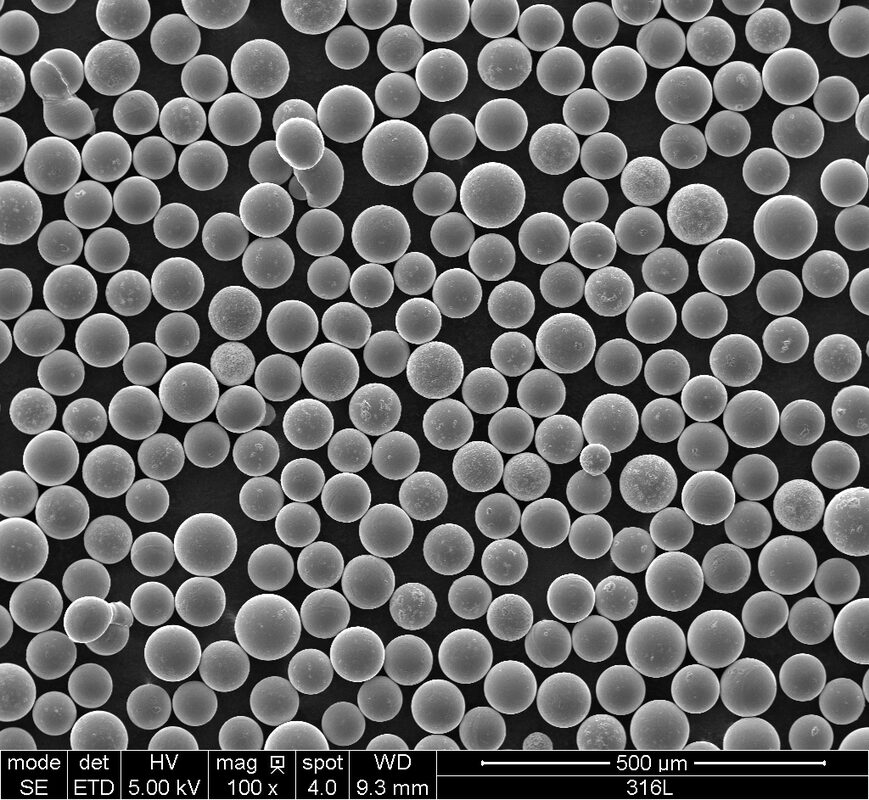
Italian metal powder producer FOMAS Group has extended ISO 19443 nuclear-supply-chain certification to its MIMETE line of gas-atomized spherical powders, a move that positions the company's iron-, nickel-, and cobalt-base alloys for use in nuclear power-generation hardware such as turbine blades and heat exchangers. It's a narrow-sounding certification with an outsized effect on who's allowed to bid on what — and it says something about where metal additive manufacturing is quietly heading next.
MIMETE, founded in 2017 and based in Biassono, near Monza in Italy's industrial north, has spent the better part of a decade building a powder portfolio aimed at the industries that care most about traceability: aerospace, defense, and oil & gas. According to VoxelMatters, the company's current grade lineup includes M 316L, an iron-based stainless powder; V X, V 625, and V 718, a family of nickel-based superalloys; and N 75, a cobalt-base alloy. All of them are produced using vacuum induction melting inert gas atomization (VIGA), a process that melts feedstock under vacuum before atomizing it with inert gas — a combination chosen specifically to keep oxygen pickup and contamination low, which matters enormously once a powder's end use is a reactor-adjacent component that can't fail quietly.
What ISO 19443 Actually Requires
ISO 19443 isn't a materials-property standard — it doesn't dictate particle size distribution or flowability the way a powder spec sheet does. It's a quality-management standard, built as an extension of the familiar ISO 9001 framework, that adds requirements specific to the nuclear supply chain: documented safety-culture practices, counterfeit-parts prevention procedures, and traceability records that can follow a lot of powder back to a specific melt, atomization run, and test batch. For a supplier, that means proving not just that the material is good, but that the paperwork proving it's good can survive an audit years later.
FOMAS backs that traceability claim with testing infrastructure rather than just process controls. Per VoxelMatters, the company runs two ACCREDIA-accredited laboratories — ACCREDIA being Italy's national accreditation body — that perform more than 20 tests per melt. That per-melt testing cadence, rather than per-lot or per-shipment sampling, is the kind of granularity nuclear buyers and their auditors tend to expect, since it lets a defect be traced to a specific production run rather than a broader batch.
ISO 19443 also doesn't stand alone in FOMAS's certification portfolio. According to VoxelMatters, FOMAS Group has held ASME (American Society of Mechanical Engineers) accreditation since the late 1970s on the strength of its long-running forged-components business, and separately holds ASME NCA-3300 — a nuclear-specific quality assurance provision within the ASME code — and NNSA HAF 604, a Chinese National Nuclear Safety Administration standard notable for signaling reach into that market. MIMETE's own product page confirms ISO/IEC 17025, the general standard for testing and calibration laboratory competence, alongside ISO 9001 and ISO 19443 itself. Layered together, that's a supplier trying to satisfy nuclear buyers across multiple regulatory regimes simultaneously, not just checking a single Western-market box.
Why Nuclear, and Why Now
The target applications VoxelMatters lists — turbine blades, heat exchangers, parts with internal cooling channels, and thermal spray coatings — read like a checklist of components where additive manufacturing's geometric freedom solves a real problem. Internal cooling channels in particular are a textbook case for AM: conformal channels that follow a part's contours are difficult or impossible to drill or cast, but straightforward to grow layer by layer in a powder bed. Nuclear power generation has historically been a conservative adopter of AM, for understandable reasons — component failure consequences are severe and qualification timelines are long — but the sector also has aging plant fleets with hard-to-source legacy parts, which is exactly the scenario where a well-documented, traceable powder supply becomes valuable enough to justify the certification overhead.
It's also worth noting what this certification is not. ISO 19443 qualifies FOMAS as a supplier that nuclear-industry customers can safely include in their own qualified vendor lists — it doesn't certify a specific printed part, printer, or process chain for reactor service. Getting a turbine blade or heat exchanger built from M 316L or V 718 powder into an actual nuclear installation still requires the fabricator, the printing process, and the finished part to clear their own qualification hurdles, likely under codes like ASME Section III (the broader code family that NCA-3300 falls under). What FOMAS has done is remove one link of that chain as a bottleneck — the powder itself now arrives with the paper trail nuclear-grade fabrication programs require.
What It Means for Makers
For hobbyist and prosumer 3D printing, none of this is directly actionable — VIGA-atomized nuclear-grade nickel superalloy powder isn't showing up in a desktop-compatible form, and it isn't priced or packaged for anyone outside industrial metal AM. But it's a useful data point for anyone tracking where the metal powder supply chain is maturing. MIMETE's alloy list — 316L stainless, Inconel-family nickel alloys (V 625 and V 718 read as Inconel 625 and 718 analogues under FOMAS's own naming), and a cobalt-base superalloy — are all materials that show up, in less exotic certification tiers, in industrial powder-bed-fusion machines that some well-funded makerspaces and university labs already operate. When a supplier adds a top-tier certification like ISO 19443, it often also tightens the general quality documentation that can trickle down to lower certification tiers, including the commercial-grade lots that eventually reach smaller industrial buyers — though that trickle-down effect is an inference from how quality systems typically work, not something either source states outright.
The bigger signal is about market diversification. FOMAS already served power generation, oil & gas, general industry, and aerospace/defense customers through MIMETE's in-house VIGA atomization plant, per the company's own site. Adding nuclear-grade certification doesn't replace that business — it adds a fifth vertical with its own qualification cycle and, likely, its own margin profile. For an independent powder producer competing against much larger atomizer operations, stacking certifications across sectors that don't shrink in sync during a downturn is a reasonable hedge. Watch for whether other European and Asian powder producers follow with their own ISO 19443 filings over the next year; if nuclear AM component adoption is real rather than aspirational, the certification lists on competing powder datasheets should start filling in too.
