
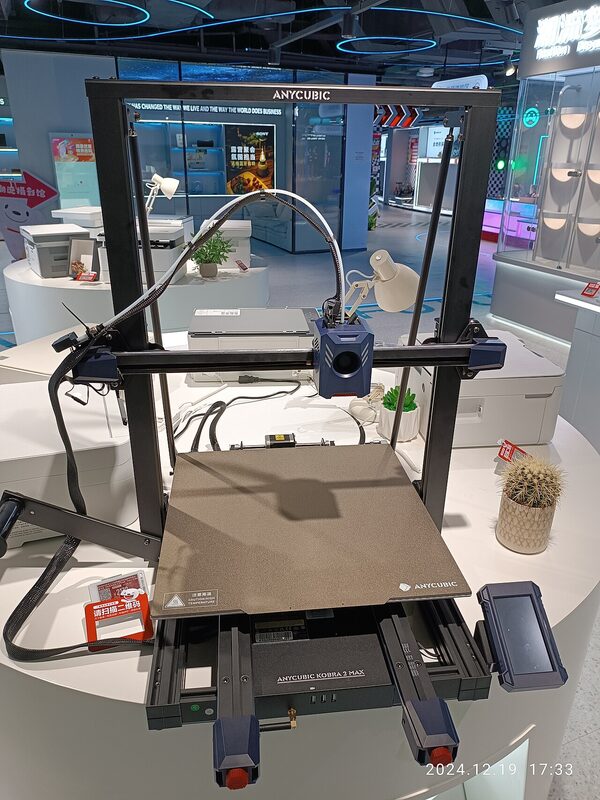
Formnext, the additive manufacturing industry's largest trade show, is set to open in Frankfurt this November with a noticeably different exhibitor map than in years past. According to organizer Mesago's official press release, 527 exhibitors from 34 countries had registered as of early March 2026, with 64.5 percent of them based outside Germany and 21 countries appearing among the show's new exhibitors. By late September, as the exhibitor list filled out toward an expected total of roughly 800, one country's contingent had pulled decisively ahead of the rest: China.
Formnext 2026 runs November 17-20 at Messe Frankfurt, and trade coverage tracking the registration list found China supplying 124 exhibitors — more than any other single nation and well clear of the next-largest delegations. The United States follows with 35 exhibitors, the United Kingdom with 30, Italy with 29, and France with 26, according to a report from 3D Printing Industry published September 25. That puts China's presence at roughly three and a half times the size of the next-largest national contingent, in a show whose total footprint has grown even as the exhibitor mix has shifted.
Why Chinese Manufacturers Are Crossing the Continent
The scale of the shift raises an obvious question: why now? Formnext VP Sascha Wenzler, quoted in the 3D Printing Industry report, ties the surge to conditions inside China's own additive manufacturing market rather than to any single marketing push by the show itself. Domestic price competition among Chinese printer makers has intensified to the point that manufacturers are looking outward for margin and market share, and the United States — long a default export destination for Chinese hardware — has become harder to enter amid geopolitical and market barriers, Wenzler said. Europe, still growing and comparatively open, is absorbing that redirected supply.
That reading lines up with what's visible on the exhibitor list itself. Bambu Lab, the desktop and prosumer printer maker that built an outsized reputation in maker communities over the past few years, is among the confirmed exhibitors, listed by organizer Mesago alongside fellow desktop manufacturers Creality and Prusa. Mesago's own preview material notes that machines in that category are "increasingly being used in industrial companies, SMEs, and print farms" — the organizer drawing a direct line between desktop-class hardware and the industrial-scale adoption Wenzler describes elsewhere in the show's build-up.
Formnext Vice President Christoph Stüker, who joined Wenzler for the London presentation, pointed to a second, related trend shaping this year's exhibitor mix: the rise of "print farms" — fleets of smaller, lower-cost machines run in parallel rather than a handful of large, expensive industrial systems. Wenzler called it "another way of scaling": "You can scale it with an industrial machine, and you can also scale it having hundreds of smaller machines running," he said. "It's a different way of industrialising AM." 3D Printing Industry editor Michael Petch, who conducted the interview, cited a concrete case reported to him separately: one Chinese print-farm operator had recently filled an order for 60,000 small industrial components within seven days. That approach favors exactly the kind of manufacturer that has proliferated in China's competitive domestic market: companies that can produce reliable, moderately priced machines at volume. A crowded field of Chinese exhibitors at Formnext is, in that sense, a mirror of a crowded field of Chinese factories back home, now looking for buyers who want quantity and value rather than a handful of flagship systems.
The gap is thrown into relief by this year's official Partner Country. The UK holds that designation for 2026, following France in 2025, and arrives with 30 registered exhibitors — a showcase Formnext has tied to British strengths in aerospace, energy, motorsport, advanced automotive manufacturing and defence, backed by a formal government-industry partnership. China, with no such formal designation, has more than four times as many exhibitors on the show floor.
What It Means for Makers
For hobbyists and small-shop owners who don't plan to fly to Frankfurt, the practical effect of this shift is likely to show up in the product pipeline over the next year or two rather than at the show itself. A larger, more competitive field of Chinese exhibitors chasing European and international buyers generally means more printer models, more component suppliers, and more price competition making their way into the channels makers already shop — often before those products get formal US distribution, given the same trade friction Wenzler cited as pushing exhibitors toward Europe in the first place.
It's also a signal about where the center of gravity in desktop and mid-range 3D printing manufacturing currently sits. Bambu Lab's rapid rise from a new entrant to one of the most talked-about brands in maker forums wasn't an isolated case; it happened inside a Chinese manufacturing ecosystem that Formnext's own registration numbers now show is large enough to field 124 exhibitors at a single European trade show — about 15 percent of the roughly 800 exhibitors Formnext expects in all. Buyers evaluating a new printer, filament line, or motion-system component in the coming months should expect an increasingly China-heavy supplier landscape, with the accompanying tradeoffs familiar from the desktop segment already: aggressive pricing and fast iteration, set against the usual questions around long-term parts support, warranty service outside China, and quality consistency across a crowded field of similarly specced machines.
The print-farm trend Wenzler described is worth watching separately. If more of the market — from prototyping shops to production bureaus — keeps favoring arrays of cheaper machines over single large industrial systems, that reinforces demand for exactly the kind of hardware Chinese manufacturers have gotten efficient at building. Makers running multi-printer farms of their own, even at hobbyist scale, are effectively riding the same industry current that's reshaping Formnext's exhibitor floor.
