
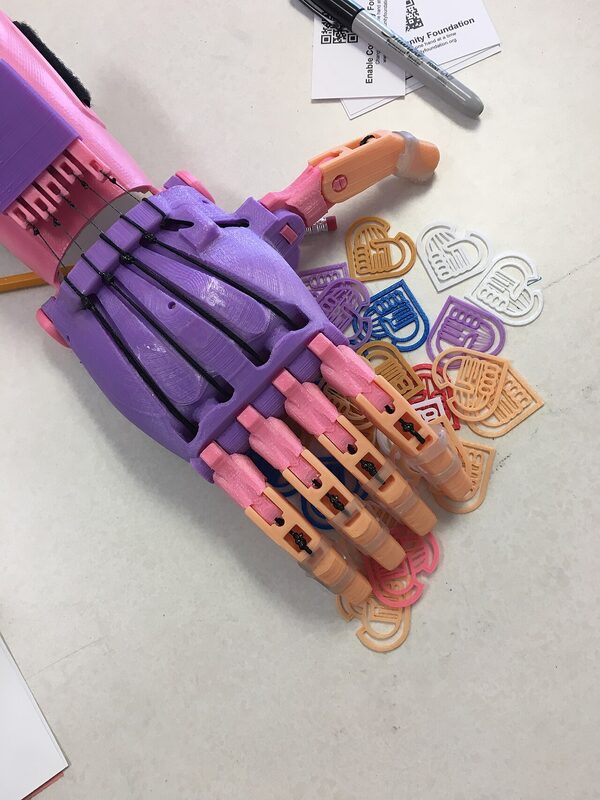
The economics of adaptive sports equipment have always been brutal. A prosthesis built for sprinting, a socket that survives a basketball game, a device that lets a hand amputee surf: each is a low-volume, high-customization product, and the people who need them often pay accordingly or go without. Tikkun Olam Makers (TOM) is trying a different model. As VoxelMatters reported on November 27, the organization has launched the Guttmann Portfolio, a free, open-source library of production-ready design files for sports equipment for people with disabilities, starting with 36 solutions that anyone can download, modify and build.
The pitch is aimed squarely at distributed fabrication. Rather than shipping finished devices from a central manufacturer, TOM wants local workshops, hospitals and rehabilitation centers to produce the equipment on ordinary 3D printers, close to the athletes who will use it. That is a familiar idea in the maker world. What is new here is the framing: a curated, sports-specific collection with an explicit path toward the Paralympic stage.
A Name With History
The portfolio takes its name from Ludwig Guttmann, whose Stoke Mandeville event on July 29, 1948, brought together 16 wheelchair archers. That modest competition is widely treated as the seed of what became the Paralympic movement, and TOM's choice of name signals the scale of its ambition. The organization says it plans to present the portfolio at the 2028 Los Angeles Games, roughly two years after the library's debut.
The launch itself took place in July 2026 at the Maccabiah Games, in cooperation with the Israeli Paralympic Committee and Maccabi World Union. Press materials for the launch included remarks from Pascale Bercovitch and Michelle Betty Levy. TOM expects the collection to grow over the next two years, so the 36 designs available now are best understood as a starting inventory rather than a finished catalog.
What Is in the Library
The initial designs come from engineers in the United States, Israel and elsewhere, and they span sports with very different mechanical demands. Three examples stand out in the launch coverage:
- A basketball prosthesis, intended for a sport defined by sudden direction changes, jumping and contact.
- A surfing solution for hand amputees, addressing the problem of gripping and controlling a board without a full hand.
- A Monofin Prosthesis, developed by students at the Holon Institute of Technology. The design won the TOM Global Innovation Challenge and has been used by freediver Sergey Korol.
The monofin is a useful case study in how this pipeline is supposed to work. It began as a student project, moved through a structured competition, and reached an actual athlete in an actual discipline. Folding that kind of design into a public library means the next freediver who needs one does not have to wait for another student team to reinvent it.
One important caveat: the press materials do not specify print technologies or materials for individual designs. Makers should not assume that every file in the portfolio is intended for an FDM machine running PLA, or that any given part is rated for the loads a competitive athlete will put through it. Those details presumably live in the documentation attached to each design, and anyone planning a build should read it closely before committing filament.
The Organization Behind It
TOM was founded in 2014 under the Reut Group and is led from New York. On its own site, TOM Global describes itself as a worldwide community that builds and open-sources affordable assistive technology. The numbers it publishes suggest the Guttmann Portfolio is an extension of an existing habit rather than a pivot. The site lists 1,507 open-source assistive technology projects. Of those, 146 are tagged with 3D printing as a technology, and 116 fall under a Sports category.
The popular projects on the site give a sense of the community's range: a 3D-printed toddler mobility trainer, a parametric prosthetic arm, an adaptive surfboard and a 3D-printed violin prosthesis. Notably, the TOM Global homepage does not itself list the Guttmann Portfolio, so the sports collection appears to be presented as a distinct initiative rather than simply a filter on the broader project database.
That distinction matters. A database of more than 1,500 projects is a powerful resource, but it is also a lot to wade through, and quality and completeness can vary across community submissions. A portfolio branded as "production-ready" implies a higher bar: designs that have been vetted enough that a hospital workshop can print them without first acting as an engineering department.
What It Means for Makers
For the maker community, the Guttmann Portfolio is less about any single design than about where printers sit in the supply chain. Assistive devices are a textbook case for additive manufacturing: small batches, individual fit, geometry that benefits from parametric adjustment, and users who are often underserved by commercial vendors. The barrier has rarely been the printers themselves. It has been the lack of trustworthy, documented designs and someone local willing to build them.
A few practical points follow from that:
- Local makerspaces have a real role. TOM explicitly names local workshops alongside hospitals and rehab centers as intended producers. A makerspace with a few reliable machines and members willing to collaborate with clinicians could become a meaningful source of adaptive sports gear in its region.
- Fit and safety are not optional. Sports equipment worn on the body takes repeated, sometimes violent loads. Without published material and process specifications in the launch materials, builders need to treat each design's documentation as the authority and work with the athlete, and where appropriate a clinician, on fit and testing.
- Open source cuts both ways. Free-to-adapt files mean a local builder can modify a socket or a mounting interface for a specific user. It also means modifications are the builder's responsibility. Documenting changes and contributing improvements back is how a library like this gets better over its planned two-year growth period.
- There is room to contribute. With the collection expected to expand, and TOM already running innovation challenges that feed designs like the monofin into the pipeline, makers with engineering skills have a plausible route to getting their own adaptive sports designs in front of athletes.
Bottom Line
Thirty-six designs is a small number next to the 1,507 assistive projects already listed on TOM Global alone. But the Guttmann Portfolio is a deliberate attempt to package sports-specific, production-ready files and push them toward the people who can print them locally. If the collection grows as planned and arrives at Los Angeles in 2028 with a track record of athletes actually using the gear, it will be a strong argument that the ordinary 3D printer in a hospital basement or community workshop belongs in the adaptive sports supply chain.
