
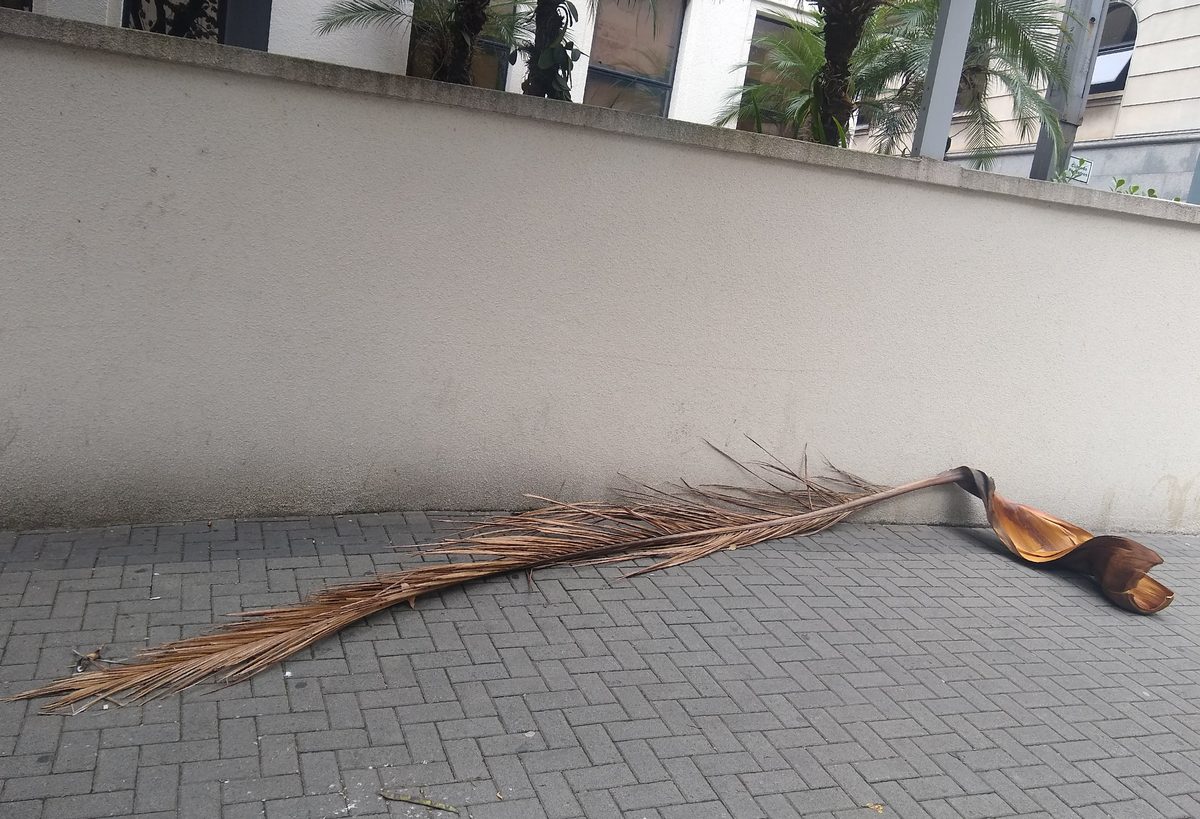
A Dutch company is betting that the next sustainability argument in 3D printing will not be about what filament is made from, but about where it ends up. Hembased B.V., based in Nieuw Vennep in the Netherlands, has launched an FDM filament built from a biopolymer derived from fallen palm leaves — a material the company calls "koud composteerbaar," or cold compostable, meaning it breaks down in an ordinary backyard compost bin rather than requiring an industrial facility. 3DPrint.com covered the launch on July 19, 2026. The claimed timeline is within one year at 20-30 degrees C, decomposing into water, biomass and CO2. Price: 32 euros per kilogram, roughly $36.
How the material is made
The process Hembased describes is straightforward, at least in outline. Palm leaves that have fallen to the ground — and that could otherwise have been burned — are collected, dried and ground into a fine powder using local machinery. That powder becomes a granulate the company calls HemCell, which is then processed into finished products including filament. Hembased's site describes the product as "100% biologisch afbreekbaar filament op basis van palmblad-biopolymeer" — a 100 percent biodegradable filament based on a palm-leaf biopolymer — sourced from agricultural waste streams. On the disposal end, 3DPrint.com reports that under the right conditions a printed object can ultimately serve as a nutrient source within a biological system.
Five colors are listed: grey, pink, brown, beige and black — all showing as out of stock or unavailable at the time of writing. Hembased also offers bulk delivery, recurring supply, test programs and R&D partnerships on request, which suggests it is aiming at packaging and industrial customers as much as at desktop makers. Notably, print settings are not published on the product page — no nozzle or bed temperatures, no recommended speeds, no drying or enclosure guidance. For a material with an unfamiliar feedstock, that is a meaningful omission. Anyone ordering a spool is running their own temperature tower first.
The PLA end-of-life reality most makers get wrong
The cold-compostable framing matters because of a persistent misconception about PLA. PLA is bio-based and technically compostable, and those two facts get collapsed into "it breaks down if I bury it." It does not, in any practical sense. PLA's compostability is defined against industrial conditions — sustained elevated temperatures and managed humidity that a backyard bin does not reach and cannot hold. A PLA benchy in a garden compost heap is, functionally, a plastic benchy in a garden compost heap.
This is why "home compostable" is a materially different claim from "compostable," and why Hembased's positioning aims at that gap. Founder Erik Janssen framed it in terms of lifecycle responsibility, saying materials "should not only perform well during use, but should also have a credible and responsible end-of-life solution." That is the correct framing. Whether this product is the answer is a separate question.
This category is thirteen years old
Here is the context the launch coverage included and most aggregators will drop: Hembased is not first. Although the company positions itself as a first mover, 3DPrint.com identifies at least five prior producers of cold-compostable biofilament. ColorFabb's allPHA has been on the market since 2013. Regen Filaments, Phanbulous, Ecogenesis EcoFab, Loopha and Genecis all occupy the same space.
So the newsworthy element is not the concept. It is the feedstock and the price. Palm leaves that would otherwise be burned are a genuinely low-value input, and a waste-stream feedstock is a better story than a purpose-grown crop if the conversion process scales. Thirty-two euros per kilogram is expensive against commodity PLA — several times a decent mainstream spool — but it is not exotic-materials pricing. It sits in the neighborhood makers already pay for specialty engineering filaments, a bracket a hobbyist might plausibly try on a whim rather than as a statement purchase.
The certification gap
Now the caveat that should govern how much weight you put on any of this. Hembased's site references ESG and compliance requirements and the EU's Packaging and Packaging Waste Regulation (PPWR), but names no specific third-party compostability certification. There is no TUV OK compost HOME mark cited, and no equivalent independent verification listed. The site gives no fixed timeline at all, noting only that breakdown depends on compost composition, moisture, aeration and particle size; the one-year figure comes from the launch coverage.
That matters, because home-compostability certification exists precisely to keep this kind of claim honest. Ambient-temperature degradation is the hard case — industrial certification is easier to earn and far more common — and a mark is the difference between a tested result and an assertion. Hembased may have testing in hand and simply not published it. But as things stand, the one-year figure is a company claim rather than an audited one.
The palm plantation question
The second complication is sourcing. Palm cultivation carries a well-documented set of land-use concerns, and a filament marketed on environmental credentials invites scrutiny of the whole supply chain, not just the disposal end. 3DPrint.com raised this directly, with the writer saying he hoped the leaves did not come from the palm plantations associated with palm oil production and deforestation, and questioning whether plantation sourcing could inadvertently incentivize more of it.
What is on the record is that the leaves are collected after falling and would otherwise have been burned — a waste stream being diverted rather than, on its face, a driver of additional cultivation. That is the same logic behind coffee-ground and hemp-waste filaments. It also cannot be evaluated from a product page, and the coverage did not resolve it. Which plantations, under what certification regime, and whether demand for HemCell granulate could eventually make palm leaves valuable enough to influence planting decisions are all open questions.
What It Means for Makers
If you print functional prototypes, jigs, packaging inserts or anything with a short intended life, this is worth watching. The end-of-life problem in desktop 3D printing is real, and most responses to it have been expensive, poorly documented, or both. A waste-derived feedstock at 32 euros per kilogram is a more reasonable-looking attempt than most.
But do not treat it as settled. Before ordering, ask Hembased for two things: published print settings, and any third-party home-compostability test data or certification. A company selling on end-of-life performance should answer the second without hesitation. If it can, this becomes a serious option for anyone uneasy about the pile of dead prototypes in the garage. If it cannot, you are buying an unusual bioplastic with an unverified disposal story — still probably better than PLA's, but not by as much as the marketing implies.
And regardless of what you print with: stop putting PLA in the garden compost. It is not doing what you think it is doing.
