
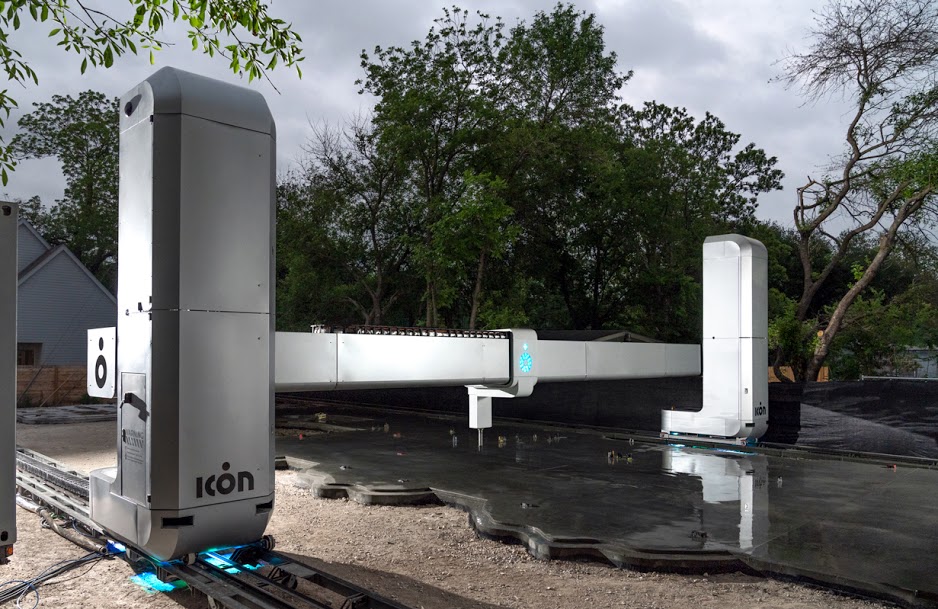
Soldiers at Fort Bliss began moving into the first two of ten robotically 3D-printed barracks on July 29, according to an ICON newsroom announcement, marking what the construction-printing company describes as the largest robotic-construction deployment in Department of War (DoW) history — the Pentagon's current name for what was long known as the Department of Defense. The occupancy comes roughly six and a half months after the January 2026 contract award, while the full ten-building project remains on track for its overall nine-month sprint from contract signature to final delivery, expected in September — a compressed timeline that would be aggressive for a single building, let alone ten.
The numbers behind the project are the real story. ICON's production contract, worth $62.8 million, was awarded January 15, 2026. All ten barracks — each 5,772 square feet of conditioned space, for a combined 78,000 square feet across the project, enough to house 560 service members — have now been printed, according to VoxelMatters. ICON says the buildings are fully compliant with Unified Facilities Criteria (UFC), the U.S. military's engineering and construction standard for infrastructure, and that the project came in about 9% cheaper and roughly four times faster than a comparable conventional-construction timeline.
How the Numbers Break Down
Print speed is where the project distinguishes itself from the handful of prior military 3D-printing demonstrations. According to reporting from VoxelMatters, the print phase for all ten structures was completed in just 58 days. The builder of record is ICON Prime, and the full arc from contract signature to final delivery is projected at about nine months, with the overall project on track for completion in September 2026 as finishing work, utilities, and interior fit-out wrap up on the eight buildings not yet occupied.
That 58-day figure is a printing-throughput number, not a full-project timeline — a distinction that matters for anyone trying to benchmark large-format construction printing against traditional framing crews. Ten buildings, each just under 5,800 square feet, printed in under two months works out to roughly six days of wall-printing per structure if the schedule were sequential — though large-format construction printers of ICON's type are more likely to have run multiple builds in parallel, using gantry or robotic-arm systems that traverse the print site rather than a single fixed printer.
Military Housing as a Construction-Printing Proving Ground
The military has been a recurring test bed for large-scale concrete printing for several years, and barracks are a logical target: they're a standardized, repeatable building type with fixed dimensional and life-safety requirements, which is exactly the kind of job that favors an automated, code-compliant print process over bespoke architecture. UFC compliance is the detail worth underlining here — it means the printed walls had to meet the same structural, fire, and life-safety standards as conventionally built barracks, not a relaxed pilot-program standard. That's a meaningfully higher bar than the demonstration and single-family housing projects that have made up most of ICON's public portfolio to date.
Major General Curtis Taylor, commanding general of Fort Bliss, framed the project around readiness rather than novelty. "It is about combat readiness... taking care of our people," Taylor said, according to VoxelMatters' account of the ribbon-cutting. In the near term, the barracks will house soldiers from Task Force Bastogne, who are supporting Joint Task Force-Southern Border as part of Operation Ardent Vanguard, VoxelMatters reported. That framing is consistent with how the military has talked about barracks modernization generally: aging and undersized housing has been a persistent readiness and morale concern across the services, and a faster, cheaper build pipeline is attractive independent of whether the underlying technology is printed concrete or modular steel.
What It Means for Makers
None of this is desktop-adjacent — nobody is scaling a Fort Bliss barracks print down to a Bambu Lab build plate — but the underlying trend is worth watching for anyone tracking additive manufacturing's credibility trajectory. A $62.8 million, UFC-compliant, DoW-inspected structural contract is a very different proof point than a novelty pavilion or a single printed show-home: it means a construction-printing company had to pass structural engineering review, meet federal procurement and life-safety standards, and deliver at production scale on a fixed government timeline. That's the kind of institutional validation that tends to precede wider adoption, the way early industrial and aerospace metal-printing contracts did for powder-bed fusion a decade ago.
It also says something about where large-format printing's economic case is strongest. The reported ~9% cost savings and 4x speed advantage over conventional construction aren't dramatic on cost alone — construction-printing advocates have sometimes promised more — but paired with a hard deadline and a standardized, repeatable building type, they're enough to win a real production contract rather than a research grant. For makers who follow the additive-manufacturing industry beyond their own printer's build volume, this is a useful data point on where large-format concrete printing is actually competitive today: not one-off custom architecture, but high-volume, code-compliant, repeatable structures where speed and standardization matter more than aesthetic flexibility.
There's also a supply-chain angle worth flagging for anyone curious about the hardware side. Large-format construction printers of this class typically run proprietary cementitious material formulations rather than off-the-shelf concrete, and the print system itself — gantry, mixing/pumping unit, control software — is a purpose-built industrial machine with little in common with a filament or resin printer beyond the shared "additive manufacturing" label. None of the source material here details ICON Prime's specific hardware configuration, so any claims about printer count, gantry type, or material chemistry used at Fort Bliss would be speculation beyond what's been confirmed.
Bottom Line
The first two of ten barracks are occupied, eight of ten remain in finishing stages, and ICON expects the full project done by September 2026. For an industry that has spent years fielding skepticism about whether construction printing can meet real structural and regulatory standards at scale, a UFC-compliant, DoW-funded, on-time barracks contract is a concrete answer — pun very much intended.
