
A gold signet ring buried for roughly 1,700 years now has a plastic stand-in, and the stand-in is doing a job the original never could: getting handled. According to South West Heritage Trust, Somerset Council's Library Service used a Creality Sermoon P1 3D scanner to digitize the Ilminster Ring — a Roman-era gold ring dated to around AD 297 — and turned the scan data into a 3D-printed replica that museum and library visitors can pick up, turn over, and examine without putting the actual artifact at risk.
The ring itself has the kind of backstory that makes archaeologists sit up. It was found in 2018 near Ilminster, Somerset, by metal detectorist Kevin Minto, buried alongside a hoard of Roman coins. The band is decorated with an engraving of the goddess Victory driving a two-horse chariot, a motif common enough on late Roman intaglio and signet work but rare to recover intact and identifiable in a ring this well preserved. It's now cared for by the Museum of Somerset under the South West Heritage Trust, which means it lives under the environmental controls and handling restrictions any museum applies to fragile, irreplaceable gold artifacts — restrictions that, by definition, keep it out of the hands of the public that wants to understand it.
The Scan: Seven Passes for One Hollow Ring
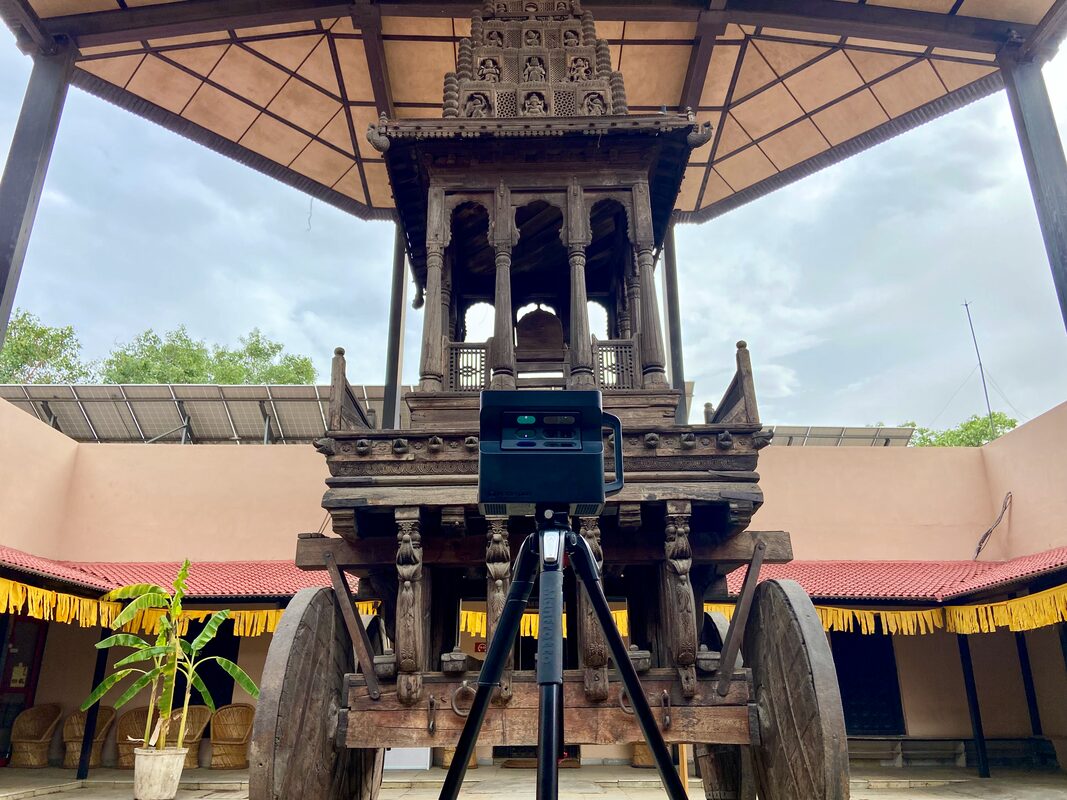
The technical detail worth dwelling on here is why this particular scan wasn't a single pass. The Sermoon P1 is a tripod-mounted scanner that tracks its own position using white reference markers placed around the object, then builds a mesh from laser distance measurements — thousands of individual readings per pass — rather than the structured-light patterns some competing scanners use. Somerset Libraries staff member Olly Hellis ran the scan, with Museum of Somerset senior curator Amal Khreisheh positioning the ring and rotating it by hand on a turntable for each pass. But the Ilminster Ring is hollow, and a hollow, roughly toroidal object is a genuinely hard scanning target: a single fixed laser position can't see around the inner bore, the underside of the band, and the recessed detail of the Victory engraving all at once without self-occlusion. South West Heritage Trust's team worked around that by capturing seven separate geometric scans from different orientations, cleaning up noise and gaps, and stitching them together into one composite mesh using the ring's own asymmetrical features as alignment points — then running an additional set of scans purely to capture color and texture, the gold and blue hues of the piece, and wrapping that data onto the finished geometry. That's a detail with real value for anyone scanning small, geometrically awkward objects — rings, beads, pierced or hollow work, anything with interior surfaces a single scan pass can't reach. Seven passes is a lot of manual repositioning and alignment work for a single small ring, and it says something about how much cleanup a hollow, high-detail original demands even from purpose-built hardware.
From Scan to Something You Can Actually Hold
Once the mesh was clean, it went to a 3D printer to become a handling replica — a stand-in that visitors can pick up and even try on their own finger, something the original, gold and seventeen centuries old, was never going to be handed around a gallery floor. The replica went on public display alongside the original ring at the Ilminster Ring Discovery Day, held at the Ilminster Arts Centre on Thursday, August 20. Trade coverage from 3D Printing Industry describes the equipment used as "a sophisticated 3D hand scanner funded by the British Library," employed to produce "a highly detailed digital model." That framing matters: this wasn't a scrappy workaround with whatever hardware happened to be lying around, but purpose-funded equipment doing the job it was bought for. The ring's fine detail and hollow geometry were transferred faithfully enough that the physical copy functions as a genuine study object, not just a rough approximation, while the actual gold ring stays in controlled storage and display conditions at the Museum of Somerset. This isn't a one-off experiment for Somerset's libraries, either. The Library Service's 3D printing operation has been running for roughly a decade, serving individuals, schools, community groups, and local businesses — the kind of quietly persistent public infrastructure that rarely makes headlines until it's pointed at something like a Roman artifact and the result is obviously newsworthy.
What It Means for Makers
The headline hardware here — a Creality Sermoon P1 scanner — was run in-house by Somerset's own library staff rather than handed off to an outside conservation contractor, and according to 3D Printing Industry's coverage it was funded specifically by the British Library to put that capability inside a regional library service. That's the actual story worth taking note of: a public library's in-house digitization team, not a national museum's conservation lab, executed a heritage-documentation workflow good enough to stand in for a fragile Roman gold artifact — proof that the skill and process matter as much as which institution's name is on the door. For makers who scan small, detailed, or geometrically tricky objects — jewelry, coins, mechanical parts with internal cavities, cosplay hardware with recessed detail — the multi-pass-and-merge approach is the transferable lesson. A single scan from one angle is rarely enough for anything with an interior or an occluded underside; budgeting for several partial scans and a stitching pass in software is standard practice once you're past flat or simple convex objects, and this project is a clean, well-documented example of it working on genuinely difficult subject matter — seven geometry passes plus a separate color-and-texture pass, all merged after the fact. There's also a quieter case study in institutional use of library-run digitization tools: a public library system running a 3D printing service continuously for around ten years, serving everyone from schoolkids to local businesses, and having that infrastructure and expertise ready to reach for when a heritage trust needed exactly this kind of digitization-and-replication project. If your local library or makerspace has a scanner and a printer sitting in a corner, this is a reminder of the kind of project they're actually capable of — not just prototype brackets and cosplay props, but conservation-grade documentation of objects nobody's normally allowed to touch.
