
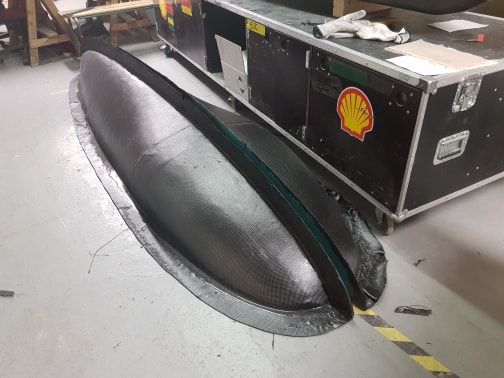
Massivit has opened its first Europe-based Service Center in Barcelona, a facility built around the company's Cast In Motion (CIM) digital tooling technology and positioned as the on-the-ground debut of RapidWings, the aerospace-and-defense composite manufacturing platform Massivit launched earlier this year. The facility went live on July 8, 2026, and its job is narrow but consequential for anyone who has ever waited on a composite tool: print molds, masters, mandrels, jigs and fixtures on demand, and do it in days instead of the months that machined or laminated tooling typically requires.
For makers steeped in desktop FDM and resin printing, "tooling" can sound like a step removed from the actual object being made — and it is. A mold, mandrel, or jig doesn't ship to a customer; it's the equipment a shop uses to lay up, cure, or hold a composite part in place while it's built. But tooling is also where a huge amount of composite manufacturing's time and cost actually lives. Machining a mold from tooling board or metal, or hand-laying a composite master, can take weeks to months before a single production part is ever made. That lead time is the bottleneck RapidWings and the new Barcelona center are aimed squarely at.
What Cast In Motion and RapidWings Actually Do
RapidWings, which 3D Printing Industry reported Massivit launched in June 2026, is described as an end-to-end system for aerospace and defense composite manufacturing — not a single machine or material, but a platform meant to connect digital tooling production to the broader composite supply chain. The Barcelona Service Center is the first physical expression of that platform in Europe, and it's built specifically around Massivit's Cast In Motion (CIM) digital tooling technology, which the company uses to 3D print tooling assets directly rather than machining or hand-building them.
The sourcing does offer some technical specifics, even if it stops short of full process documentation. TCT Magazine describes CIM as producing isotropic tooling — meaning the tooling's material properties hold up consistently in every direction — with dimensional stability, thermal resistance, adhesion, and surface quality suitable for autoclave processing, and molds that TCT reports can withstand hundreds of duty cycles. 3D Printing Industry separately describes CIM as a large-format digital deposition process built around a dual-component thermoset composite material. Neither source publishes exact build-volume dimensions, layer resolution, or deposition-speed figures, so this article won't speculate on those. What is confirmed is the scope of what the Barcelona facility produces: molds, masters, mandrels, jigs, fixtures, and prototype tooling, all generated on demand rather than stocked or scheduled far in advance.
Why Barcelona, and Why Now
Massivit CEO Yossi Azarzar called the Barcelona opening "a milestone in Massivit's business transformation and in the transition to the implementation of our international expansion strategy," according to TCT Magazine's report. That framing matters as much as the technology itself. The new center, which coverage describes as operating under Massivit's European entity, isn't just a satellite showroom — it's described as the first step toward a network of future RapidWings service and production centers globally.
sUAS News's coverage of the opening adds an important structural detail: these future centers are meant to be deployable either independently, run directly by Massivit, or through what the company calls a Joint Manufacturing Alliance — a third-party network model. That's a distribution strategy familiar to anyone who has watched other manufacturing-technology companies try to scale physical production capacity without building and staffing every site themselves. Rather than shipping tooling internationally or waiting for a single centralized facility to work through a backlog, the model spreads localized, on-demand production across a network of centers — owned by Massivit in some cases, operated by partners in others — all built on the same RapidWings/CIM foundation.
The aerospace-and-defense framing is also deliberate. Both sUAS News and 3D Printing Industry position RapidWings within that sector specifically, not general industrial composites. Aerospace and defense programs are notorious for long qualification cycles and tooling that has to be replaced or modified as a design iterates — exactly the kind of repeated, time-sensitive tooling need that a "print it in days" pitch is built to address. sUAS News in particular covers uncrewed and defense-adjacent systems, which lines up with a platform explicitly aimed at that supply chain rather than, say, automotive or marine composites.
What It Means for Makers
Most FilamentFeed readers aren't running composite layup shops, so the direct relevance here is limited — this isn't a desktop printer story. But it's a useful data point for anyone tracking where large-format and industrial 3D printing is actually earning its keep in 2026: not in printing finished end-use parts at scale, but in printing the infrastructure — the molds, mandrels, and fixtures — that traditional manufacturing processes depend on. That's a pattern worth watching if you follow the industrial end of the additive manufacturing market, because tooling-on-demand is one of the clearer cases where 3D printing's speed advantage translates directly into dollars: a machined composite mold that used to gate a program for months becomes a bottleneck measured in days.
It's also a signal about where the geographic expansion of digital tooling is heading. Massivit's decision to plant its first European facility in Barcelona, explicitly as a template for future centers elsewhere, suggests the company sees this less as a one-off deployment and more as a franchise-style rollout — either run in-house or handed to manufacturing-alliance partners. If that model works in Europe, expect more regional service centers to follow, each one shortening the physical distance between a composite manufacturer's design files and its finished tooling.
For now, the concrete facts are these: a facility exists, it opened July 8, 2026, it's built on CIM digital tooling technology, it operates under Massivit's European entity as part of the RapidWings platform, and its stated purpose is compressing composite tooling lead times from months to days. Whether it delivers on that timeline at scale — across multiple customer programs, multiple part geometries, multiple material systems — is the next thing worth checking, once real users outside Massivit's own announcements start talking about turnaround times.
