
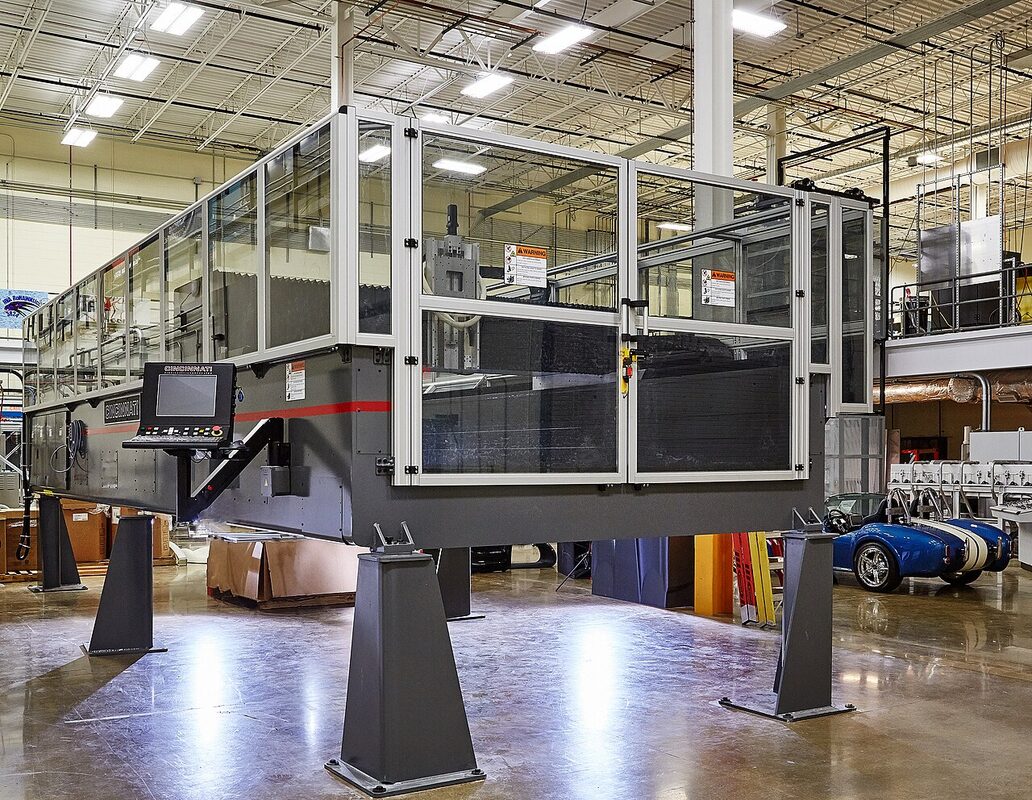
A robotic arm slowly building up bead after bead of molten metal isn't the image most people have of aerospace tooling — but that's exactly how Oak Ridge National Laboratory and Boeing just produced a mold destined for NASA's next-generation composite aircraft work. According to ORNL's announcement, the two organizations used wire-arc additive manufacturing (WAAM) to print a Stamp Form Die — a mold roughly 6 feet tall, 4 feet wide, and weighing nearly two tons — over eight weeks, betting that large-format metal printing can outcompete traditional machining, casting, and forging on cost and lead time.
The tool was built on ORNL's Arc-1 system, a robotic WAAM platform housed at the Department of Energy's Manufacturing Demonstration Facility (MDF) at Oak Ridge, according to reporting from 3D Printing Industry. WAAM works by feeding metal wire through an electric arc, melting it, and depositing it layer by layer to build up large, dense structures — a process better suited to producing big, chunky parts quickly than the powder-bed printers most makers associate with metal 3D printing.
What a Stamp Form Die Actually Does
A Stamp Form Die, or SFD, is the hard tooling used in a punch press to cut and form material into a target shape. In this case, the die will be used to stamp thermoplastic composite sheet into aircraft parts — the kind of tooling that traditionally gets machined out of solid billet, cast, or forged. 3D Printing Industry notes that ORNL's goal with this build was specifically to test whether a thermally controlled SFD mold produced via additive manufacturing could lower cost, shorten lead time, and simplify fabrication compared with that conventional route — notably, ORNL's announcement doesn't publish actual cost or lead-time figures for either approach, so the comparison remains a hypothesis the project was built to test rather than a proven result.
The engineering choice inside the mold itself is worth pausing on. Rather than printing the whole tool from one alloy, the team combined mild steel in the load-bearing zones — where the part needs to survive the repeated mechanical stress of stamping — with a stainless-steel surface layer for corrosion resistance where the tool actually contacts material. That's a multi-material strategy that's difficult or impossible to replicate with a single casting or forging, and it's one of the clearer arguments for why WAAM earns a seat at the table for tooling like this rather than just novelty parts.
Why NASA and Boeing Care
The mold isn't a standalone demo piece — it's built to support Boeing's contribution to NASA's Hi-Rate Composite Aircraft Manufacturing (HiCAM) project, a program aimed at pushing composite airframe production to rates the industry can't currently hit with legacy processes. Richard Young, NASA's HiCAM project manager, is quoted in the ORNL release framing the broader goal as increasing the production rate of composite aircraft while reducing aircraft weight and fuel costs — the two levers that matter most for airlines trying to cut operating expense.
Boeing Technical Fellow Michael Matlack, also quoted in the release, frames the project in more competitive terms: manufacturers that don't keep innovating on how they build tooling and structure risk losing ground to rivals who do. That's a notable admission from a legacy aerospace manufacturer — Boeing isn't printing this mold because additive is trendy, but because the tooling bottleneck for composite parts like the doors this SFD was built to stamp is likely a real constraint on how fast the company can scale production. ORNL also notes Boeing drew on a network of American small and large businesses across the project, suggesting this isn't a closed-door lab exercise but something meant to seed a broader domestic supply chain around large-format metal AM tooling.
What It Means for Makers
None of this touches a desktop FDM printer directly, but it's a useful data point for anyone tracking where additive manufacturing is proving its economic case rather than just its technical novelty. Tooling — molds, dies, jigs, fixtures — has quietly become one of the strongest niches for metal AM precisely because tooling lead time is often the actual bottleneck in a production line, not the part itself. A punch press can't run until the die exists, and if printing that die in eight weeks meaningfully undercuts the time a machined or forged equivalent would take, the ROI case starts to write itself even before you factor in the ability to mix alloys within a single tool the way ORNL did here with mild and stainless steel.
It's also a reminder that "3D printing" at the industrial end of the spectrum looks nothing like a Bambu Lab or Prusa on a desk. WAAM systems like Arc-1 are robotic arms doing metal deposition at a scale measured in feet and tons, not millimeters and grams, and the economics that matter — cost per pound of deposited metal, deposition rate, post-process machining time to hit final tolerances — are entirely different from the ones that govern polymer desktop printing. But the underlying logic is the same one that's driven adoption of desktop and workshop-scale printers for years: when a conventional process has a long, expensive tooling step in front of it, additive manufacturing's ability to skip or compress that step can be worth the tradeoffs in material properties or surface finish.
What's genuinely new here isn't that metal AM can make big things — DED and WAAM systems have been proving that for a while — it's that a major aerospace prime is willing to put a printed die directly into a NASA-backed production-rate program rather than treating it as a lab curiosity. If the SFD performs well in Boeing's stamping operations, it becomes a reference case other tooling shops and aerospace suppliers will point to when justifying their own investment in large-format metal printers. That kind of validation, more than any single technical spec, tends to be what actually moves an additive process from "interesting demo" to "line item in next year's capital budget."
