
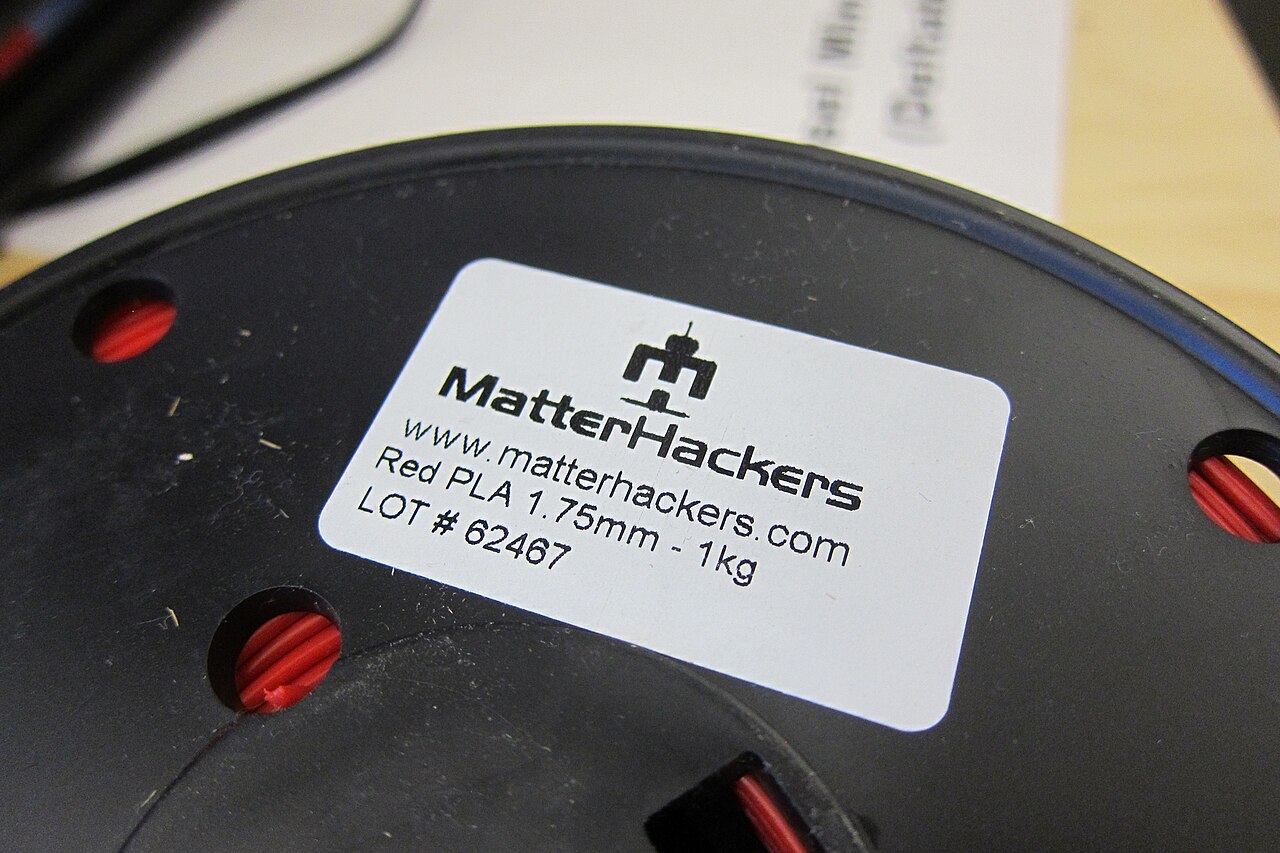
PLA has long had a reputation as the friendly filament: bio-based, easy to print, and widely treated as the safe choice for a home workshop. A new paper from researchers at St. Mary's University in San Antonio adds a complication. As reported by 3D Printing Industry, the study, published in November 2026 in the journal Pollutants under the title "3D Printing-Derived Polylactic Acid Microplastic Material Induces Germline Apoptosis and Impairs Reproduction in Caenorhabditis elegans," exposed the nematode worm C. elegans to microplastics generated from a PLA-based 3D-printed project. The worms produced fewer offspring, showed altered gonad structure, and had increased germline cell death. Their lifespan did not change.
That is a meaningful result, and it is also a narrow one. The paper's own limitations are long enough that reading it as "PLA is toxic" would be as much of an overreach as the old assumption that PLA is harmless. Below we walk through what the researchers did, what they found, and where the boundaries of the finding lie.
What Did the Researchers Actually Do?
The work grew out of student research at St. Mary's. A Spring 2026 poster in the university's Digital Commons lists the student authors as Gamez, Farley, Maldonado and Mares, with faculty mentors Susan Oxley and Jennifer Harr. The team used cryo-milled PLA microplastics, meaning material ground up at very low temperature, to study fertility, development and lifespan in C. elegans.
The important detail for makers is the source material. Rather than starting from a pure polymer, the researchers started from an actual 3D-printed PLA-based object and generated particles from it, aiming to see what happens after a printed part starts to break down. The 3D Printing Industry headline frames the result as a warning that lab-made microplastics may understate the risk.
The poster also places the work in context. It notes prior research showing that PLA exposure caused organ damage in fish and that primary and UV-aged PLA microplastics reduced reproduction in C. elegans. The new study therefore is not the first signal that PLA particles can affect living organisms; it extends that line of work to material that has passed through a 3D printer.
What Did They Find?
The headline effects were reproductive. Exposed worms laid fewer offspring, their gonads looked structurally different, and the researchers observed germline apoptosis, the programmed death of the cells that give rise to eggs and sperm. Lifespan, by contrast, was unaffected. In other words, the worms did not die sooner, but their reproductive systems showed signs of damage.
Jennifer Harr, Ph.D., of St. Mary's, who led the work, made the broader point plainly: labels such as "bio-based" should not be read as a guarantee of safety. That is a reasonable caution regardless of how this particular study holds up. "Made from plants" describes where a polymer's feedstock comes from, not how its particles or additives behave once they get into an organism.
What the Study Does Not Show
This is where careful reading matters, because the limitations, as summarized by 3D Printing Industry, are substantial.
One dose. The worms were exposed at a single concentration, 1 µg/L. With only one dose, there is no dose-response curve. We cannot tell whether effects scale with exposure, whether there is a threshold below which nothing happens, or how 1 µg/L relates to any real-world exposure scenario.
Mass, not particle count. The dose was measured by mass rather than by number of particles. Two suspensions with the same mass can contain very different numbers and sizes of particles, which makes comparisons with other studies harder.
Particle size versus what worms can eat. Adult C. elegans ingests particles up to about 5 µm, and fewer than 3% of the particles in this preparation fell in that range. Most of the material, then, was too large for the worms to swallow. The authors note that the harm may therefore have come through feeding interference or skin contact rather than ingestion, so how the effects arose remains open.
The filament is not just PLA. This may be the most important caveat for makers. Chemical analysis of the filament found the polymer plus more than 50 other components, including 14 chemicals the researchers could not identify. Leachates, the chemicals that can migrate out of the plastic into the surrounding liquid, were not tested separately. Because the suspension was sonicated before use, the authors also caution that the nominal mass concentration should not be read as a measured particle concentration. As a result, the effects cannot be attributed specifically to the PLA polymer, the particle properties, or associated chemical additives, which is why the paper says "PLA-MP material" rather than blaming the plastic itself.
Put together, these limits mean the paper is best read as a signal worth following up rather than a verdict. It shows that material derived from one PLA-based printed project affected worm reproduction under one set of conditions. It does not establish a mechanism, a safe exposure level, or that pure PLA is the culprit. The team has already outlined next steps: examining the chemical classes present, testing leachates on their own, adding UV aging, and using multiple concentrations to build a dose-response curve.
What It Means for Makers
The practical takeaway is less about panic and more about retiring an assumption. "PLA is harmless" was always a shortcut, and this study is a reminder that a spool of filament is a formulated product, not a pure polymer. If a single filament can carry more than 50 other components, some of them unidentified, then the safety profile of any given spool may depend at least partly on what the manufacturer put into it, and that information is rarely printed on the box.
The study's method also hints at where the relevant exposure might lie. The researchers tested particles made by cryo-milling, a mechanical process, not fumes from printing. That makes the work most relevant to situations in which printed PLA gets broken down mechanically or ends up shedding fragments into the environment. Makers who already treat dust from sanding and post-processing with some care have little reason to change course; those who have assumed PLA dust is benign may want to apply the same basic hygiene they would to any other plastic dust.
It is also a reminder about disposal and waste. Failed prints, supports and purge lines are a steady output of any active printer, and the bio-based reputation of PLA can encourage a casual attitude toward where that material ends up. Harr's own framing is that understanding the consequences of the waste that 3D printing and bioplastics generate is increasingly important.
Finally, the most useful thing makers can do with this paper is hold it to its own limits. One dose, one filament, a mostly non-ingestible particle size distribution and untested leachates leave plenty of room for follow-up studies to strengthen, weaken or reframe the result. Until then, the reasonable position is the one Harr outlined: a bio-based label is not a guarantee of safety, and PLA deserves the same ordinary respect as any other plastic in the shop.
