
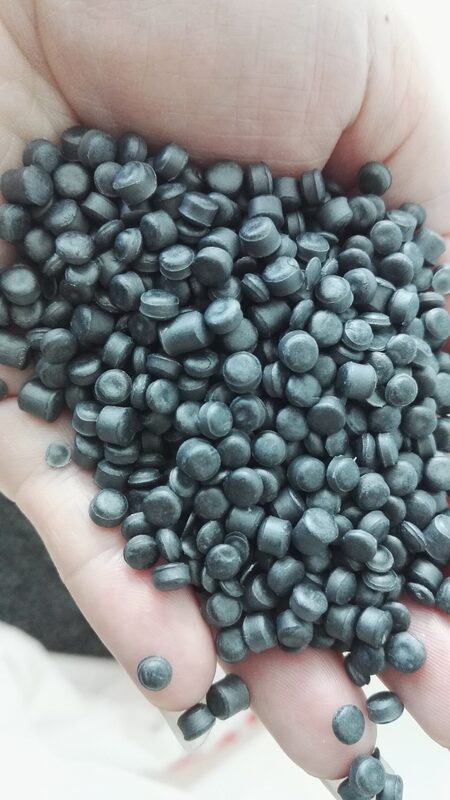
Large-format pellet printing has always had a color problem. If you want a part in a specific brand blue, the usual answer is a custom masterbatch, and that means minimum order quantities and lead times that make no sense for a one-off sculpture, a trade-show prop or a short run of architectural panels. Polymaker thinks it has a way around that. On October 13 the company announced CymphoniK, a six-pellet color system that lets a printer operator blend more than 100 colors on site, according to 3D Printing Industry's report on the launch. Polymaker's own product pages were not reachable for this story, so the details below rest on that report.
The pitch is simple: stop buying color, and start mixing it. Instead of stocking dozens of pre-colored pellet SKUs or commissioning a batch for every job, a shop would keep six base pellets on hand and combine them according to a recipe. CymphoniK will be shown at Formnext in Frankfurt, in Hall 12.1 at booth C21, where Polymaker will present case studies and live software demonstrations.
Six pellets, one color model
The six SKUs are cyan, magenta, yellow and black, plus white and a neutral. Anyone who has ever sent a file to an offset press will recognize the first four; CMYK is the subtractive model that underpins most commercial printing. The two additions matter. According to Polymaker, as relayed by the report, the two additions widen the workable color gamut, letting studios reach soft pastel tones, deep shades and precise saturation levels without holding hundreds of single-color inventory lines. The report does not spell out exactly how the neutral is used in recipes.
According to 3D Printing Industry, more than 100 colors have been validated so far, starting with Polymaker's PETG-1213 R50 grade. Translucent colors are planned, but the company has not given a timeline for them.
The choice of PETG as the first base material fits with where CymphoniK sits in Polymaker's catalog. The system extends PolyCore, the company's pellet line for large-format additive manufacturing, which already spans glass-fiber-reinforced PETG, ASA, ABS and recycled grades. In January 2026, PolyCore PETG-1312 was validated with Ginger Additive on that company's G1 pellet system, which gives some sense of how Polymaker has been building out hardware partnerships for the line.
The recipe engine
Pellets alone do not make a color system. The second half of CymphoniK is software: an online platform called CymphoniK Palette. It combines two things. The first is a library of lab-validated recipes, meaning combinations Polymaker has actually mixed, printed and measured. The second is an AI color-prediction tool that generates a recipe for a target color the library does not already cover.
Users can specify that target in several ways: as CIE Lab values, with RGB or CMYK sliders, or with a visual color picker. The CIE Lab option is the one that will interest anyone who has worked with industrial color matching, because Lab is a device-independent space designed so that numerical distance tracks roughly with perceived difference. That is also the basis for the verification step. According to the report, Polymaker uses Delta E, the standard measure of color difference calculated in that space, to check printed samples against their targets.
That detail is worth dwelling on. A color system for printing is only as good as its agreement between screen and part, and the gap between a predicted mix and a printed one can be substantial once you account for layer lines, surface texture, wall thickness and how pigment disperses through a screw extruder. Measuring printed samples rather than pellets or molded plaques is the right approach, though 3D Printing Industry does not publish the tolerance Polymaker targets or how close the AI predictions land compared with the lab-validated recipes.
Hardware compatibility
Polymaker says CymphoniK has been tested on several pellet printers and extruders from large-format vendors, but the report does not name them. That leaves an open question for prospective users: how the mixing actually happens. Blending dry pellets ahead of a hopper, metering them through multiple feeders, and relying on the extruder screw to homogenize the melt are all plausible approaches, and each would have different implications for color consistency across a long print. Until the vendor list and the recommended workflow are public, buyers should treat compatibility claims as something to confirm against their own machine.
Why masterbatch is the target
Polymaker frames CymphoniK as a replacement for custom masterbatch, and the economics explain why. Masterbatch is concentrated pigment carried in a polymer, blended into natural resin at a fixed ratio. It works well in injection molding, where a single color might run for months. It works poorly when a large-format shop needs a few kilograms of an unusual shade by next week. High minimum order quantities and long lead times push those shops toward either compromising on color or painting parts after printing, which adds labor and another failure point.
An on-site mixing system turns color into an inventory problem with six line items rather than a procurement problem with dozens. Deborah Claxton, PolyCore Business Development EMEA, spoke to that customer need in comments reported by 3D Printing Industry.
It is also a different take on color than Polymaker's consumer business. Polymaker expanded its direct-to-consumer webshop to six additional European markets, and 3D Printing Industry notes that its Panchroma color range includes a Full Spectrum bundle of four translucent filaments that blend optically into a wider palette. CymphoniK applies the same idea to pellets: a fixed base palette plus software that calculates the mix.
What It Means for Makers
For most desktop FDM users, CymphoniK is not something you will load into your printer. It is aimed squarely at pellet-fed large-format machines, the sort of equipment found in fabrication shops, design studios and makerspaces that produce furniture, signage and full-scale prototypes. If you work in that world, or contract with someone who does, the appeal is obvious: matching a client's color without waiting weeks for a custom batch.
There are caveats. Only one base grade, PETG-1213 R50, is confirmed so far. Translucents are not yet available. The tested hardware has not been named. And the accuracy of AI-predicted recipes, as opposed to the lab-validated library, has not been independently demonstrated. Those are the questions worth asking at Formnext.
Still, the underlying idea is sound and overdue. Color has been one of the stubborn friction points that keeps large-format printing from feeling like a production process. A small, fixed set of pellets combined with measured recipes and a Delta E check is a credible attempt to fix that, and it borrows a model the graphic arts industry has relied on for decades.
