
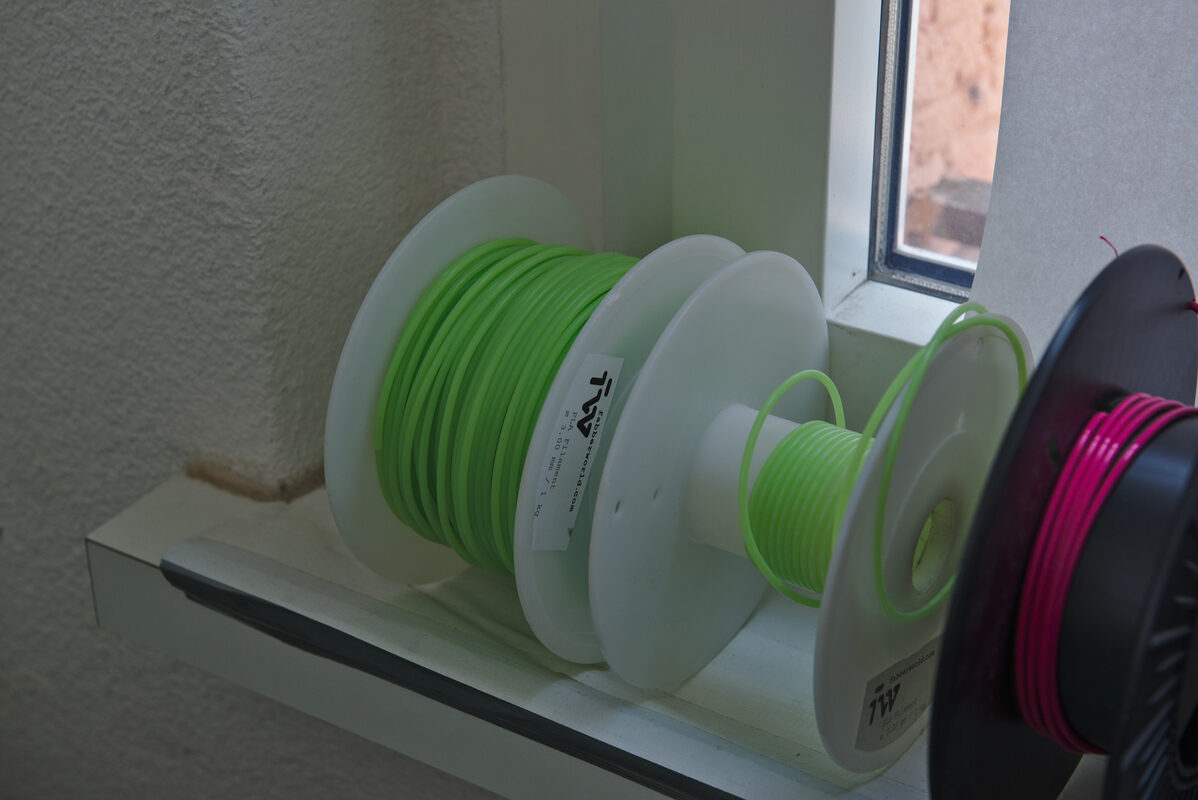
Polymaker has released HT-PLA Pro, a reformulation of its heat-resistant PLA line that the company says nearly doubles impact toughness over the original HT-PLA while holding onto the annealed heat deflection performance that made the earlier material useful for functional parts. The new spool sells for $25.99 per kilogram — priced alongside rather than above the rest of Polymaker's HT-PLA range — and is designed to print on the same unmodified FDM hardware, with no enclosure or hardened nozzle required.
HT-PLA carved out a niche as a PLA-based alternative to ABS and PETG for parts that need to survive a warm car interior or a garage in July: good dimensional stability, easy bed adhesion, none of the fumes or warping headaches of ABS. Its weak point was always brittleness. A part could shrug off heat and then shatter the first time it took a drop or an unexpected side load. HT-PLA Pro is Polymaker's attempt to close that gap without regressing on the thermal properties that justified using a heat-treated PLA in the first place.
What the numbers actually show
According to testing reported by 3D Printing Industry, notched Charpy impact strength for HT-PLA Pro comes in at 9.94 kJ/m², roughly double the 4.94 kJ/m² measured for standard HT-PLA. Notched Charpy is a deliberately unforgiving test — a small notch is cut into the sample specifically to concentrate stress and trigger the crack-propagation behavior that plagues brittle polymers — so a near-2x gain there is a meaningful claim about how the material behaves at the point of failure, not just under steady load.
Layer adhesion also improved. Z-axis strength, historically the soft underbelly of any FDM print because interlayer bonds are inherently weaker than the polymer itself, rose to 26.8 MPa from 20.8 MPa in standard HT-PLA. That's a meaningful shift for anyone who has had a functional bracket or enclosure snap cleanly along a layer line under load — the failure mode Z-axis testing is meant to catch.
Heat performance didn't get sacrificed to buy that toughness. Vicat softening temperature measures 148.3°C as-printed and rises slightly to 150.5°C after annealing, and heat deflection temperature — the more load-relevant number for anything that has to hold shape under stress while hot — reaches 107.6°C at 0.45 MPa following a 30-minute anneal at 100°C. That's well above what a part left in a hot car or near a running motor is likely to see, though it does require the anneal step; Polymaker's recommended print settings otherwise sit in familiar PLA territory: 230°C nozzle, 25-65°C bed, and print speeds up to 300 mm/s.
What It Means for Makers
The practical pitch here is straightforward: if you were already reaching for HT-PLA for enclosures, jigs, brackets, or automotive-adjacent parts and you'd made peace with its impact fragility as the cost of doing business, HT-PLA Pro removes that trade-off without pushing you into a higher price tier. At $25.99/kg, positioned alongside rather than above the rest of Polymaker's HT-PLA range, with the same easy-print profile and the same annealing workflow, you just get tougher parts coming out the other end. For anyone printing functional hardware that lives outdoors, in a vehicle, or anywhere near a heat source, that combination of properties is genuinely hard to find in an easy-print PLA formulation, and it undercuts the usual argument for stepping up to ABS, ASA, or PETG purely for heat tolerance.
It's still worth being precise about what "doubled impact strength" buys you. Going from 4.94 to 9.94 kJ/m² is a real improvement, but it's not a leap into engineering-nylon territory — this is PLA chemistry with a tougher formulation, not a different polymer class. Parts that need to survive genuinely hard impacts, sustained vibration, or chemical exposure should still be evaluated against materials built for that duty cycle. Polymaker itself is explicit that HT-PLA Pro is not intended for automotive under-hood or engine-bay applications, nor is it certified for food-contact or medical use — worth flagging for anyone tempted to push it past "toughened prototype and enclosure material" into safety-critical territory.
The annealing requirement also deserves a second look before committing a print queue to this material. The 107.6°C HDT figure is an annealed number, achieved with a 30-minute bake at 100°C after printing. Skip that step and you're presumably closer to the as-printed Vicat figure of 148.3°C in terms of softening onset, but the HDT-under-load number for unannealed parts isn't part of the published data here — anyone specifying this material for a genuinely hot application should plan the anneal into their workflow rather than treat it as optional.
On the practical side, HT-PLA Pro ships in 1.75mm, 1kg spools (SKU PA20001) in 18 color options, with volume pricing dropping to $22.09/unit at four spools and $19.49/unit at ten — useful if a shop or print farm wants to standardize on it rather than keeping separate stock of standard HT-PLA and a tougher alternative. Polymaker also markets the spools as "Made in USA," and slots the material into its existing functional-PLA lineup alongside HT-PLA and the glass-fiber-reinforced HT-PLA-GF, positioning it as a middle ground between easy-print PLA and reinforced or engineering filaments rather than a replacement for either.
For makers who print heat-tolerant functional parts regularly, the upshot is a lower-risk default: HT-PLA Pro looks like a straightforward swap-in wherever standard HT-PLA was already the plan, at a comparable cost and the same print settings, with a meaningfully lower chance of a part failing at a stress concentration rather than by gradual overheating. Whether it displaces ABS or ASA for tougher-duty enclosures will depend on how it holds up in the field beyond Charpy and Vicat numbers on a datasheet — but the specs give makers a real reason to try it before reaching for a harder-to-print alternative.
