
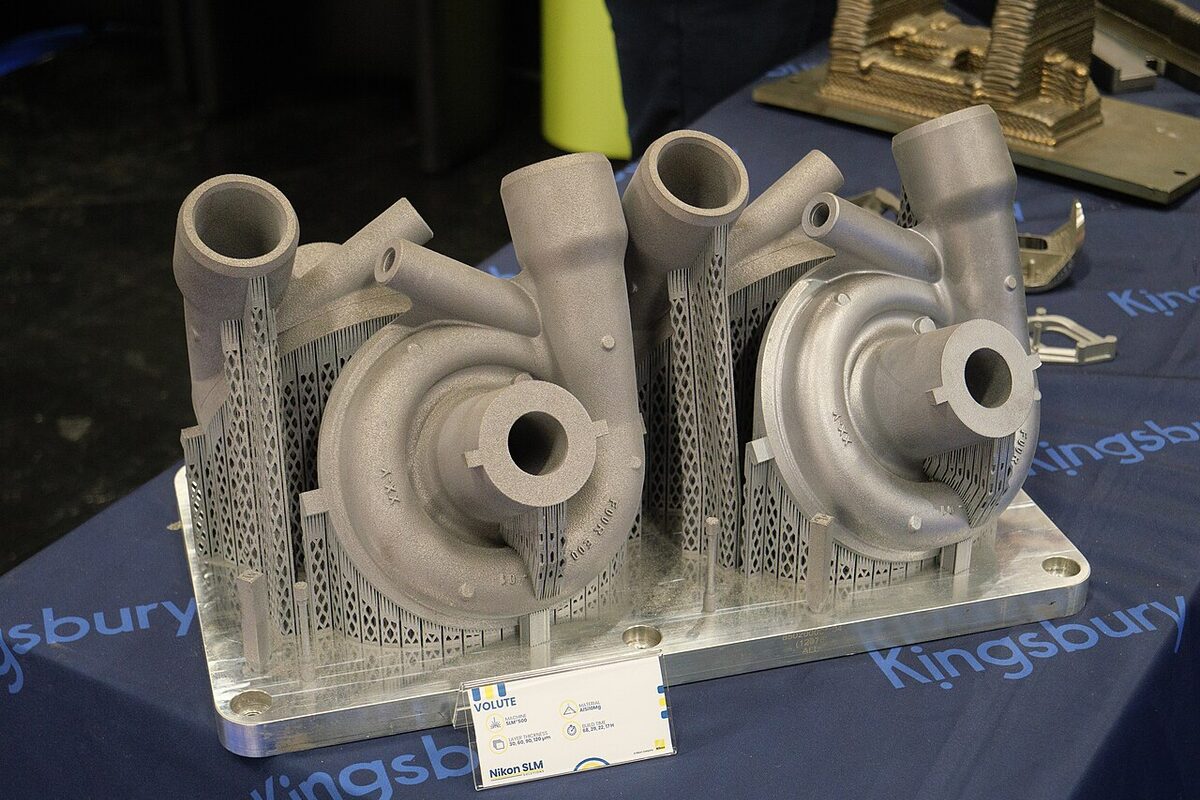
Precision Resource, a U.S. maker of precision metal components, is putting more of its future into laser powder bed fusion. In a 3D Systems press release dated October 28, 2026, the company said it has broken ground on two new production additive manufacturing facilities. One is in Huntington Beach, California, and the other is in Shelton, Connecticut. 3D Printing Industry reported on the expansion on November 12 and added details about the machines going into both buildings. The company plans to add 3D Systems DMP Flex 350 Triple systems to its existing fleet of DMP 350 printers. It is also bringing heat treatment and complex machining in-house.
The release was not issued this week. It came out about two weeks before the trade-press coverage. The story itself is unchanged, though. A long-established contract manufacturer is building metal printing capacity across two states, and it is setting up those sites to work as a single operation.
Two Sites, Two Different Starting Points
The two new locations play different roles. According to 3D Systems, Huntington Beach will be Precision Resource's second additive manufacturing location, and the expansion is expected to double that site's current industrial AM capacity. In other words, the company already prints metal at scale in California and wants to expand that business.
Shelton is new territory. The Connecticut site will be Precision Resource's first additive manufacturing location, and the company says it can expand further as demand grows. Shelton is also where the company is headquartered, so the AM operation will sit in its home town. Both facilities are expected to be operational in the first quarter of 2027. That date coincides with Precision Resource's 80th year in business, and the company was founded in 1947.
Precision Resource describes itself as a leader in components for the automotive, heavy-duty, aerospace and medical device industries, and it serves both commercial and defense customers. In those sectors, a part usually has to pass a qualification process before anyone ships it. That helps explain why the rest of the announcement focuses on post-processing as much as on printers.
The Hardware: Staying in One Ecosystem
The new capacity will be built on DMP Flex 350 Triple systems, which will join the company's existing 3D Systems DMP 350 machines. The choice to stay with one vendor matters. Changing laser powder bed fusion platforms in a production environment is expensive. Process parameters, build preparation workflows, operator training and part qualification records all tend to be tied to a specific machine family. Buying more machines from the same family lets a contract manufacturer carry over what it already knows instead of starting again.
Neither source gives a machine count, a capital figure or performance numbers for the new systems. We aren't going to guess at them. What the sources do confirm is the direction. The company is adding DMP Flex 350 Triple machines to a fleet it already operates, and it is spreading its additive work across two coasts. 3D Printing Industry says the additional systems are intended to increase production throughput while maintaining part quality and repeatability.
Heat Treatment and Machining Come In-House
The less prominent part of this announcement may be the more important one. Both 3D Systems and 3D Printing Industry say Precision Resource is adding in-house heat treatment and expanding its complex machining alongside the printers.
Anyone who has worked with metal additive parts knows that the printer handles only part of the job. A powder bed part usually comes off the build plate needing stress relief or other thermal processing, support removal and machining of critical features before it matches the drawing. If any of those steps go to an outside vendor, the result is more shipping, more scheduling, more paperwork and more places where a job can stall. When a supplier handles printing, heat treatment and finish machining under one roof, it controls the whole chain. For customers in regulated industries, that can make documentation and traceability much simpler.
An Integrated Network, Not Two Islands
The company's own description of the project centers on the connection between the sites. "This expansion is much more than adding machines," Chris Gratton, Precision Resource's Director of Additive and Machine Operations, said in the announcement. "We are building something significant by connecting our Huntington Beach and Shelton operations into an integrated additive manufacturing network."
According to the coverage, the two sites will operate as an integrated network to provide geographic redundancy and reduce supply-chain complexity. In practice, a customer working with a two-site supplier that shares one machine platform has a fallback. If one plant is down, at capacity or facing a regional disruption, the other plant could in principle run the same jobs on the same type of equipment.
What It Means for Makers
Most FilamentFeed readers won't be buying a DMP Flex 350 Triple. Still, this kind of expansion affects anyone who designs parts and orders them from outside suppliers.
Metal AM is becoming ordinary contract manufacturing. Precision Resource is not a startup selling a printing service. It is an established components supplier whose listed capabilities include fine blanking, grinding, lapping, laser powder bed fusion, heat treatment and complex machining. Each time a company like this adds capacity, it becomes more realistic to send a metal printed part through the same purchasing process as a machined or stamped one.
Post-processing is where lead times slip. If you have ordered printed metal parts and waited on heat treatment or finish machining from a separate shop, the reasoning here will be familiar. Vertical integration is how suppliers shorten that wait, and it's a sensible question to ask any metal print service you're considering.
Design for the whole process. When printing, heat treatment and machining happen at one supplier, it becomes easier to design a part with both stages in mind. You can leave machining stock on critical surfaces and print the complex geometry that only additive can produce. Hobbyists who move from desktop FDM to ordering metal parts should get comfortable with that hybrid approach.
Watch the 2027 timeline. The facilities are scheduled to come online in Q1 2027. Until then, this is a statement of intent backed by construction, not new capacity you can order from today.
Bottom Line
Precision Resource is making a measured, industrial bet. It is staying on a platform it already runs, adding the post-processing that metal AM requires, and connecting two sites so either can back up the other. The plan contains little hype and a lot of practical manufacturing work, which suits a technology that is still building its place in production supply chains.
