
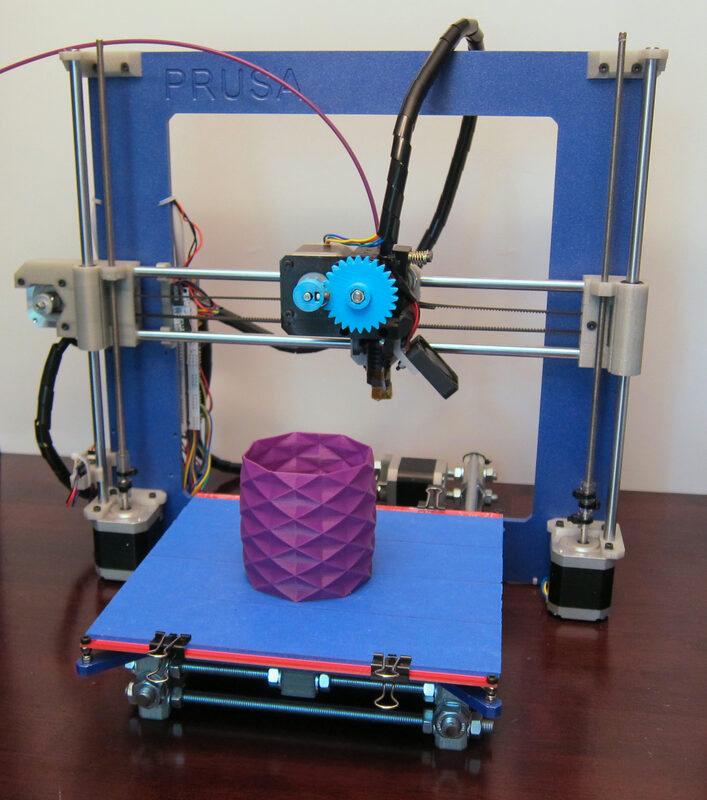
On paper, the Prusa MK4S and the AnkerMake M5C answer the same search query: both advertise 500 mm/s print speeds, both are direct-drive FDM machines aimed at people who want fast, reliable results without tinkering. In practice, they occupy different price classes and — as of mid-2026 — different market realities. Prusa Research's store currently lists the MK4S at $740 assembled and $591.66 as a kit (both carrying promotional discounts at the time of writing), while the M5C launched at $399 and is no longer sold new at all: Anker rebranded its printing division to eufyMake in March 2025 and pulled the M5 and M5C from sale in July 2025, citing an inability to source critical components. That single fact reshapes the whole comparison — but the spec sheets still matter, because the M5C remains widely available on the used market at prices that undercut everything in the MK4S's class.
Spec Sheet, Side by Side
The MK4S builds 250 × 210 × 220 mm; the M5C offers 220 × 220 × 250 mm. Total volume is nearly identical, but the shapes differ — the Prusa gives you a wider X axis, the Anker 30 mm more height for tall single pieces. Both are bed-slinger (Cartesian) designs rather than CoreXY, which surprises some buyers given the M5C's speed marketing.
Hotend temperatures actually favor the cheaper machine on paper: the M5C's all-metal hotend is rated to 300°C, against the MK4S's 290°C ceiling with a 120°C heatbed. In reality both figures put the same materials in reach — PLA, PETG, TPU, and ABS or ASA with an enclosure — and neither machine ships enclosed. The MK4S's Nextruder is the more sophisticated extrusion system: a planetary 10:1 gearbox driving a quick-swap 0.4 mm high-flow CHT brass nozzle, paired with 0.9° X/Y stepper motors and a loadcell sensor that probes only the area your print will occupy. 3D Printing Industry's review measured the M5C as a genuinely fast machine — 500 mm/s maximum speed with 5,000 mm/s² acceleration — but its 49-point automatic bed leveling and standard direct-drive extruder are conventional by comparison.
Control Philosophy: Screen vs Single Button
The starkest difference is how you operate each printer. The MK4S carries a 3.5-inch color screen, Ethernet, a removable Wi-Fi module, and an NFC receiver for easy network setup; you can run it entirely offline, forever, without an account. The M5C famously has one physical button — pause and resume — with every other function delegated to the AnkerMake smartphone app or the AnkerMake Slicer over Wi-Fi, Bluetooth, or USB-C. As 3D Printing Industry noted, AnkerMake's own slicer was the only software with direct network integration; files sliced elsewhere had to travel by USB-C. When the app works, the experience is genuinely pleasant. But an app-dependent printer whose manufacturer has exited the category is a different proposition than it was at launch, and that dependency should weigh heavily in any 2026 purchase decision.
Ecosystem and the Discontinuation Problem
Prusa's case for its price premium has always rested on ecosystem: open-source firmware with published code, PrusaSlicer development, a filament sensor, power-panic recovery, and the company's claim of half a million Original Prusa printers in the field with a return rate under one percent. Whatever you think of the hardware value, the support story is unambiguous — parts, documentation, and firmware updates keep flowing, and our full MK4S review found the machine's first-layer consistency and Input Shaper tuning still set the benchmark for the class.
The M5C's story inverted in 2025. According to 3DPrint.com, Anker spokesperson Brett White confirmed the company "has been unable to source critical components needed for its M5 and M5C models," and there is no timeline for the printers returning to market. Some spare parts — extruders, hotends, filament — remained listed on the eufyMake site, but with no restocking commitment. For a machine whose extruder and hotend are proprietary, that is the difference between a repairable workhorse and a future paperweight. Our earlier M5C review covered the printer's print quality in depth; the ownership calculus has since changed more than the hardware has.
Speed Claims vs Real Throughput
Both machines advertise 500 mm/s, and both figures describe maximums rather than averages. Prusa markets the MK4S as its fastest printer yet, with a redesigned 360-degree cooling system that the company says handles overhangs up to 75 degrees without supports — cooling, not motion, is usually the limit at high speed. The M5C's 5,000 mm/s² acceleration is modest next to modern CoreXY machines, which means it spends more of each move ramping up and down; short, detailed prints won't approach the headline number on either printer. If raw throughput is your actual priority, neither of these is the class leader in 2026 — but the MK4S delivers its speed with dimensional accuracy that made its predecessors the benchmark, which matters more for functional parts.
Which One Fits You
Buy the MK4S if you want a machine that will still be supported, repairable, and improving in five years, and the roughly $340 gap over the M5C's launch price is acceptable for that certainty. It is the safer recommendation by a wide margin in 2026, and the only one of the two you can actually order new.
Consider a used M5C only with eyes open: at secondhand prices well under its $399 launch figure it can be a genuinely fast, competent PLA and PETG machine — provided you accept app-dependent control, an uncertain spare-parts pipeline, and no path back to official support. Stock up on a spare hotend if you find one. For a first printer, or an only printer, the discontinued bargain is the wrong bet; the MK4S — or, at the M5C's old price point, a current budget machine from an active manufacturer — is the answer that still makes sense after the honeymoon.
