
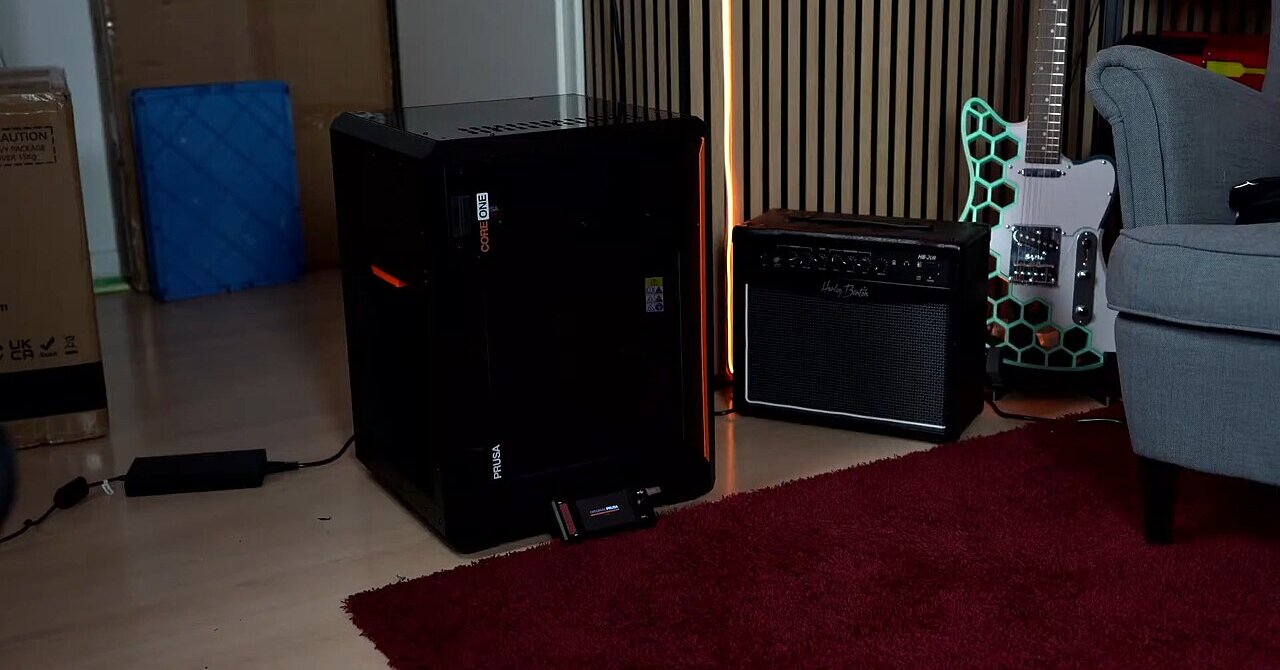
Most desktop 3D printers are built for a clean room with stable humidity and a reliable network. Prusa Research's two Formnext 2026 previews start from the opposite assumptions. The Prusa Rugged is a CORE One L+ reworked for dust, damp air and regular transport. The companion Zero-Trace system goes after a different problem: making sure a print file leaves nothing behind on the machine. Neither is a shipping product: Prusa calls the Rugged a preview, says it is still gathering customer requirements to shape the final machine, and has not published a price for either.
The two announcements cover separate threats. Rugged is about the physical environment, and Zero-Trace is about information security. It helps to take them one at a time.
Rugged: the CORE One L+ in armor
Rugged starts from the CORE One L+, the larger version of Prusa's enclosed CoreXY platform, and changes the parts that fail first outside a workshop. According to Prusa's product page, the changes are:
- A high-temperature hotend with a hardened nozzle, aimed at advanced engineering filaments. Tom's Hardware, reporting from the show floor, describes it as a hardened steel nozzle.
- A reinforced exoskeleton with a durable outer layer and heavy-duty contact points, so the frame can take being moved, stacked and handled.
- Integrated dust filtration and active internal airflow cooling. A sealed machine still has to manage its own heat, and filtered airflow is one way to do that without opening the case to grit.
- Engineering for high humidity, harsh environments and frequent transport. Tom's Hardware describes a sealed case that keeps out humidity and dust and adds protection in transit.
- Air-gapped operation, with no wireless interface and production managed entirely locally.
None of this is exotic on its own. Hardened nozzles, enclosures and filters are all familiar to makers. What stands out is the packaging. Prusa is presenting a consumer-derived printer as field equipment, meant to be loaded into a vehicle or set up in a space that nobody climate-controls. Experienced makers know that damp filament and dust on the rails ruin prints as reliably as bad slicer settings. A printer built around those failure modes is a different product from one that simply has a lid.
Zero-Trace: a printer that forgets
Zero-Trace is the more unusual idea. Most networked printers keep files somewhere, whether on a USB stick, internal flash, a cloud queue or all three. Prusa's Zero-Trace page describes a design meant to rule out every one of those:
- No USB port, no Wi-Fi, no camera, and nothing written to flash.
- Print files live only in encrypted volatile memory. Cut the power and both the file and its key are gone.
- The decryption key sits on a separate board from the memory module, so pulling one component does not hand over both halves.
- Jobs arrive only from the owner's own Prusa Connect server over a network cable, encrypted end to end. Each printer is cryptographically paired with that server and accepts nothing from anywhere else.
- The motherboard debug port is permanently disabled.
- Firmware updates happen offline through Prusa Connect, and the printer runs only signed firmware.
Prusa pitches the system at classified and proprietary workflows and lists an audit trail recording who printed what and how many copies. That last point matters as much as the encryption. In a controlled environment, the question is usually not only whether a file can be stolen but whether anyone can account for every part made from it. A copy count tied to an identity speaks to that directly.
Prusa's page also says the Prusa Connect source code is available for audit. For buyers in security-sensitive organizations, that is close to a requirement. A "trust us" air gap is hard to approve, while code an organization can inspect is a much easier case to make.
How the pieces fit
Tom's Hardware reports the Rugged as coming with Zero-Trace. Prusa, meanwhile, gives the two their own product pages, and Zero-Trace is described as a system in its own right rather than a Rugged-only feature. The overlap is clear in any case. Rugged's spec sheet already promises no wireless interface and fully local production management, which is the posture Zero-Trace formalizes. Since the Rugged is still a preview, how the two will be bundled is a detail Prusa has not published.
Prusa's Zero-Trace page has jobs coming only from a Prusa Connect server the customer runs. Tom's Hardware notes that Prusa Connect Local is free, runs on Linux, Windows, macOS or a Raspberry Pi, manages farms of 2 to 400 printers, and is open source. The self-hosted server is therefore not a premium add-on. It is the same family of tool a print farm would run, and Zero-Trace's pairing and encryption are layered on Prusa Connect running on the customer's own server.
What It Means for Makers
Most hobbyists will never need a printer that wipes its memory when unplugged, and Prusa is not marketing these machines to them. Even so, the previews say several things to the wider maker community.
Local-first control is getting serious attention. The free, open-source, self-hosted Prusa Connect Local, as Tom's Hardware describes it, serves anyone who would rather keep a farm off the cloud. That covers a makerspace with a dozen machines, a small business guarding customer files, or a home user who doesn't want a camera feed leaving the house.
Field printing is becoming a real product category. Rugged's feature list (sealing, filtration, a reinforced frame, transport protection) reads like a list of what goes wrong when people take printers to events, job sites or remote workshops. If Prusa ships it, makers who print away from a bench will have a purpose-built option instead of a DIY enclosure and a moving blanket.
It is still a preview. Prusa has published no price, no ship date and no final spec. Prusa says customer input will shape the finished Rugged. Anyone with a real use case, whether harsh-site fabrication or sensitive proprietary parts, has a chance to influence what gets built, and nobody should plan a purchase around it yet.
Bottom Line
The Rugged and Zero-Trace push the CORE One L+ in two directions: physically hardened for rough environments, and stripped of every channel a file could leak through. The engineering choices are coherent and the security claims come with auditable source code, but until Prusa finalizes the design and announces pricing, both remain a statement of direction rather than a printer you can order.
