
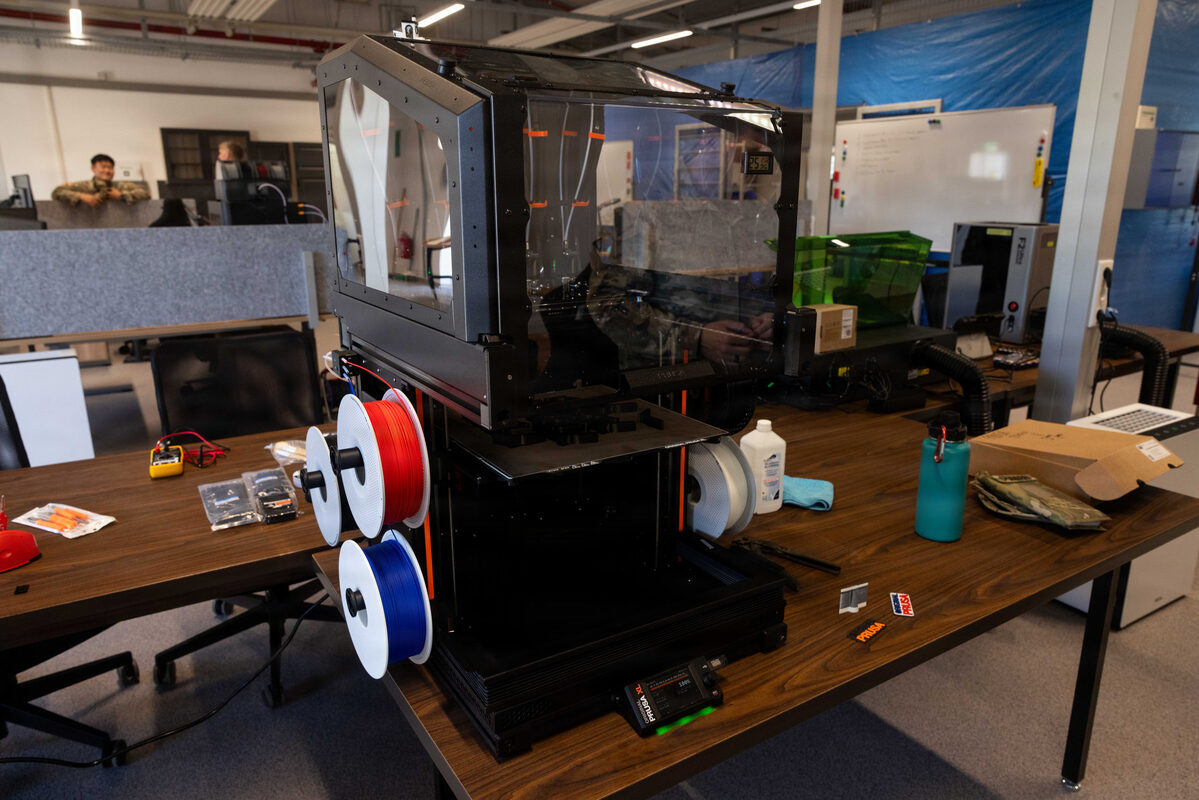
When Prusa Research launched the XL, it positioned the machine as a professional multi-material platform rather than just a large-format printer. The five-toolhead active toolchanger was the headline, but the deeper promise was modularity: a mechanical architecture open enough to accommodate whatever specialized toolhead the industry might eventually need. That promise is now being collected on. In 2026, the XL is getting its most consequential set of updates since introduction, including a price cut, the elimination of the semi-assembled configuration, and two new toolheads that push the machine into capabilities most desktop fabrication labs have never encountered.
A Price Cut Earned Through Manufacturing Discipline
The assembled five-toolhead XL has dropped approximately $200 through production refinements, reaching what Prusa describes as its lowest-ever price point. That reduction does not come from cutting materials or specifications. Rather, it reflects the kind of incremental manufacturing efficiency gains that compound over time as a production line matures: tighter supplier relationships, reduced assembly variance, and process improvements that trim labor without touching the end product.
Alongside the price reduction, Prusa has discontinued the semi-assembled version of the XL, which was phased out at the end of 2025. The move simplifies the product line and implicitly acknowledges that the market for the XL skews toward buyers who want the machine ready to run, not a kit experience. The fully assembled configuration is now the only option.
The XL's core specifications remain unchanged and are worth restating in context. The build volume is 360 by 360 by 360 millimeters, which is more than three times the volume of the CORE One Plus and roughly 50 percent larger than the CORE One L. That scale changes what the machine is useful for. Parts that would require splitting, gluing, and post-processing alignment on a smaller printer can be built in a single run on the XL. The heatbed uses 16 individually controlled tiles, maintaining under two degrees Celsius of variance across the entire heating surface. At 360 millimeters per side, uniform bed temperature is not a convenience feature; it is an engineering requirement for parts that need consistent inter-layer adhesion across their full footprint.
The active toolchanger architecture keeps all five toolheads on the gantry simultaneously, each with its own independent hotend. Nozzles can remain heated during toolhead switches, so there is no cycle time penalty for thermal management. The system supports mixed nozzle sizes and mixed materials within a single print job, and purge waste between switches is near zero because each material path is entirely self-contained.
Two New Toolheads Redefine What a Desktop Machine Can Build
The more consequential news in the XL's 2026 update cycle is the introduction of two specialized toolheads developed through external partnerships, each targeting a category of fabrication that FDM printers have historically ceded to entirely different manufacturing processes.
The Silicone Toolhead was co-developed with Filament2, a startup focused on printable silicone compounds. It enables printing with heat-resistant liquid silicone, a material class that until now has been the domain of injection molding or casting. The applications map closely to industries where flexibility, thermal stability, and chemical resistance converge: custom gaskets, living hinges, overmolded grips, sealing components, and compliant mechanisms that must survive elevated operating temperatures. For an engineer who currently outsources silicone parts to a mold shop with a four-week lead time, the ability to iterate those parts on the same machine running structural components is a meaningful workflow change.
The Pick and Place Toolhead, co-developed with ZHAW (Zurich University of Applied Sciences), does something different entirely. Rather than depositing material, it autonomously places off-the-shelf components mid-print: magnets, threaded inserts, bearings, and similar hardware that would normally require the operator to pause a print, press a component in by hand, and resume. The toolhead removes that intervention. Parts with embedded hardware can be built without interruption, and the placement is handled by the machine rather than by human judgment under time pressure. Prusa is targeting a late 2026 release for this toolhead, making it the further out of the two new additions.
Together, these toolheads describe a coherent strategy. Prusa is not competing on price per kilogram of plastic deposited. It is competing on the range of what a single machine can build. A five-toolhead XL with access to silicone capability and autonomous hardware insertion can produce assemblies that would otherwise require multiple processes, multiple machines, and multiple handoffs between them.
The INDX System Adds a Parallel Track
Separate from the XL itself, Prusa's INDX platform occupies a different architectural space. INDX is a passive toolchanger that supports up to eight materials with a single active print head and induction heating. It is worth distinguishing clearly: INDX is its own product, not an XL variant. Where the XL maintains independent toolheads each with their own hotend and extruder, INDX uses a single active head that retrieves passive toolheads from a dock. The induction heating approach is what makes passive toolheads practical, since each head can be brought to temperature quickly without carrying its own heater permanently. The result is a system that can handle eight-material jobs with less mechanical complexity than a full active toolchanger, though with different performance tradeoffs.
For the XL specifically, the trajectory in 2026 is clear: lower cost of entry, a cleaner product lineup with only the fully assembled configuration available, and a growing toolhead ecosystem that is beginning to address fabrication categories well outside conventional FDM territory. Whether the silicone and pick-and-place toolheads find their primary audience in professional prototyping shops or in smaller-scale production environments will be the more interesting question to watch as both tools move from preview to general availability.
