
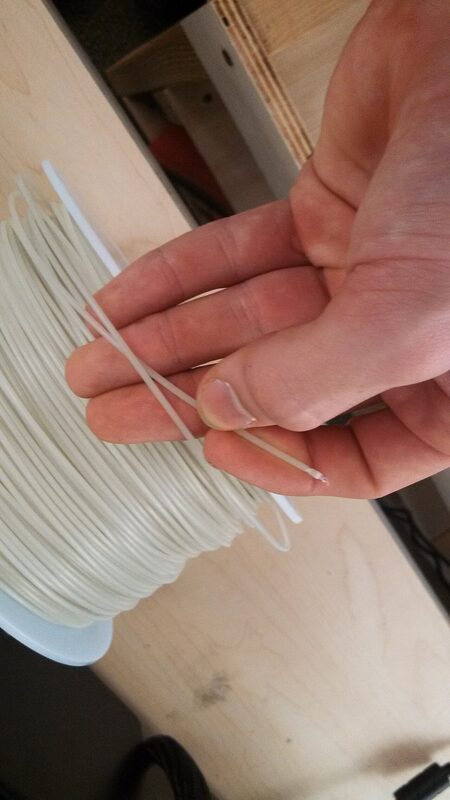
A spool of dense PLA disappears quickly on large, bulky parts. On September 17, 2026, Prusa took a different approach with Prusament PLA Lightweight, an "actively foaming" PLA that the company says prints up to 65% lighter than regular PLA and yields two to three times as many models from a spool of the same mass. The catch is that it is not a drop-in replacement: it needs its own extrusion multiplier, careful temperature control, and a dry spool.
How the Foam Works
According to the announcement, written by Jakub Kočí, heat in the nozzle activates additives that expand the extruded polymer. The same spool mass therefore produces substantially more printed volume than conventional PLA, which is the source of both the weight saving and the 2-3x stretch per spool.
The foaming factor rises with nozzle temperature. On a standard Prusa profile it starts at 215 °C, where the effect is barely noticeable, and reaches its maximum at 235 °C. Going hotter adds no meaningful weight reduction and can hurt surface quality. Prusa's warning is blunt: do not exceed 250 °C, because the material may emit potentially dangerous fumes. The default PrusaSlicer profile sits at 230 °C for the nozzle and 60 °C for the bed.
Prusa positions the material for RC aircraft, drones, costumes and cosplay, floaters, and thermal insulation such as bottle sleeves and insert liners for thermal boxes. It says printed parts float almost as well as polystyrene. The surface is matte and finely textured, and Prusa says it resembles an SLS print. The printed color also comes out paler than the spool suggests. The example given is Galaxy Black, which prints as a dark, concrete-like grey.
Settings That Are Not Optional
The default profile makes two choices that will look strange to anyone used to standard PLA. Retractions are off, and the extrusion multiplier is 0.45. The multiplier tracks the foaming factor: at 235 °C, where foaming is strongest, Prusa says to set it to the lowest value or the print will overextrude, while printing at 215 °C with 0.45 would underextrude.
Prusa asks users to calibrate rather than simply trust the default. The procedure is a small hollow cube printed with a 0.4 mm nozzle, zero infill, zero top layers and a single perimeter. Measure the resulting wall. If it is not between 0.45 and 0.5 mm, adjust the multiplier and try again.
Foaming also means more nozzle ooze, which Prusa says produces noticeable stringing that can be removed with a hobby knife or by hand. Its tip is to enable avoiding crossing perimeters with a maximum detour of 40 mm in PrusaSlicer and print one model at a time, or use sequential printing for small parts. The company recommends a smooth PEI or Satin sheet and stock brass nozzles in 0.4 or 0.6 mm, in high-flow or standard versions. Supported slicer profiles cover the CORE One+, CORE One+ (Gen 2), CORE One L+ and MK4S.
The filament is also hygroscopic and needs to be dried and stored in a dry place. Prusa's drying recommendation is five hours at 55 °C.
An Independent Hands-On
The same day, maker and blogger Petr Šrámek published a hands-on review on Chiptron.eu. It broadly supports the core claims. He repeats the up-to-65% weight figure, describes decent thermal insulation, and says printed parts float on water.
He ran his own weight check with a model he calls "Bulánek", printed at 100% infill, 0.25 mm layers and a 0.4 mm nozzle. In Prusament PETG it weighed 8.17 g; in PLA Lightweight it came to 3.42 g, which works out to 58% lighter. He stresses that the model is a terrible choice for this filament. Treat 58% as one data point on an unsuitable part.
His spec table, which is credited to prusa3d.com, lists a nozzle range of 215-235 °C, a bed range of 50-60 °C, 1.75 mm filament with a tolerance of ±0.03 mm, and a 0.4 mm brass nozzle. Its list of recommended printers is broader than the slicer-profile list in Prusa's blog post, adding the XL and XL+ alongside the CORE One family and MK4S.
Two more details stand out. First, the spool carries a rewritable NFC tag in the OpenPrintTag standard, which also stores measured production values: diameter, weight and ovality. Second, Šrámek says retraction does not work because the material keeps expanding, which matches the retractions-off setting in Prusa's profile. He suggests printing in one continuous motion, ideally in spiral vase mode, and notes that a PrusaSlicer material profile is already available.
His list of drawbacks is short but concrete. The filament strings badly, scratches easily, has low heat resistance, and must be dried before printing.
Questions Worth Asking
Is 65% lighter a guarantee?
No. Prusa says "up to," and the reviewer's own measurement, 58% on a part he calls a poor fit, is lower. The saving will depend on the model, the multiplier and how well the calibration cube was tuned.
Is it a structural material?
Neither source claims so. The stated applications favor weight, buoyancy and insulation over stiffness, and the reviewer flags low heat resistance and easy scratching.
What It Means for Makers
The value proposition is specific and easy to test. If you print large, light-duty parts such as airframes, drone components, costume pieces, or insulating sleeves, getting 2-3x more models from a spool may cut your material costs. Prusa itself says only that it "might actually save you some money." At 56.99 USD or 59.90 EUR per kilogram, VAT included, the stretch per spool is where any return would come from. It arrives in five colors: Army Green, Chocolate Brown, Galaxy Black, Natural and Coral Orange, with the caveat that printed parts are paler than the spool.
The cost is process discipline. You will be running a calibration cube, drying the spool, disabling retraction, tolerating some stringing, and accepting a scratch-prone surface. Between them, the two sources suggest printing one part at a time or in sequence, and using spiral vase mode where geometry allows, as practical workarounds.
The independent review does not overturn the manufacturer's claims, and that is the useful finding here. The behavior Prusa describes shows up in a third party's hands, along with the drawbacks a spec sheet tends to underplay. For makers building things that fly, float or insulate, it is worth a spool. For anything that needs to survive heat or handling, the evidence so far points elsewhere.
