
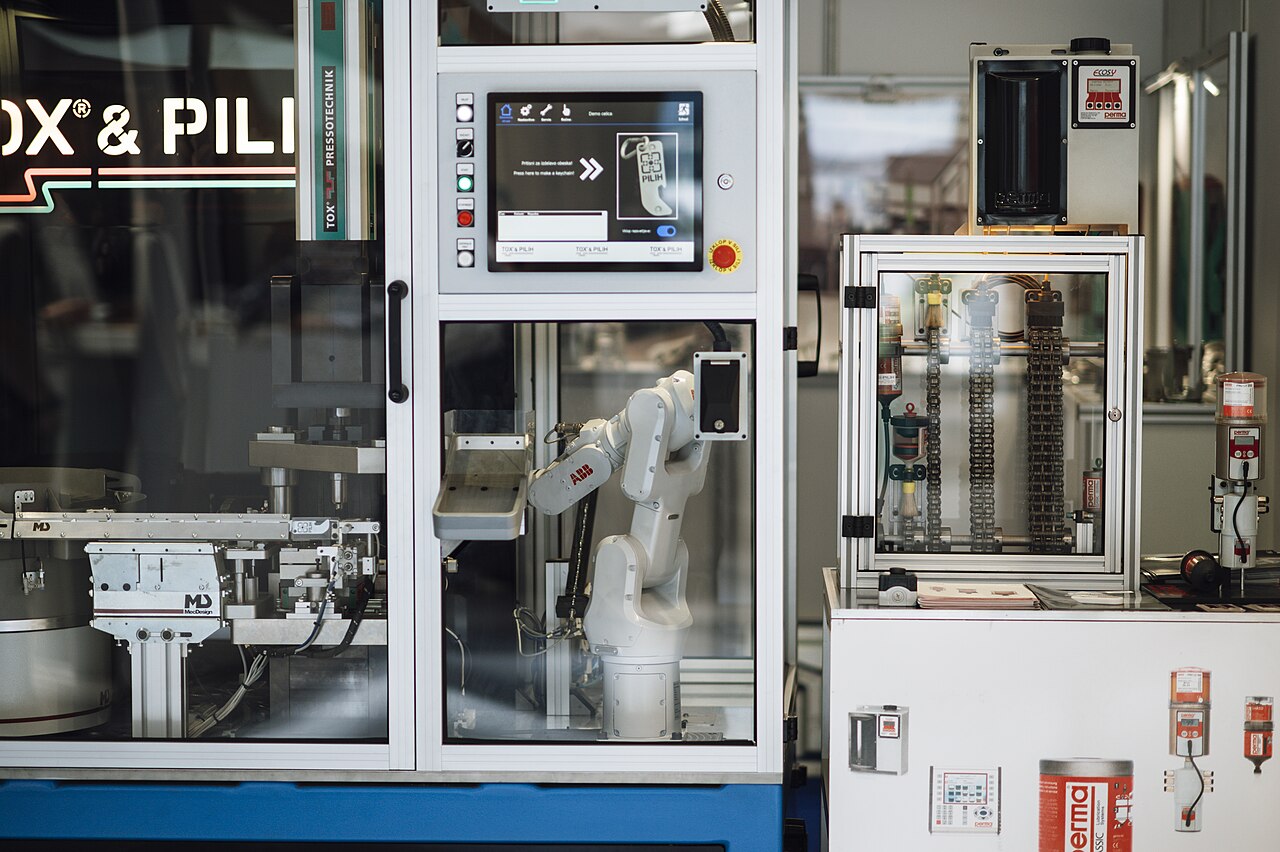
Two unrelated pieces of data, published within a week of each other, point the same way. On Sept. 23, Protolabs said in a Business Wire release (via mirror) that revenue from robotics customers more than doubled in the first half of 2026 compared with the first half of 2025. Days later, a separate analysis of more than 30,000 3D-printed parts from Upside Parts found that robotics customers order rush production at roughly five times the rate of everyone else. Robotics is not just a growing segment of on-demand manufacturing. It is a segment that wants parts fast.
What Protolabs Actually Said
The release, datelined Minneapolis, comes from Protolabs (NYSE: PRLB). The central claim is compact: robotics-customer revenue in H1 2026 was more than double that of H1 2025. There is no dollar figure attached to the segment, no share of total revenue, and no unit counts, so "more than doubled" describes growth off an undisclosed base. A small base doubling is a different story from a large one, and the release does not let outsiders tell which this is. One note on the mirrored copy: the Yahoo Finance subhead misprints the comparison period as "first half of 2025," but the body text makes clear the comparison is 2026 against 2025.
The company frames the demand against a market forecast, estimating the global robotics market at $88 billion in 2026, rising to $219 billion by 2031, a 20% compound annual growth rate. It also cites the addition of robotic devices to the FCC Covered List as an argument for manufacturing in the US. Protolabs says it serves customers through its owned US factories plus the Protolabs Network.
3D Printing Industry's coverage, dated Sept. 29, adds detail on what those customers buy. Parts include grippers, sensor systems, enclosures, gears and motor mounts, with some available in as little as one day. For 3D printing specifically, Protolabs points to flexible materials including TPU, TPV and silicone. The piece also notes data-protection measures (encryption, access controls, and auditing and logging), which matters to robotics firms guarding unreleased hardware. CEO Suresh Krishna is quoted on physical AI, and Protolabs will be at RoboBusiness 2026 on Oct. 20-21 in Santa Clara, booth #411.
3D Printing Industry also draws a parallel to Xometry's 2022 robotics commentary, citing Q4 2021 revenue of $67.1 million, up 76.6%. That is context for how long robotics has been pitched as a growth vertical for online manufacturers. It is not a comparable to the Protolabs number, which has no stated base.
The Upside Parts Data: Rush Is the Default
The more granular numbers come from 3D ADEPT's write-up (Sept. 28) of an Upside Parts analysis. Across more than 30,000 3D-printed parts, 36.7% of robotics parts were produced on rush, against 7.2% for hardware and other customers. That is about a fivefold difference. Upside Parts is the source of the data, and the 3D ADEPT piece quotes its founder, Roman Arkhangelskiy. Because this is one provider's order book, it describes that provider's customers, not the industry as a whole.
Several other findings in the analysis are worth separating out:
- Volume is not small-batch. Orders above 100 parts made up 89.0% of volume. Those larger orders ran rush 32.5% of the time, versus 23.8% for orders of 100 or fewer. Rush is not confined to one-off prototypes.
- Materials go beyond the basics. 49% of orders included a material beyond standard PETG, PLA or ABS. In 101-500 part orders, no single material above that baseline exceeded 27.1%.
- The work is repetitive. Just 19 recurring production combinations covered 97.4% of parts.
Taken together, that last set of figures is the interesting part. A long tail of exotic requests would be hard to industrialize. Instead, the analysis describes a small set of repeating configurations, ordered in volume, often on a deadline. That looks less like prototyping and more like production scheduling.
The article also cites an AMPOWER expectation that end-use parts will make up 44% of polymer additive manufacturing applications by 2028. That is a forecast, and it is offered as background for the shift from prototypes to finished parts, not as a measurement of it.
Reading the Two Together
It would be a mistake to stitch these into a single causal story. Protolabs reports revenue growth; Upside Parts reports order urgency. They come from different companies, different customer bases and different methods, and neither one supplies the other's missing denominator. What they share is direction. Robotics buyers are increasing spend with at least one large on-demand manufacturer, and, at another provider, they are paying for speed far more often than comparable hardware customers.
A plausible reading, which the sources support only loosely, is that robotics development iterates quickly and integrates mechanical parts into systems that stall without them. A gripper or motor mount that is late holds up an assembly. The data does not prove that mechanism, but it is consistent with a customer group that treats lead time as a cost to be paid down.
The forecast numbers deserve caution too. The $88 billion to $219 billion projection is a market estimate cited in the Protolabs release, and the 3D Printing Industry article attributes market figures to Mordor Intelligence. Forecasts of this kind are assumptions about the future, not results.
What It Means for Makers
If you design mechanical parts for robots, drones, or any actuated device, the practical takeaways are modest but real.
Design for the repeat case. The 19 combinations covering 97.4% of parts suggest that Upside Parts' orders cluster in a narrow set of processes and materials, and its analysis says repeatable production paths can be standardized and accelerated. It is a reasonable inference, not something the sources state, that parts specified inside well-worn combinations are easier to quote and ship quickly, while exotic choices may cost time.
Look at the flexible-material options. Protolabs specifically names TPU, TPV and silicone for 3D printing. Compliant grippers, gaskets and vibration mounts are a natural fit, and that is the sort of part a bench builder can now outsource rather than fight on a desktop machine.
Read the fine print on speed. "As little as one day" is a ceiling for some parts, not a promise for every part. Rush usage in the Upside Parts data was high, and the 3D ADEPT piece does not say how much rush cost, so budget accordingly.
Watch the sourcing argument. Protolabs leans on the FCC Covered List and domestic production. Whether that pulls more hardware startups toward US-made parts is a question the current evidence does not answer, but the company is clearly making the pitch.
Bottom Line
Protolabs says its robotics revenue more than doubled, without saying from what base. Upside Parts shows robotics buyers ordering rush at 36.7%, against 7.2% for other hardware customers. Neither dataset is independent, and neither covers the whole market. But both suggest that robotics has become a distinctive customer type for on-demand printing: repetitive in what it orders, heavy in volume, and impatient about delivery. Expect more providers to court it, and for the next round of numbers to show whether the growth holds outside the vendors' own announcements.
Sources
- Protolabs Accelerates the Future of Robotics with Rapid Manufacturing (Business Wire, Sept. 23, 2026, via Yahoo Finance mirror)
- Protolabs Reports Robotics Revenue More Than Doubled in First Half of 2026 (3D Printing Industry, Sept. 29, 2026)
- Why 37% of 3D-printed parts for robotics are produced on rush (3D ADEPT, Sept. 28, 2026)
