
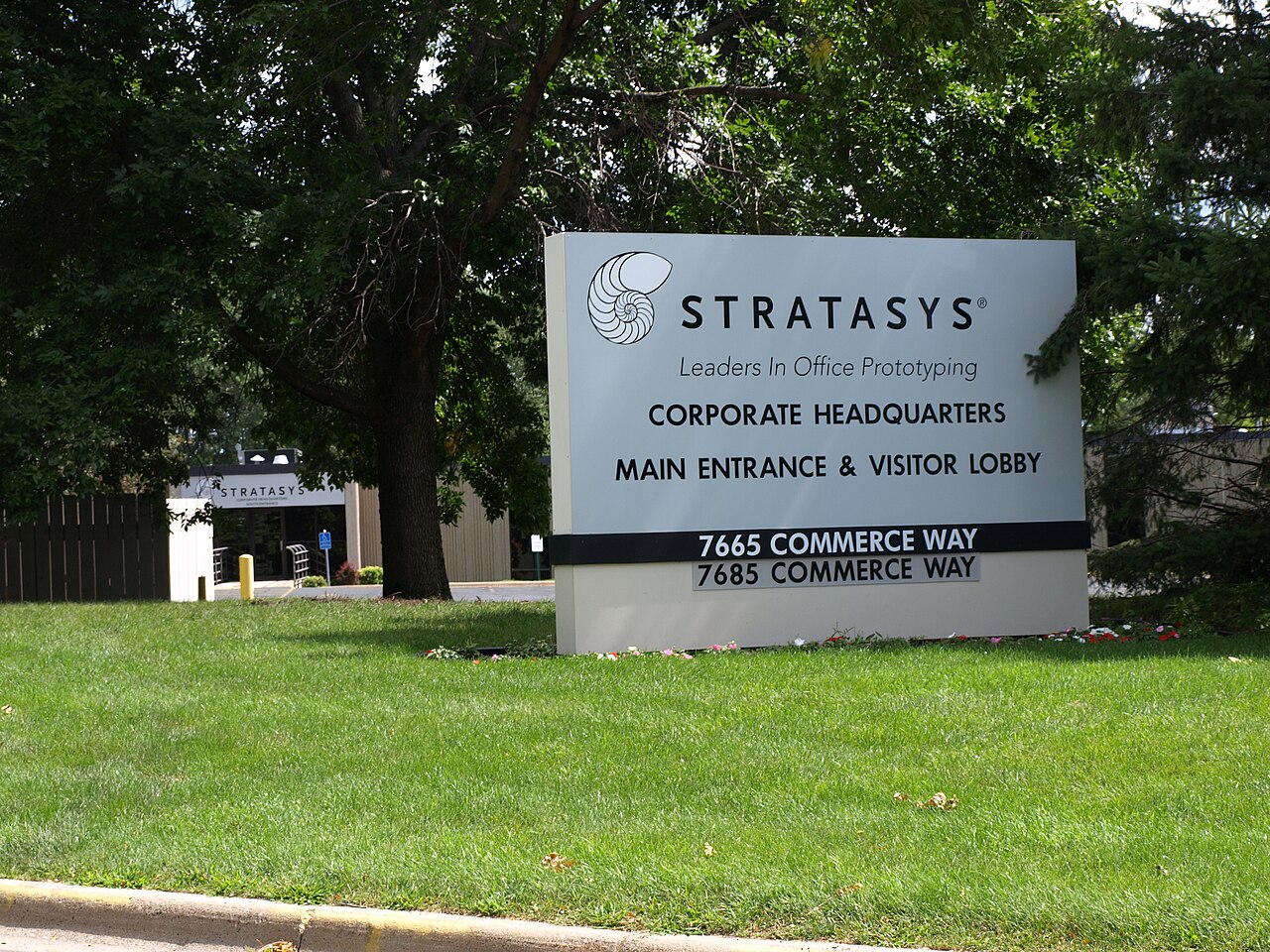
When VoxelMatters visited Stratasys headquarters and sat down with CEO Yoav Zeif, the resulting interview (published September 28, 2026, by Davide Sher) amounted to a strategy briefing. Zeif, who has led the company since 2020, described a market splitting in two, defended the pending Markforged acquisition as a bargain, and argued that the real money in polymers lies well away from the commodity end of the spectrum. Everything below that is attributed to Zeif is his own characterization, not independently verified.
A Market Pulling in Two Directions
Zeif's framing is that the industry is polarizing. At one end are high-end workflows, where printers slot into qualified production processes. At the other is what he characterizes as a race to the bottom. Stratasys, he says, is choosing the first.
He backs that with a volume-versus-value comparison. By his account, roughly 70 percent of polymer additive manufacturing material by volume is PLA and ABS, yet that volume represents only about 20 percent of the market's value. "There is no value there," he said. In other words, the filament that most makers run through their machines is the bulk of the tonnage and a small slice of the revenue.
Makers should read that number with the usual caution. It is a single executive's estimate, offered in support of a company strategy, and the interview does not detail how it was derived. It is nonetheless a useful statement of where Stratasys thinks it can defend margins.
The Markforged Deal
The centerpiece is Markforged. According to the Stratasys press release distributed via Business Wire on May 27, 2026, the company signed a definitive agreement to acquire MarkForged, Inc., a wholly owned subsidiary of Nano Dimension, in an all-cash transaction valued at $42.5 million, subject to customary adjustments. Markforged generated about $70 million in revenue in 2025, a figure that includes the Metal Binder Jetting line, which Nano Dimension is retaining. Closing is expected in the second half of 2026, subject to conditions and regulatory approvals.
Per the release, Markforged brings The Digital Forge platform and its Continuous Carbon Fiber technology, aimed at aerospace, defense, automotive, and food and beverage customers.
In the interview, Zeif said the deal is signed and awaiting closing. His pitch on price was blunt: Stratasys bought Markforged for about a third of what Nano Dimension had paid a year earlier. "We got it for a good price," he said. On technology, he said of Markforged, "They invented 3D printing with continuous carbon fiber, and they did it well." Of its software he said, "We will keep it. It will be an integral part of Stratasys' software offering."
How that software integration works in practice, and what it means for existing Markforged users, was not spelled out in the interview.
Three Metal Routes, and a Cool Take on Metal Filament
Metal is where Zeif was most candid about the limits of what Markforged brings. The Markforged metal filament approach, he said, is "great for high-end prototyping," but "we don't see it as a manufacturing tool."
That is a notable statement from the executive about to own the company. It also fits the structure of the deal: the Metal Binder Jetting line stays with Nano Dimension, so the metal story Stratasys tells does not depend on it.
Instead, Zeif counted three distinct metal offerings inside Stratasys. Alongside the Markforged filament process, Stratasys has investment casting via SLA, which he called the best solution on the market, and it holds an investment in Tritone. Tritone uses a resin-based metal carrier and can process a wide range of alloys including copper, he said, in parts up to roughly 20 centimeters, and he called it "a real manufacturing machine," though one that still needs further development before it fully reaches the market. Copper is a hard material for many metal AM routes, so that capability is worth watching, though the interview offers no performance data to weigh it against.
The iAM Marketplace
The interview also covered the iAM Marketplace, which launched at Formnext last year with twelve participating companies, several of them direct competitors. The team running it is based in Germany. Zeif's rationale, as relayed, is economies of scale on materials: producing five tons a year of a specialty molecule is expensive, but producing 500 tons brings the cost down enough to offer fair pricing across the board. "It's working out. It's growing," he said, while acknowledging that it means overcoming old habits.
A marketplace that includes rivals is an unusual move for a hardware vendor, and it signals that Stratasys sees a role for itself beyond selling machines. The interview does not give volume or revenue figures for the marketplace, so its commercial weight remains unknown.
Bigger Orders, Bigger Fleets
The clearest evidence Zeif offered for the high-value thesis is a change in order size. Where Stratasys once sold a machine here and a machine there, he said, it now closes deals for 7, 10, 12, even 20 machines at a time, with aerospace, defense and government leading adoption and automotive following. That is a different purchasing pattern from a lab buying a single printer for prototyping.
It is worth noting what the interview does not include: customer names, total unit counts, or how many such orders have closed. The order-size range comes from Zeif himself.
Sustainability Reporting
The visit also included a discussion with Rosa Coblens, VP of Sustainability & Communications, who discussed the company's sustainability strategy and the upcoming fifth edition of its Sustainability & ESG report. The interview gives no further detail on the report's contents.
What It Means for Makers
For hobbyists and small shops, the strategic message is mostly indirect. Stratasys is explicitly steering away from the low end, which Zeif frames as a race to the bottom. That concentrates the company's attention on aerospace, defense, and industrial customers rather than desktop users.
There are still practical takeaways. First, continuous carbon fiber and the associated software are heading into a larger company's portfolio, assuming the deal closes as expected in the second half of 2026. Anyone running or considering Markforged hardware should watch for announcements on software, support, and product roadmap after closing, since Zeif said the software will be kept but gave no timetable.
Second, the CEO's assessment that Markforged metal filament is a prototyping tool, not a manufacturing tool, is useful calibration for anyone weighing metal options, though Stratasys has its own commercial interest in steering buyers toward its other metal routes.
Third, the 70-percent-of-volume, 20-percent-of-value claim explains a lot about why Stratasys is chasing premium materials and workflows rather than commodity filament. Makers who depend on inexpensive materials are not the audience Stratasys is chasing; those who need certified, repeatable parts are.
The deal is not closed, the marketplace is still young, and the fleet-order trend rests on the CEO's word. The strategy is clear, though: fewer bets on volume, more on value.
