
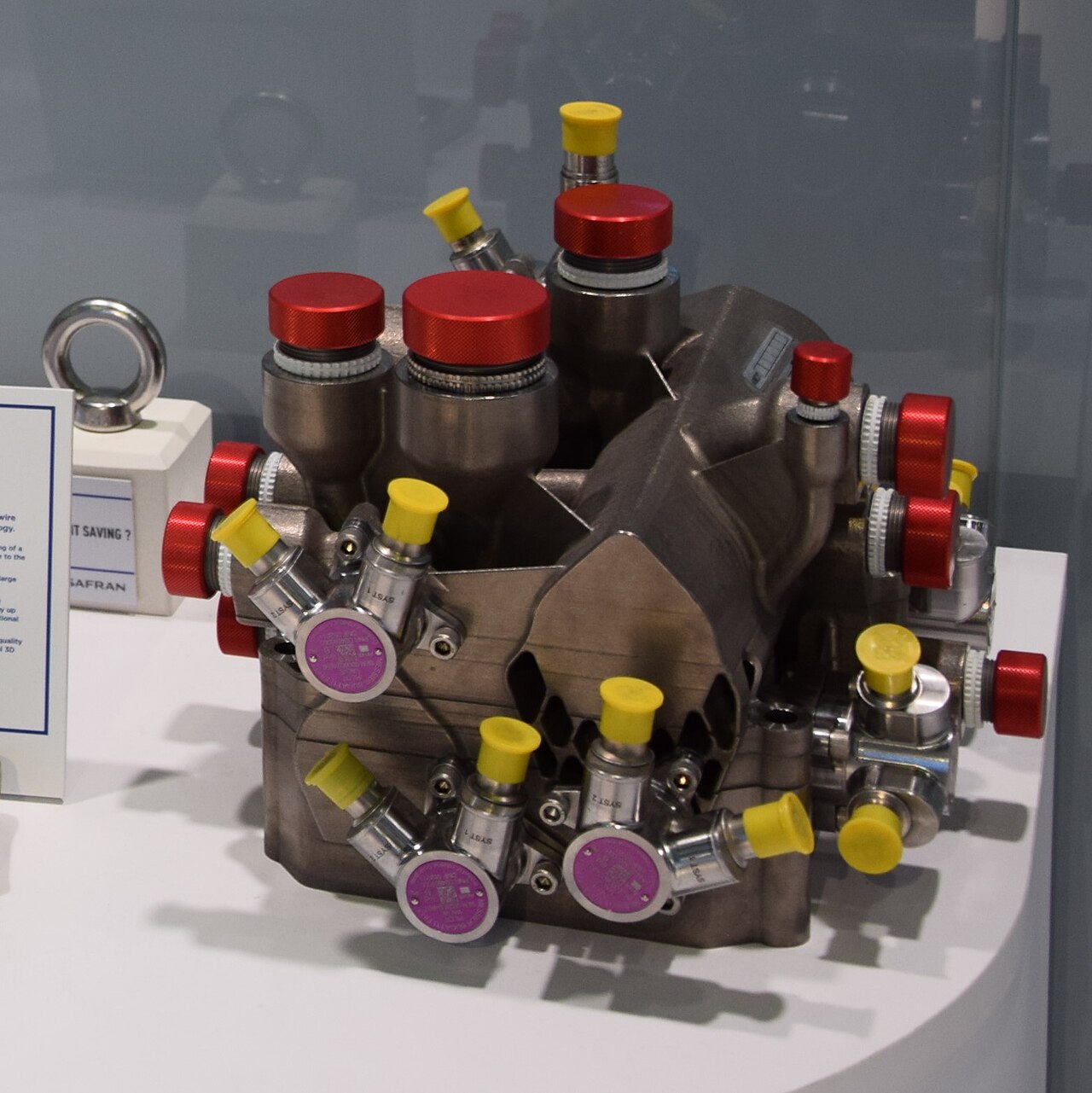
Five years ago, Safran's additive manufacturing campus in Mérignac, France, was a place where a handful of parts were headed for serial production. According to Safran's anniversary announcement on September 28, 2026, the Safran Additive Manufacturing Campus (SAMC) now has more than 25 part numbers in serial production, a workforce that has more than doubled, and a delivery figure of roughly 18,000 parts expected this year. Those numbers make a useful benchmark for anyone who wants to know what "industrial additive" looks like once the pilot phase is over.
The numbers, in order
The headline comparison comes from the campus head, François-Xavier Foubert. He says there are now "more than 25 part numbers" in serial production, against five or six at the start. VoxelMatters, which also covered the anniversary, repeats that comparison.
The volume figures follow the same trajectory. Safran reports that the campus delivered 15,000 parts last year and expects to deliver 18,000 this year. That is an increase of 3,000 parts, or 20 percent, in a single year, based on the two figures the company gave. VoxelMatters describes the site as covering 12,500 square meters and producing about 18,000 aircraft and helicopter parts a year.
The team has grown alongside the output. Both sources say headcount went from around 60 to more than 150. Safran adds that the campus runs about 100 development and industrialization projects, and that SAMC contributes to 10 of the Group's 12 companies. That last figure matters because it shows the campus works as a shared service across the group rather than serving one product line.
Serial production is a different job from prototyping
Going from five or six serial part numbers to more than 25 is not just a matter of adding machines. Each part number that enters serial production has to be developed, industrialized and qualified, and the campus reports about 100 such projects in progress. The gap between that project count and the 25-plus parts already in serial production suggests a pipeline that is still filling. The sources do not say how many of those projects are expected to reach serial production, so we will not guess.
The people side of the ramp is easier to see. Safran says it worked with UIMM, the metallurgical industry body, on a professional metallurgical qualification certificate (CQPM), and that three cohorts have been certified. It also says hundreds of designers have been trained. Those two programs address different bottlenecks: the CQPM builds a shop-floor workforce, while designer training spreads the design habits that additive requires across the wider engineering organization.
"Design enabler"
Asked about the campus's greatest achievement, Foubert does not point to a production count. He describes additive manufacturing as a "design enabler." His example is structural components that reduce the weight of helicopter engines. The argument is one makers will recognize from their own work at smaller scale: the process earns its place when it permits geometry that other methods do not, not merely when it swaps one route for another. Safran's announcement does not specify which components or how much weight was saved, so the claim should be read as a direction rather than a measurement.
Still under 1%
The most sobering figure in the coverage comes from Stéphane Bensilum, the campus's engineering director, as reported by VoxelMatters. He says that less than 1 percent of parts are additively made today. Set against 18,000 parts a year from one campus, at a company VoxelMatters describes as the world's second largest aircraft equipment manufacturer, that share explains both the ambition and the remaining headroom. Five years of growth have made additive a routine production route for a set of parts. They have not made it a default.
What comes next
Safran lists three priorities for the next five years. The first is large-scale parts for future aircraft engines. The second is productivity and quality. The third is certification of increasingly critical parts. Read together, they describe a shift from proving that additive parts can be delivered to proving that bigger, more safety-relevant ones can be delivered reliably and at a sensible cost. Safran does not give targets, dates or part counts for any of the three.
What It Means for Makers
Most makers will never certify a helicopter engine component, but the campus's five-year record still carries practical lessons.
- The scale-up was slow and people-heavy. Headcount rose from about 60 to over 150 while serial part numbers rose from five or six to more than 25. Safran pairs that growth with qualification and training programs, which suggests output depended on more than equipment.
- Design knowledge is the multiplier. Hundreds of trained designers and a "design enabler" philosophy point the same way that hobbyist experience does: parts designed for the process beat parts adapted to it.
- Qualification defines the ceiling. Safran's third priority, certifying increasingly critical parts, is the constraint that decides which parts can move to additive at all. Consumer-grade printing rarely faces that question, but the discipline of documenting and repeating a process is the same in kind.
- Adoption is still early. With additive under 1 percent of parts even at a leading manufacturer, the technology has plenty of room to grow, and the emphasis on training and certification suggests skilled people matter as much as machines.
The numbers are Safran's own, and the company has an interest in presenting its campus favorably. Even so, the pattern of steady growth in parts, people and projects is more informative than any single figure. It shows what a five-year commitment to additive looks like when the goal is serial production rather than demonstration.
