
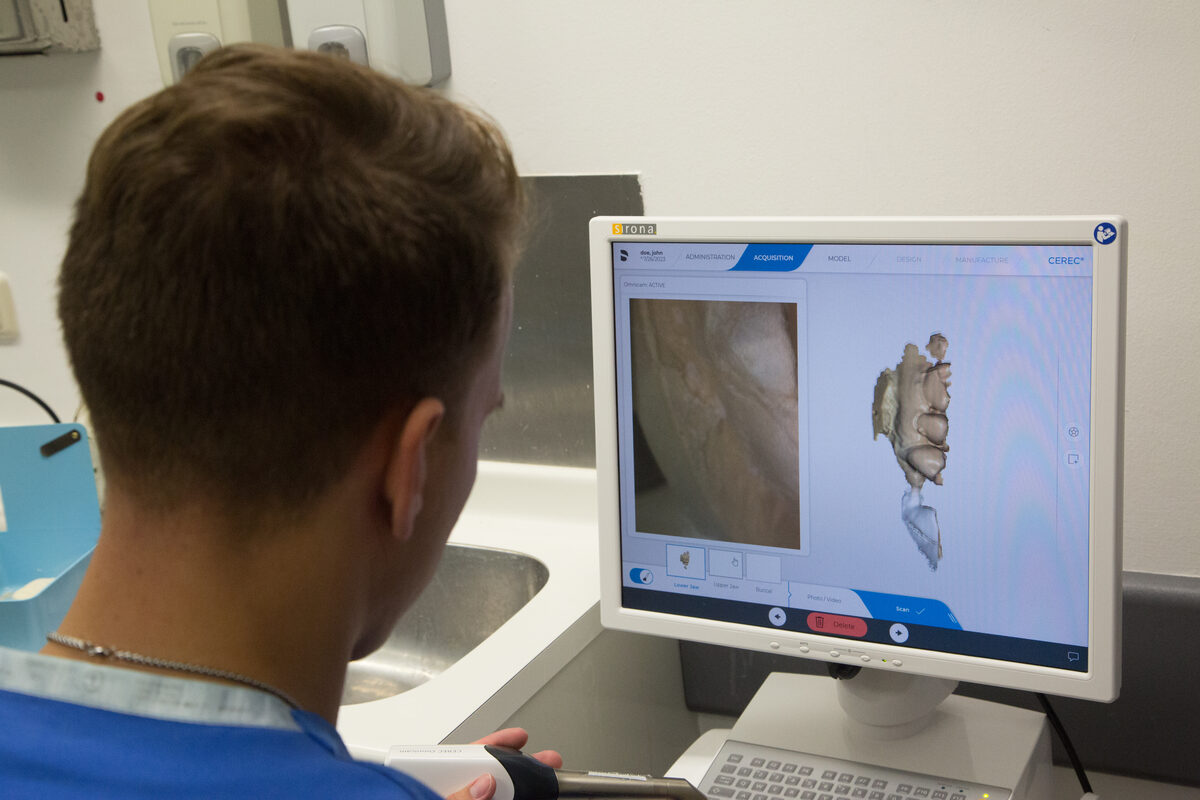
SprintRay has launched Midas Restore, a definitive restorative resin the company says packs more than 75% ceramic and zirconia filler by weight — a figure that puts it well outside the range typical of dental SLA resins and, per SprintRay, delivers five times the wear resistance of the company's previous Ceramic Crown material over 200,000 test cycles. The resin launched September 1, 2026, and is engineered specifically for SprintRay's Midas Digital Press, a chairside stereolithography system built around what the company describes as a patent-pending SLA process.
Materials science, not printer hardware, is the actual story here. Dental 3D printing has spent the better part of a decade proving it can produce accurate provisional crowns, surgical guides, and models fast enough to fit inside a single patient visit. Definitive — meaning permanent, not temporary — restorations have been the harder problem, because resin-based materials have historically lagged milled ceramic and zirconia on wear resistance and long-term surface durability. Midas Restore is SprintRay's attempt to close that gap by loading a resin matrix with enough inorganic filler that it starts to behave, mechanically, more like the milled materials it's meant to replace.
What's Actually in the Capsule
Per SprintRay's release, Midas Restore is a glass-ceramic-and-zirconia-filled resin cleared by the FDA under 510(k) number K260661, classified as a Class II device and available by prescription only. The company lists a maximum flexural strength of 215 MPa (mean 180 MPa) and a surface hardness above 80 HV (Vickers hardness), along with 98% gloss retention after 5,000 simulated toothbrush abrasion cycles — a proxy metric for how long a polished crown surface stays smooth and stain-resistant under normal chewing wear. Applications listed are definitive crowns, inlays, onlays, and veneers, all produced through what SprintRay calls a same-visit digital workflow: scan, design, print, and seat the restoration in one appointment rather than sending an impression to an outside lab and waiting days or weeks for a milled piece to come back. SprintRay also cites a post-cure time of four minutes and final polishing in under two minutes with two wheels, with no glaze or oven step required.
That same-visit framing is the entire commercial rationale for the product. Chairside milling systems have offered this convenience for years using pre-fabricated ceramic blocks, but milling wastes material by cutting a crown out of a solid block and requires a mill unit that's a different capital purchase than a 3D printer many practices already own for guides and provisionals. A printable resin that can hit comparable strength and wear numbers lets a practice reuse existing SLA hardware — in this case, the Midas Digital Press, plus SprintRay's NanoCure unit for post-curing — for the higher-margin, higher-stakes definitive-restoration category instead of only provisionals.
TCT Magazine's coverage of the launch corroborates the same-visit workflow claim and the patent-pending SLA process underpinning the Midas Digital Press, and adds that SprintRay describes the resin's wear resistance as comparable to a milled hybrid ceramic and its translucency as in the same range as milled lithium disilicate — company-supplied comparisons, not independent test results, worth noting for readers weighing how much of this is verified outside SprintRay's own claims.
Reading the Numbers Skeptically
The 5x wear-resistance figure is a comparison against SprintRay's own earlier Ceramic Crown resin, not against milled zirconia, lithium disilicate, or a competitor's printable crown material — so it tells you Midas Restore is a real improvement over what SprintRay shipped before, not necessarily where it sits against the field. Similarly, "80 HV and above" surface hardness and 215 MPa max flexural strength are numbers worth having independently verified over time in clinical use; they're the kind of spec that reads impressively on a data sheet and needs years of real mouths and real chewing cycles to confirm. None of that makes the release illegitimate — FDA 510(k) clearance under K260661 is a real regulatory hurdle SprintRay had to clear with the agency, and it's a meaningfully higher bar than "a maker resin someone posted good print settings for." But 510(k) clearance establishes substantial equivalence to a predicate device and safety for the stated use; it isn't an independent endorsement of the specific wear-resistance multiplier SprintRay is advertising.
SprintRay's CEO and founder, Amir Mansouri, framed the launch around exactly this durability gap in the company's release, saying: "Traditional dental 3D printing forces a compromise: the material has to be fluid enough to print, which limits how highly filled it can be. Midas Restore was designed in our material science lab to address that limitation." He added that pairing the highly filled formulation with the Midas Digital Press lets SprintRay "give clinicians access to a new class of definitive restorative materials" inside an efficient same-visit workflow — language that positions this squarely as a materials-chemistry play rather than a printer-hardware one, even though the resin is validated only for SprintRay's own hardware, the Midas Digital Press and NanoCure.
What It Means for Makers
This one lands outside the desktop-printing world most FilamentFeed readers work in, but it's a useful data point on where filled-resin chemistry is headed. A material formulated to carry more than three-quarters of its weight in inorganic filler and still process on an SLA machine is a nontrivial viscosity and cure-behavior problem — the kind of formulation work that, if any of it trickles down into open or semi-open resin lines, could inform harder, more wear-resistant printable ceramics-composite resins for jewelry casting, functional prototyping, or end-use parts that need to survive abrasion. Don't expect Midas Restore itself on your bench, though: it's validated only for SprintRay's own Midas Digital Press and NanoCure hardware, sold only through SprintRay's store and authorized distributors, priced at $135 for a three-pack of single-unit capsules, and available in five shades (A1, A2, A3, B1, C2) rather than as an open material for third-party systems. For context on the platform this material extends, SprintRay says the Midas Digital Press line, introduced in 2024, has been used by clinicians in 33 countries to produce more than 100,000 restorations to date.
Bottom line: Midas Restore is a legitimate, FDA-cleared step toward same-visit permanent crowns on desktop-class SLA hardware, backed by real regulatory clearance and specific published mechanical numbers — but those numbers are SprintRay's own, compared mostly against SprintRay's own prior material, and the proprietary hardware lock means this is a closed-ecosystem material story rather than one that expands what the broader resin-printing community can buy and use today.
