
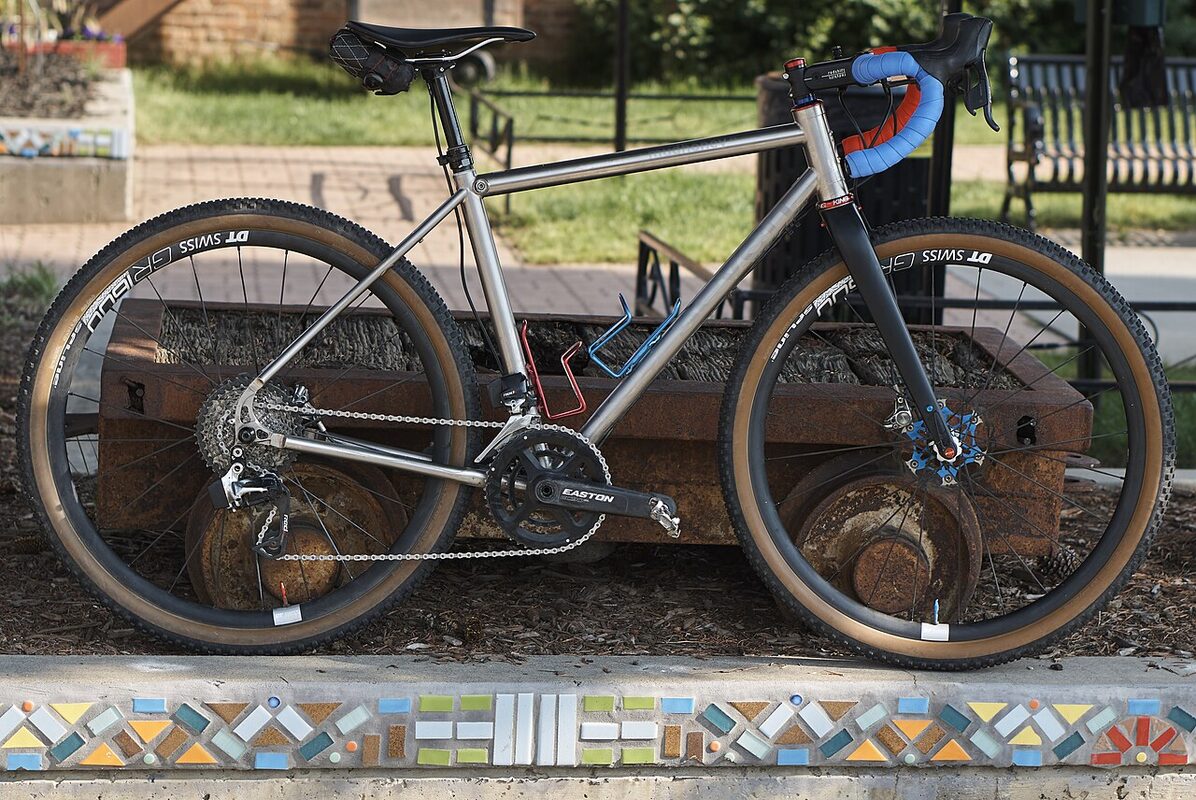
Most additive manufacturing stories go one way: a small manufacturer finds a part it can't make well with conventional methods, prints it, and never looks back. Sturdy Cycles, a titanium bicycle maker based in Frome, Somerset, has gone the other way. On its manufacturing page, the company explains that the frame junctions on its new Fosse road frame and Drove gravel frame are no longer 3D printed. They are now machined from solid in its own workshop. The two frames were shown at Rouleur Live in London on November 12, 2026, and the change ends a long run, which Sturdy dates to 2017, in which printed titanium parts were central to how it built bikes.
The reasons the company gives deserve attention from anyone who has bought into the idea that printing is always the advanced option. Sturdy's page gives two main ones. The material properties of printed parts had become the limiting factor in its designs, and producing printed parts at a competitive price takes industrial-scale machines and infrastructure the company has no interest in running.
One Rule, Applied Over Time
Sturdy describes its operating principle plainly: if something can be made in the Frome workshop, it is made there. The junction change is the latest step in a long process of bringing work in-house. Tube processing and shot peening were both outsourced at one point and were later moved into the workshop. Printing was the one major part of the frame not made in Frome.
Seen that way, the move to CNC machining is less a rejection of additive manufacturing than the company finishing a long-running plan. When every other stage of the frame is under your own roof, the one outsourced process sets the schedule, the cost and the design limits for everything else. Machining let Sturdy close that gap with equipment it can run itself.
The rest of the finishing chain is in-house too. According to 3D Printing Industry's report, post-processing at the workshop includes tumbling, polishing, glass bead blasting and Cerakote ceramic coating.
Years of Printed Titanium
Sturdy was not dabbling with printing. Its own page says it started 3D printing in 2017 and was one of only a handful of builders in the world using it for several years. 3D Printing Industry adds detail from 2020, when New Zealand's RAM3D printed titanium parts for three Sturdy road models using selective laser melting (SLM). In 2022 the company changed process and supplier. It moved to Headmade Materials' Cold Metal Fusion technology, with Element22 producing crank arms, frameset connectors and chainstay parts for the Fiadh.
That is two printing technologies and two supply relationships over several years, on parts that carry load on a bicycle frame. Sturdy also says it machined the bearing seats, threads and mating faces of every printed part after printing. A company with that history has a better sense than most of where printed titanium helped and where it held them back. When it says the material became the constraint, that judgment comes from experience.
Why the Material Became the Limit
Sturdy's wording is careful. Printed material, the company says, has its own inherent properties that became the limiting factor in what could be designed and in how parts could be made and finished. The point is not that printed titanium failed. Sturdy says printing served it and its riders well, and describes machining as the next step in the same direction.
The new junctions show what machining from solid makes possible. The clam-shell junctions are machined as two halves and then laser-welded together along the centreline of the frame. Each model's seat stay yokes carry its name, Fosse or Drove.
3D Printing Industry reports that Sturdy fully redesigned the parts it previously printed so they could be CNC machined, and that the company says both frames are designed to exceed ISO 4210, the safety standard for bicycles.
The Economics Nobody Puts on the Brochure
The second reason is the one smaller manufacturers should think hardest about. Sturdy says that producing printed parts at a competitive price takes industrial-scale machines and infrastructure, and that running that kind of operation "isn't the business Sturdy wants to be." It describes itself as a small workshop making frames one at a time, and says machining in-house suits that.
This is the awkward side of metal additive manufacturing for small firms. Printing can give a boutique builder access to complex parts, but 3D Printing Industry notes that Sturdy spent years buying printed titanium parts from outside service bureaus. Depending on a bureau means depending on an outside supplier. The alternative is to buy industrial capacity and become, in effect, a part-time print shop. A CNC cell in its own workshop fits Sturdy's size better than that.
What Changes for Riders
The production change also changes the product. 3D Printing Industry reports that the Fosse and Drove come in a fixed range of six sizes, each in three stack heights, which Sturdy says still gives riders much of the fit of a custom frame. Frames are made to order with a lead time of about six weeks, and the first are scheduled to ship at the end of 2026.
That trade-off cuts against the usual pitch for printing, which is that it makes per-customer customisation cheap. Sturdy's earlier printed parts were shaped around each customer's fitting, and 3D Printing Industry says fixed sizes now replace that per-rider approach. Owners of earlier Sturdy frames with printed junctions are not left behind: the company says it supports every frame it has made.
What It Means for Makers
For the maker and small-shop audience, Sturdy's decision is a useful corrective. It is not evidence that 3D printing is losing ground in cycling or anywhere else. One company, after years of real production experience, concluded that a different process suited its parts, its scale and its preference for doing the work itself.
A few lessons carry beyond titanium bikes:
- Process choice is a business decision as much as an engineering one. Sturdy's case rests as much on who owns the equipment and where the work happens as on material data.
- Look at the whole process chain, not only the part. Printing was the one major part made outside Frome. Bringing it in-house through machining put every step of the frame under one roof, from tube processing to the ceramic coating.
- Printing's advantages depend on what you sell. Per-rider customisation suited printing. A fixed size run suits machining. When the product strategy changes, the best process can change with it.
- Volume economics matter. If a printed part is only affordable because a large operation runs the machines, a small business relying on it is relying on that operation.
Anyone planning to put additive parts into a small product line should run the test Sturdy did. Check whether printing is the best way to make the part, and check whether it is the best way for your particular business to make it. Sometimes the answer will be yes. Sturdy's experience shows it is worth asking both questions every few years.
