
Berthoud, Colorado-based propulsion company Ursa Major announced it is going public through a merger with Bleichroeder Acquisition Corp. III, a move that will list the combined company on Nasdaq under the ticker IPXX as Inflection Point Mach X Bleichroeder Corp. The deal values Ursa Major at roughly $1.6 billion pre-money and $2.3 billion post-money — a striking figure for a hardware company whose signature product, the Hadley rocket engine, is built almost entirely on a production floor of metal 3D printers.
The transaction is structured as a SPAC merger rather than a traditional IPO, with an expected close in the first quarter of 2027, pending shareholder and regulatory approval. Alongside the merger, Ursa Major has lined up PIPE (private investment in public equity) commitments of at least $350 million, with roughly $110 million already committed at signing and up to $345 million more in potential additional proceeds depending on shareholder redemptions. CEO Chris Spagnoletti framed the raise around defense-industrial urgency, stating that "deterrence depends on what can be built reliably, safely and at scale."
That phrase is doing a lot of work. Ursa Major has spent a decade building a case that additive manufacturing isn't a prototyping shortcut for rocket engines — it's the production method that lets a company scale hypersonic and space-launch hardware without the years-long tooling cycles that define traditional aerospace manufacturing. The IPO proceeds are earmarked for exactly that thesis: expanding solid rocket motor production, the HAVOC missile system, liquid hypersonic engines, and space mobility systems, plus converting an existing solid rocket motor test facility in Galeton, Colorado, into a full production campus, and adding more additive manufacturing capacity in Youngstown, Ohio.
The Hardware Behind the Valuation
Founded in 2015, Ursa Major has grown to more than 360 employees across six facilities spanning roughly 500 acres, backed previously by around $380 million in private capital, according to reporting from VoxelMatters. The company is headquartered in Berthoud, Colorado, with its additive manufacturing operations concentrated in Youngstown, Ohio. But the number that matters most to the 3D printing world is this: Hadley, the company's flight-proven engine, is approximately 80% 3D printed by mass.
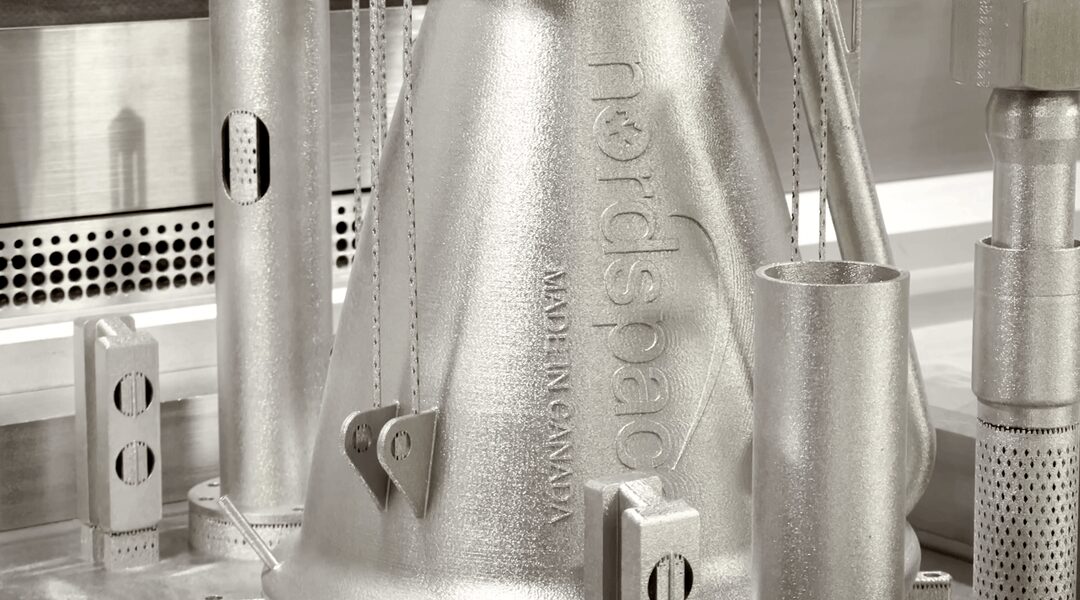
That's not a marketing rounding error — it reflects a genuinely printing-first approach to engine architecture. Hadley's metal components come off nine laser powder bed fusion (LPBF) machines split across two Ohio facilities, running a materials palette that reads like a survey of aerospace superalloys: nickel alloys 718 and 625, Haynes 230, copper alloys, maraging steel, and 17-4 stainless steel.
What's arguably more significant than the machine count is what Ursa Major has done with the software layer. The company developed custom scan-path software on its EOS machines — the toothpath-like instructions that tell an LPBF laser exactly how to trace and fuse each layer of metal powder — and EOS has since folded that capability into its standard licensing offering, making it available to other EOS customers industry-wide. More recently, the company has folded AI and large language models into the process to help write scan strategies and balance thermal loads during builds.
The payoff shows up in the test record: Ursa Major cites more than 5,500 ground tests, over 140,000 seconds of cumulative engine hot-fire testing, and more than a dozen hypersonic missions flown using its hardware. According to VoxelMatters, Hadley currently powers the Department of War's hypersonic test bed — a detail that underscores how central the engine has become to government hypersonics testing programs, not just to Ursa Major's own commercial roadmap. For a company whose core product line is essentially "printed metal parts that survive rocket combustion," that's the track record that turns a manufacturing process into an investable thesis.
What It Means for Makers
This deal is a data point in a trend that's been building for years: metal additive manufacturing is no longer a niche capability bolted onto legacy aerospace production — for some companies, it's the primary manufacturing method, full stop. Hadley isn't a 3D-printed bracket bolted to a conventionally machined engine; the print process is load-bearing across the majority of the assembly by mass, spanning major rotating machinery and combustion components alike.
For hobbyists and small-shop operators running FDM or resin printers, the direct technology overlap is limited — LPBF machines cost orders of magnitude more than a desktop printer and require an entirely different regulatory and materials-handling environment. But the signal matters anyway. Ursa Major's SPAC valuation is effectively a market bet that additive manufacturing can hit aerospace-grade reliability at production volume, not just as a one-off prototype technique. That validates the broader case for metal AM investment across the supply chain — more LPBF machine sales, more powder metallurgy R&D, more software tooling for scan-path optimization that eventually filters down into cheaper, better-understood processes industry-wide.
It's also worth watching what "additive manufacturing capacity" spending actually buys. Ursa Major explicitly earmarked IPO proceeds for expanding its Youngstown, Ohio print facilities — meaning a public listing is directly funding more LPBF machine purchases, more build volume, and likely more of the AI-assisted scan-path development the company has already pioneered. If that expansion delivers, it strengthens the case that AI-tuned printing parameters are becoming a competitive differentiator in metal AM the way slicer settings and tuning have long been for polymer printing communities — just several orders of magnitude higher in stakes and cost.
Bottom Line
Ursa Major's path to Nasdaq runs directly through its print farm. A $2.3 billion valuation attached to a company whose flagship engine is 80% 3D printed by mass is a strong public signal that metal additive manufacturing has crossed from "impressive engineering demo" to "the production method investors will bet nine figures on." Whether the SPAC deal closes on schedule in early 2027, the underlying claim — that scan-path software, AI optimization, and LPBF machines can produce flight-qualified rocket hardware at scale — is now getting a very public test.
