
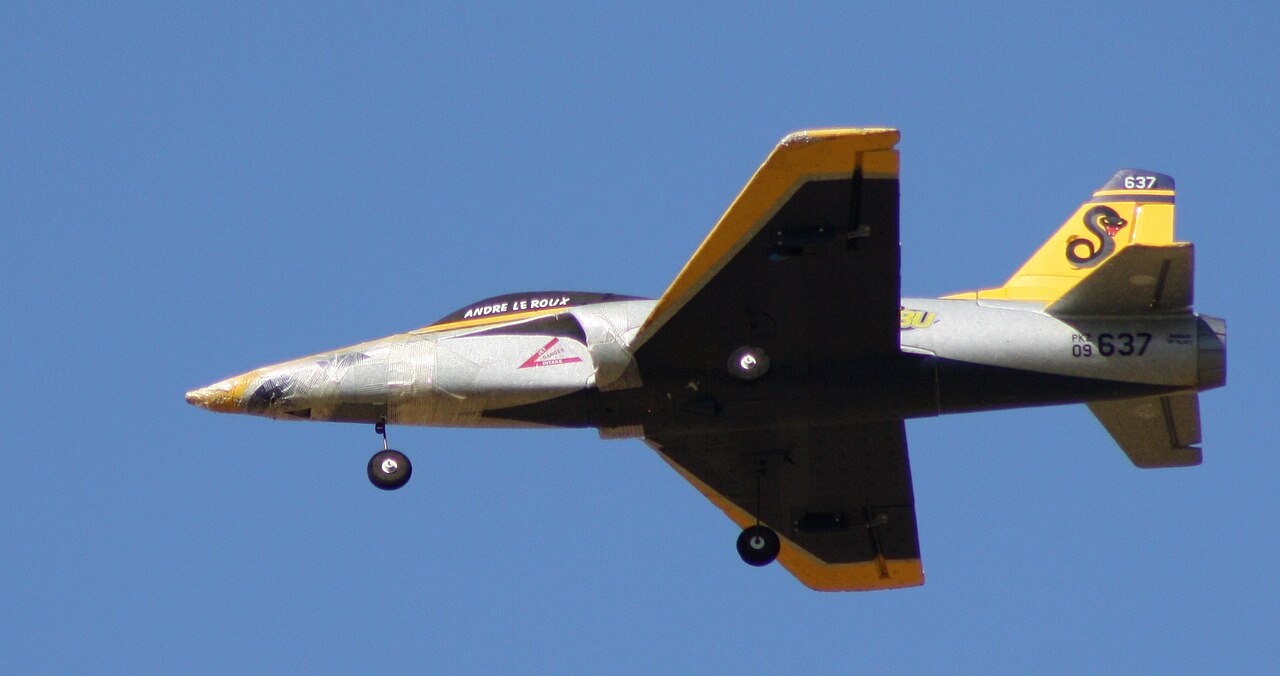
A student team calling itself the Mach Initiative wants to take the Guinness speed record for a remote-control jet with an airframe that came, for the most part, off a desktop printer. As DroneXL reported when the team published the build on October 3, 2026, the aircraft is called KingChaser. It weighs about 9 kg fueled, runs on a 300 N (67 lbf) turbine, and is aimed at a record of 465 mph (749 km/h) that Niels Herbrich set on August 23, 2017. One caveat comes first: KingChaser has not flown yet. So far it has completed five full-throttle static runs on the ground.
The interesting part for makers is not the headline speed. It's the set of material decisions the team had to make to get a mostly-PETG structure anywhere near that speed, and the one place where a common engineering filament failed them.
Three Birds, Each Bigger and Faster
KingChaser is the third aircraft in the series. According to Tom's Hardware, the first was Kinglet, a ducted-fan (EDF) aircraft printed in PETG, PET-CF and PLA. Next came Kingfisher, a jet just under a meter long powered by a Jetcat P60. DroneXL reports that Kingfisher flew in January and reached 205 mph (330 km/h) on a 60 N engine.
That makes the jump to KingChaser a large one. The team first planned around a 150 N engine. It then scaled the design up by 20 percent and fitted a 300 N turbine, which is five times the thrust that pushed Kingfisher to 205 mph. Tom's Hardware gives the build's ultimate goal as 614 mph (988 km/h), or about Mach 0.8. That is well beyond what the team needs to beat the record. (Tom's Hardware writes the engine thrust figures in "N-m," a torque unit. The newton figures used here come from DroneXL and Hackaday.) DroneXL also notes that the KingChaser and Kingfisher figures come from the team's own video and have not been independently timed.
Why PETG, Not PLA
Most of KingChaser's exterior is ordinary PETG. Hackaday's write-up says the switch from PLA, the default for so many printed RC airframes, was made to deal with the expected aerodynamic heating at roughly 990 km/h (615 mph). DroneXL likewise says the team chose PETG for better tolerance of that heating. For a part that has to keep a precise aerodynamic profile while it warms up, that margin matters more than PLA's easier printing.
Surface finish counted too. Hackaday notes that the team polished the skin smooth, because skin drag dominates at this speed regime, and DroneXL says the skin is sanded to 1,000 grit. Layer lines that don't matter on a slow foamie turn into a real drag penalty when you're chasing hundreds of miles per hour, so post-processing the surface is part of the performance work, not just cosmetics.
The Engine Bay: Where Annealing Fell Short
The hottest part of any turbine airframe is the area around the engine, and that's where the team's materials story gets more interesting. Tom's Hardware reports that Kingfisher's engine housing was annealed PET-CF, but annealing the larger KingChaser housing caused warping, possibly from uneven heating. (DroneXL describes the failed part as an annealed PETG bay baked in a secondhand oven; the sources differ on the base filament, not on the outcome.) The team switched to PPS-CF, a carbon-fiber-filled polyphenylene sulfide, and wrapped the printed housing in a few layers of carbon fiber. DroneXL says PPS-CF holds its shape above 200 °C (392 °F) but is brittle, which is why the wrap is there. In photos it's the black section around the motor, which Hackaday also identifies as PPS-CF wrapped in carbon fiber.
Printed plastic isn't left to handle exhaust heat alone. Tom's Hardware describes titanium exhaust sheets plus aluminum tape to shield the print from the engine's heat, a layered approach in which the printed part provides the shape and metal handles the most extreme thermal load.
Structure and Controls
The printed shell isn't asked to carry everything either. Per Tom's Hardware, carbon-fiber rods replace an aluminum skeleton in the internal structure, saving weight and cutting the number of custom CNC-machined parts. Hackaday describes the airframe as largely PETG with carbon-fiber rods and an aluminum frame. Either way, stiffness comes from the reinforcement, and the printed panels provide the outer shape.
Moving control surfaces at speed takes considerable force, so the hardware there grew too: Tom's Hardware reports 70 kg-cm servos driving the elevons. And at about 9 kg (20 lb), KingChaser can't be hand-launched the way smaller printed jets often are. DroneXL says it needs a launch speed above 50 mph, and that the team's pneumatic launcher fell through, so a replacement launcher is still an open item.
Is Mach 0.8 Realistic?
Not everyone thinks so. The comment thread under Hackaday's article is openly skeptical that a printed airframe can safely reach Mach 0.8, with one commenter worrying that the real problem is drag loading rather than heat. That doubt is fair for an aircraft that, so far, has only been run on a static stand. DroneXL says the five full-throttle static fires, run with no cooling airflow, confirmed fuel burn, thermal protection and a clean FPV feed. They don't show how the structure handles flutter, how the control surfaces behave at speed, or how the PETG skin holds up under real aerodynamic heating. Those are flight-test questions.
Clearing the record is also a much lower bar than reaching the design goal. Beating 465 mph means going about 2.3 times faster than Kingfisher's 205 mph, the team's best flight result to date. The 614 mph goal is roughly three times that figure. Kingfisher proved the team can build a printed jet that flies, but a gap that large is where untested assumptions usually show up.
What It Means for Makers
You don't need a 300 N turbine to take something useful from this build. Several of its lessons apply directly to ordinary printed parts:
- Pick a filament for its heat margin, not just its stiffness. The team chose PETG over PLA because of operating temperature. The same reasoning applies to anything that sits in a hot car, near a motor, or in sunlight.
- Annealing has a cost. Annealing the larger engine housing warped it. If a component has to hold tight geometry, a material that's heat-resistant as printed, like PPS-CF, may be the better choice than annealing a cheaper one after printing.
- Let print and reinforcement split the work. Printed shape over carbon rods, with a carbon-fiber skin over the hottest printed part, is a pattern that works at hobby scale too.
- Surface finish can be a performance spec. When drag, flow, or wear matters, polishing a part is engineering, not decoration.
Bottom Line
KingChaser is an ambitious student project with a well-documented materials story behind it: PETG for the main airframe, PPS-CF and carbon fiber around the engine, and metal where printed polymer can't cope. For now it's a set of numbers and static tests. Whether those materials choices hold up will be decided when it flies.
