
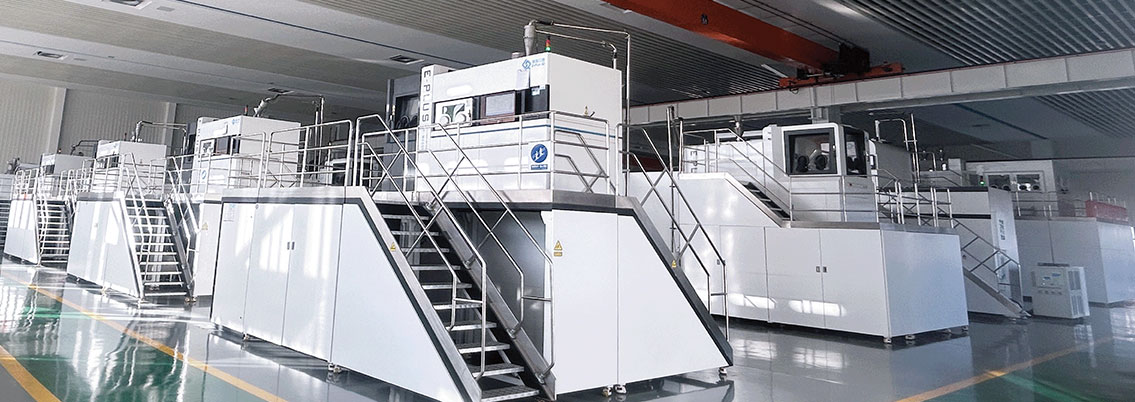
Metal printing has a quiet supply-chain problem: the machine maker qualifies a process, but the powder in the hopper often comes from somewhere else, and the user is left to prove that the combination behaves. Eplus3D, Rosswag Engineering and German powder supplier qualloy are trying to close that gap with Eplus3D select, a validated powder range for Eplus3D systems. The first two alloys are 316L stainless and 17-4PH precipitation-hardening stainless. Both have been on sale through the qualloy online shop since 9 November 2026, with stock held in Germany and delivery quoted at 2 to 5 business days. The partners also did something vendors often skip: they published tensile numbers for both alloys, tested in both XY and Z.
The launch is the first commercial product of a partnership the three companies announced in April 2026. According to 3D Printing Industry, a sample build was on display at Formnext 2026, at Eplus3D's booth (12.0-E101) and qualloy's (11.0-C51).
Who Does What
The division of labor is the interesting part, because it spreads the validation across three organizations rather than leaving it with one vendor. qualloy supplies the powder. Eplus3D Germany prints the validation builds on its own systems using that powder. Rosswag Engineering then tests the tensile specimens, pulling samples oriented in the XY plane and along the Z build direction.
In effect, the "select" label is a promise that a particular powder, run on a particular family of machines, produced a documented set of properties. Eplus3D's announcement says the two initial materials were "fully tested and validated" on Eplus3D systems, and the company's page includes a cross-sectional micrograph of 316L next to the tensile table. Eplus3D presents the benefits mainly as shorter delivery times and competitive pricing. Locally held stock is the practical side of that claim: powder stocked in Germany can reach customers within the quoted two to five business days.
The Numbers
Here are the published results, as reported by 3D Printing Industry. These are results from the validation program. The sources do not state a build or heat-treatment condition, so readers should not assume one.
| Property | 316L XY | 316L Z | 17-4PH XY | 17-4PH Z |
|---|---|---|---|---|
| Ultimate tensile strength (MPa) | 664 ±15 | 585 ±15 | 957 ±10 | 980 ±10 |
| Yield strength (MPa) | 531 | 452 | 464 | 575 |
| Elongation at break | 41% | 51% | 29% | 26% |
| Young's modulus (GPa) | 166 | 149 | 151 | 168 |
The two alloys show different anisotropy. 316L is stronger in the build plane: its XY ultimate strength is 79 MPa above its Z value, roughly 12 percent, and the yield gap is also 79 MPa. In the Z direction it gives up that strength for ductility, stretching 51 percent before failure versus 41 percent in XY. The modulus follows the same pattern, at 166 GPa in XY and 149 GPa in Z.
17-4PH goes the other way on strength. Its Z specimens reached 980 MPa ultimate against 957 MPa in XY. The yield result is the most striking number in the table: 575 MPa in Z versus 464 MPa in XY, a gap of 111 MPa. Elongation is a little lower in Z (26 versus 29 percent), and the modulus is higher in Z (168 versus 151 GPa).
The two alloys, in other words, do not share one "weak axis." With 316L, the Z direction is the softer, stretchier one. With 17-4PH, the Z direction is stiffer and has a noticeably higher yield point. That is the reason directional data matters. A designer who carries a single datasheet number into a load case, without knowing which way the part was built, can be wrong in either direction depending on the alloy.
Reading the Data Critically
Published numbers are a start, not a certificate. The sources give a scatter figure for every value (the table shows only the ultimate strength, at ±15 MPa for 316L and ±10 MPa for 17-4PH). Some are wide: elongation carries ±5 points, and the 17-4PH XY-versus-Z ultimate strength gap of 23 MPa is larger than the stated scatter but not by much. The sources also do not give specimen counts, specimen geometry, or any post-processing, and say little about the full parameter set. Those details decide whether a table like this can go into a design allowable or only serve as a sanity check. Anyone qualifying a part for a real application will still want to run coupons from their own builds.
The values are also specific to the setup they came from: qualloy powder on Eplus3D machines, built at Eplus3D Germany. Change the machine, the parameters or the powder lot, and the numbers may not transfer. That limitation is also the point of a validated range. It narrows the variables to a known combination.
Context: What Eplus3D Machines Are Making
Eplus3D's recent production work shows where reliable powder supply counts. 3D Printing Industry notes that roughly 100,000 tire-mold sipes were made on the company's EP-M300 for Hankook Precision Works. Sipes are the thin blades that mold the fine slits into tire tread, and they are a high-volume, repeat-geometry job where repeatable processing parameters matter. In August, Eplus3D also supported UCL Rocket in manufacturing a CuCrZr combustion chamber for a 7 kN cryogenic rocket engine, a reminder that the company works with alloys well beyond the two stainless grades in this first release.
What It Means for Makers
For most hobbyists, a metal powder program for industrial machines is something to watch rather than buy. It still matters to the wider community, which includes service-bureau customers, engineering students on rocketry and racing teams, and small shops that send metal parts out to be printed.
- Ask for directional data. If you order printed 316L or 17-4PH parts, these figures give you a reference for how much the properties can shift with build orientation. Ask your print provider which axis your critical load runs along.
- Orientation is a design choice. For 316L, loads along Z mean lower strength but more ductility. For 17-4PH in this data set, Z was the stronger direction for yield. Orient parts to match.
- Validation shortens the start. A shop using Eplus3D process parameters can begin from a documented powder and property set instead of qualifying an unknown supplier from scratch, and the quoted 2-to-5-day delivery from German stock may help European users with lead times.
The partners say further validated powders will be added over time. No alloys or dates have been named. If later releases keep publishing XY and Z data, that will be the most useful part of the program, because it gives users more than a pass or fail result.
