
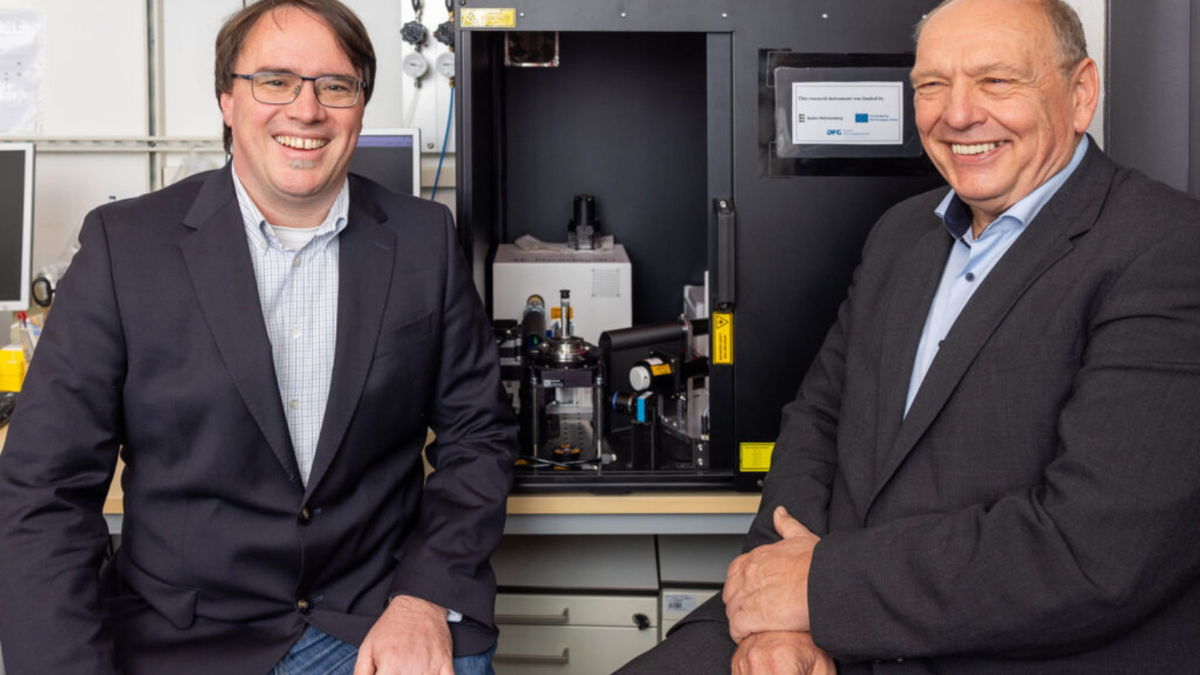
Two researchers at the University of Freiburg have won a European Research Council award for an idea that turns the usual logic of 3D printing upside down. Instead of building a part layer by layer from a specialty resin or filament, their project would use light to create structures inside a block of ordinary commercial plastic, and would design those parts so they can be taken apart and recycled. According to the university's announcement (via mirror), Prof. Dr. Bastian Rapp and Prof. Dr. Jürgen Rühe of the Faculty of Engineering have received a European Research Council Synergy Grant worth about ten million euros over six years for the project, called CHiC2PRINT.
The grant is a selective one. The university says the ERC picked 48 projects from more than 950 proposals this year. Synergy Grants go to small teams whose combined skills are meant to solve a problem neither could solve alone, and the pairing here fits that brief: Rapp works in process technology, and Rühe works on the chemistry and physics of interfaces. CHiC2PRINT, as the university describes it, aims to connect sustainable 3D printing with the cheap, high-performance plastics that industry already uses in huge volumes.
The Problem: Two Manufacturing Worlds That Don't Overlap
The project starts from a tradeoff anyone who has priced out a production run will recognize. As VoxelMatters summarized, injection molding is inexpensive but limited in the complexity of shapes it can make, while 3D printing can make complex shapes but depends on special materials.
That second half will be familiar to makers: printing often depends on materials made specifically for the printer, which can leave a gap between a printed prototype and a molded production part.
The Freiburg pitch is to stop asking plastics to adapt to the printer and instead adapt the printing process to the plastics industry already makes.
How CHiC2PRINT Is Supposed to Work
The method combines two ingredients. The first is volumetric printing, in which a structure forms throughout a volume of material rather than being stacked up one layer at a time. The second, and the part that makes the project unusual, is what the university calls a photochemistry trick that makes commercial plastics light-sensitive.
Put together, the approach is meant to create structures inside an existing plastic body. Rather than starting from an empty build plate or a vat of liquid resin, the process would start from a solid piece of conventional plastic and use light to define features within it. In the university's words, the goal is to structure the material with light instead of building it up layer by layer.
Rapp's claim for the approach is ambitious. He says it should allow objects to be made from established plastic systems much faster than injection molding. That is a notable comparison, since speed at volume is exactly where molding usually beats any additive process. The announcement does not give numbers, timelines or details of the chemistry, which is not surprising for a six-year research program that is just getting funded. Readers should treat the speed claim as the project's goal, not a demonstrated result.
Gradients and Disassembly
Two longer-term goals stand out. The first is parts whose strength varies within a single workpiece. If light can selectively change the plastic inside a body, the same piece could in principle be stiff in one region and different in another without joining separate components or switching materials. Doing that within one block of commercial plastic would be a different route from printers that combine several materials.
The second goal is recycling, and it may matter most. The university notes that printed objects are usually not recyclable today. According to VoxelMatters, CHiC2PRINT aims to make it possible to fully disassemble printed objects into their individual components at the end of their life, so the original plastics can be recovered and reprocessed.
That is a design-for-recycling goal built into the process from the start, rather than added afterward. It also follows from the material choice: if a part is built from an established commercial plastic rather than a bespoke photopolymer, there is at least a recycling stream that already knows what to do with the base material, provided the light-sensitizing chemistry can be removed or separated. How that separation would actually work is one of the questions the project will have to answer.
What It Means for Makers
None of this is coming to a workbench soon. This is early-stage, publicly funded research with a six-year horizon, and the announcements describe aims rather than hardware, materials or results. There is no product, no printer and no material to buy.
Still, the direction is worth watching for a few reasons.
- Material freedom. The biggest limit on printed parts for many makers is not resolution or speed but material. A process that can work with mainstream commercial plastics, rather than a short list of printer-specific feedstocks, would narrow the gap between a printed prototype and a molded production part.
- Recyclability as a requirement. Failed prints, supports and retired parts pile up in most shops. Research that treats end-of-life disassembly as a core goal, rather than an afterthought, points toward printed parts that can go back into a material stream instead of a landfill.
- Volumetric printing keeps getting attention. Large research grants tend to signal where the field expects progress. Funding at this scale for a volumetric, light-based approach suggests the technique is being taken seriously as more than a lab curiosity.
- Graded parts from one material. If strength can be tuned inside a single piece, designers could get some of the benefits of multi-material printing without the hardware complexity of multiple nozzles or vats.
Bottom Line
CHiC2PRINT is a bet that the next big step for additive manufacturing is not a new printer for new materials, but a new process for old ones. Rapp and Rühe want to make ordinary industrial plastics light-sensitive, shape them from the inside out with volumetric printing, and build in the ability to take the result apart for recycling. The ERC's roughly ten million euros buys them six years to find out whether the chemistry and the speed claims hold up. For makers, the payoff, if it comes, would be printed parts made from the same plastics as everything else, and parts that do not have to end up as waste.
