
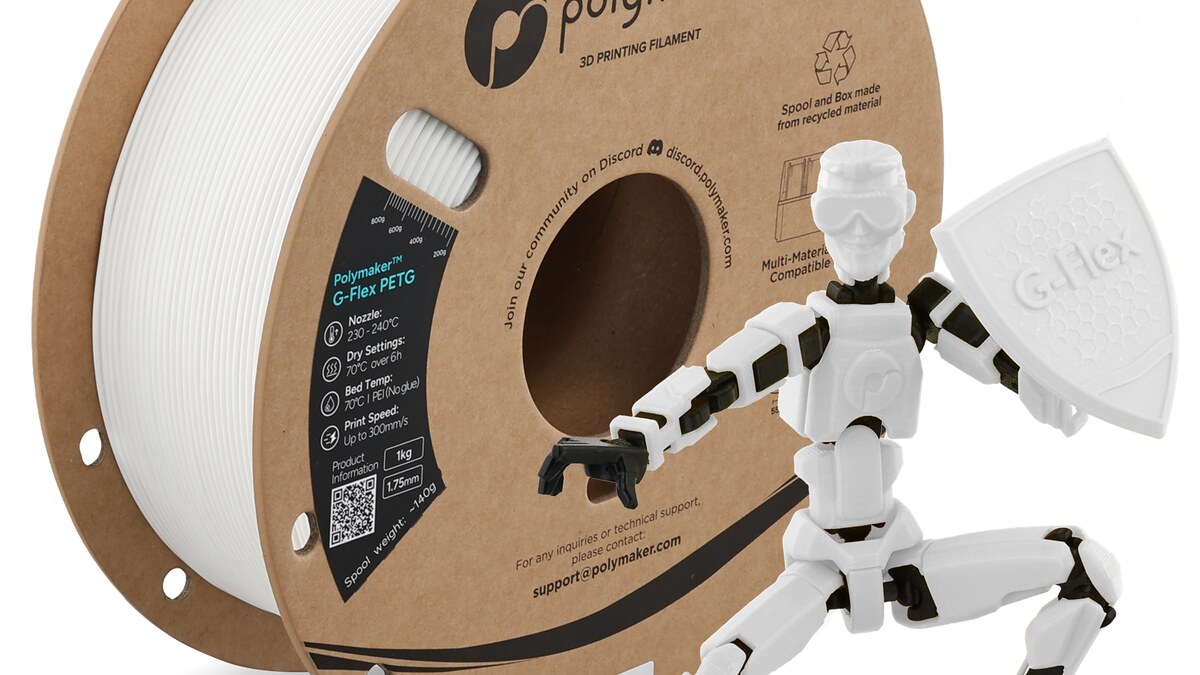
Polymaker has brought G-Flex PETG to Europe, using Formnext as the stage for a material it first launched at TCT Shenzhen last month. The pitch is easy to state and harder to deliver: a filament that keeps the printing ease and shape retention of PETG while borrowing the elasticity and impact absorption usually reserved for TPU. Polymaker rates it for print speeds up to 300 mm/s and volumetric flow up to 24 mm³/s, figures that put it far closer to everyday rigid filaments than to the flexibles most makers have learned to print slowly and carefully.
It is a narrow target, but a real one. Anyone who has tried to print a snap-fit clip, a cosplay part that has to survive a convention floor, or a drone arm that will eventually meet the ground has run into the same trade-off. Rigid materials print fast and hold detail but crack. TPU survives abuse but punishes you in speed and fine features. G-Flex PETG is Polymaker's attempt to sit in the gap between the two.
The Problem It Is Trying to Solve
According to TCT Magazine's report on the European debut, the material was designed specifically for the gap between TPU's durability and its drawbacks: slow printing and a lack of fine detail. Polymaker is aiming it at makers, educators, studios and print farms, which is a telling list. Those are the users for whom throughput and predictability matter as much as material properties. A print farm cannot afford to run a whole shelf of machines at TPU speeds for parts that only need some give, and a classroom cannot afford the failed prints that come with flexible filament in a shared machine.
TCT's coverage, which includes comments from Polymaker Product Marketing Manager Maarten Bosters, frames G-Flex PETG as a material that works from standard slicer profiles rather than a bespoke tuning exercise. The company's guidance is to start from PLA or PLA Silk profiles, and it says joints under 1 mm thick print cleanly. That second claim is the one that will matter most for articulated models and print-in-place mechanisms, where tolerances are tight and a sticky or stringy material can fuse parts that are meant to move.
What the Numbers Say
The headline mechanical claim comes from ISO 179-1 unnotched Charpy impact testing. Polymaker's product page states that all tested specimens recorded "No Break" in both the XY and Z orientations under the test conditions. That is worth reading carefully. An unnotched Charpy test measures how much energy a bar absorbs when struck by a pendulum; a "No Break" result means the specimen did not fracture. Getting that result in the Z direction, across layer lines, is the more interesting half, because interlayer adhesion is where most FDM parts fail under impact.
Two caveats apply. First, these are manufacturer results, not independent testing. Second, a "No Break" result does not give a number to compare against other materials; it says the test could not break the part, not how much margin remained. It is a strong qualitative signal, but makers who need hard engineering numbers should treat it as a starting point.
The print parameters are where G-Flex PETG separates itself from conventional flexibles:
- Nozzle temperature: 230–240 °C
- Bed: 70 °C on PEI, no glue required
- Speed: up to 300 mm/s
- Volumetric flow: up to 24 mm³/s
- Supports: G-Flex PETG itself or PLA
- Format: 1 kg spools of 1.75 mm filament, factory-dried and vacuum-sealed
- Planned price: $21.99 per 1 kg spool, according to TCT
The temperatures are unremarkable for a PETG-family material, which is the point. Polymaker's product page also advises a standard nozzle, noting that high-flow nozzles are not recommended because they may reduce interlayer toughness, and it recommends against cryo or cold-print build plates.
Multi-Material Compatibility
Perhaps the most consequential detail for current hobbyist hardware is that Polymaker says G-Flex PETG has been verified with Bambu Lab's AMS and AMS 2 Pro and with Creality's CFS, using its recommended settings. Soft flexibles are generally harder to run through automatic material systems than rigid filaments, so a material that delivers some flexibility while being cleared for these changers could open up multi-colour prints with compliant parts. As with the other claims, it is worth testing on your own machine.
Polymaker offers the material in six colours: black, white, grey, red, blue and yellow, with green, orange, tan and brown to follow, according to TCT. The product page lists it as a new arrival, and some variants were showing as sold out at the time of writing.
Safety and Handling
Polymaker says G-Flex PETG is VOC-certified as a low-emission material and meets EN 71-3, the European toy safety standard covering migration of certain elements. Neither certification makes a printed object automatically safe for every use, but both are relevant for educators and for anyone printing toys or articulated models intended for children.
The spools arrive factory-dried and vacuum-sealed. If moisture-related stringing appears, Polymaker recommends drying at 70 °C for at least six hours and resealing the spool with desiccant after use, a standard reminder that PETG-family materials absorb moisture and print worse for it.
What It Means for Makers
Polymaker's listed use cases are functional parts, articulated models, props, cosplay accessories, RC and drone parts, and snap-fit assemblies, and TCT adds toys, educational models and repairs. That is a good map of where the material is likely to earn a place on the shelf. It is pitched at parts that need toughness and some flex, and that have historically been printed in either a too-brittle rigid material or a too-slow flexible one.
For print farms producing clips, mounts and enclosures, the combination of PLA-like profile starting points, 300 mm/s speed claims and AMS or CFS compatibility could make G-Flex PETG a straightforward drop-in rather than a specialist job. For cosplayers and RC builders, the impact claims are the draw: parts that resist breaking on impact are parts that may not need reprinting after every event or crash.
The sensible approach is to verify Polymaker's claims on your own hardware. Print a set of thin snap-fit test pieces and a few sub-millimetre articulated joints, try a drop test on a representative part, and run it through your material changer before committing a production job to it. If the material holds up, it fills a gap that makers have been working around for years.
