
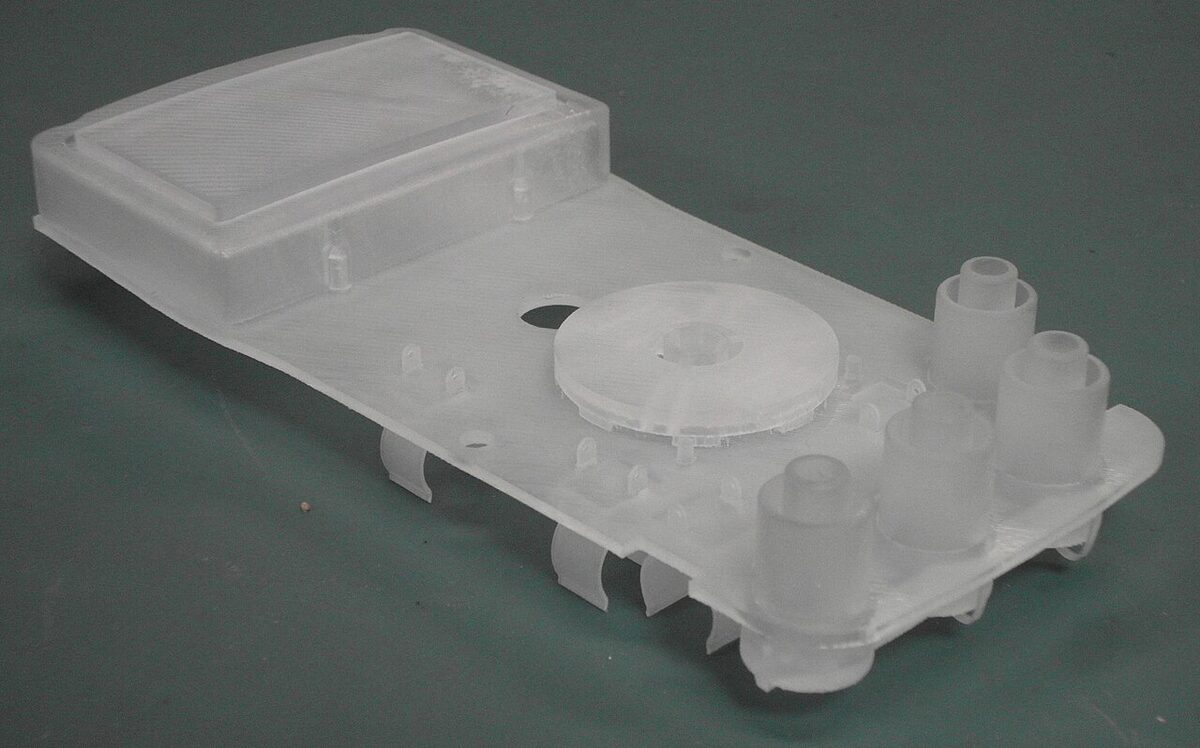
Most resin announcements at a trade show are about a new color, a little more toughness or a slightly shorter cure time. The two materials Axtra3D brought to Formnext 2026 are more interesting than that. In a press release dated November 17 from its Charlotte, North Carolina headquarters, the company added two partner photopolymers to its Lumia X1 platform. Ultracur3D xMOLD, supplied by AM Marketplace, is a resin made to be printed as a mold, shot full of thermoplastic, and then dissolved away. ATARU BLACK, from QTREX, is a silica-filled resin whose glass transition temperature and heat deflection temperature are both quoted above 300 C. The materials are built for different jobs, but both push SLA further into territory usually covered by machined tooling and engineering thermoplastics.
The Platform and the Program
The Lumia X1 is Axtra3D's high-speed SLA system. As VoxelMatters notes in its coverage, the machine uses a process Axtra3D calls Hybrid PhotoSynthesis, which combines laser and DLP imaging in one system. The new resins are part of Axtra Solutions, the company's program of partner materials. Each comes with tuned print profiles, and Axtra3D's applications team works alongside the material suppliers to support them.
That structure is worth understanding. Neither resin is an Axtra3D formulation. Each was developed by a specialist chemistry supplier, and Axtra3D supplies the print profiles and application support on its platform. This is a common setup in industrial resin printing, where the printer maker curates materials rather than inventing every one. For buyers, it suggests the performance claims come from two sources: the chemistry supplier for the material itself, and the platform vendor for the profile.
xMOLD: Tooling You Throw Away on Purpose
The xMOLD workflow is easy to describe. You print a sacrificial mold in the dissolvable photopolymer, injection-mold a thermoplastic part inside it, and then dissolve the mold to free the part. According to the release, the dissolution leaves no residue, and the process handles undercuts and complex geometries.
The undercut point matters most. With a conventional two-part metal mold, every undercut means a side action, a lifter or a collapsible core, and each of those adds machining time, cost and failure points. A mold that is destroyed when the part comes out doesn't need draft angles or parting-line planning in the usual way, because nothing ever has to be pulled apart. That is the same reasoning behind lost-wax casting and soluble support materials, applied here to injection-mold tooling.
Axtra3D presents xMOLD as an alternative to metal tooling for product development, design validation and low-volume manufacturing. Both the release and VoxelMatters list automotive, consumer products, aerospace and sporting equipment as target sectors. The headline number is that AM Marketplace says the approach can cut tooling costs by up to 90 percent "in suitable applications."
That qualifier deserves attention. Both the release and VoxelMatters attribute the figure to AM Marketplace, not to independent testing, and neither describes the comparison behind it: which part, which baseline tool, which production volume. A 90 percent saving against a hardened steel tool for a twenty-part validation run is plausible. Against an aluminum soft tool spread over a few thousand parts, the math is different, because a sacrificial mold has to be printed again for every shot. The economics of a single-use mold depend on volume, and the announcement does not say where the break-even point falls.
Several other practical questions go unanswered. The sources do not list which thermoplastics have been molded, what injection pressures and melt temperatures the printed mold can take, what solvent or bath the dissolution uses, or how long it takes. Those details decide whether xMOLD replaces a bridge tool or mostly serves as a way to get early form-fit parts in the production resin.
ATARU BLACK: Pushing a Photopolymer Past 300 C
ATARU BLACK is aimed at a different problem. The release describes it as a UV-curable, silica-filled photopolymer developed by QTREX, with a glass transition temperature above 300 C and a heat deflection temperature above 300 C at 0.45 MPa. The release also claims high stiffness, high impact strength and ultra-low dielectric loss, and both it and VoxelMatters say the resin reproduces fine features.
Those are very high numbers for a printable resin. The listed applications show who it is for: electrical connectors and sensors, low-loss PCB structures and substrates, RF components and antennas, heat-resistant tools and fixtures, and molds for glass- and carbon-fiber-filled thermoplastics. The last item links it to xMOLD in an obvious way. Filled engineering polymers run hot and abrade tooling, and a mold insert that keeps its shape above 300 C is a real requirement there.
Read the HDT figure carefully. It is quoted at 0.45 MPa, the lower of the two loads commonly used in heat deflection testing. A rating at the higher load would say more about stiffness under structural stress at temperature. The announcement gives no figures for the dielectric constant, loss tangent, or the frequency at which "ultra-low dielectric loss" was measured, and those are the numbers an RF designer would ask for first. "High impact strength" is likewise a claim with no figure attached. None of this means the material falls short. It means the datasheet, not the press release, is where an engineer should start judging it.
What It Means for Makers
Nobody in a garage shop is buying a Lumia X1 this week, and neither resin is presented as a desktop product. Still, these announcements are worth following, because industrial materials have a pattern of moving downmarket. A printed mold has to survive molding heat and pressure, which is the usual limit on printed tooling.
A dissolvable mold resin attacks that limit from the other direction. It doesn't try to make the printed mold last. It accepts that the mold is used once and puts the effort into shapes a durable tool can't produce at all. If that approach proves itself at the industrial level, it is the kind of workflow that could reach benchtop injection presses.
For now, the sensible approach is interest without assumptions. The 90 percent tooling-cost claim is a supplier figure with an explicit caveat. The 300 C ratings are real specifications, but they were measured under particular conditions. The electrical claims need numbers before they can guide a design. What the announcement does show is that two specialist suppliers think SLA is ready for sacrificial tooling and high-temperature, low-loss electronics, and that Axtra3D is building its platform around that view.
